
LinkedIn Post
Physical AI is becoming one of the biggest technology stories of 2026. 🤖
Robotics startups are attracting extraordinary amounts of capital—not simply because robots look futuristic, but because AI is finally moving from screens into the physical world.
From humanoid robots and intelligent automation to warehouse operations and industrial applications, investors are betting on something much bigger: machines that can perceive, reason, learn, and act in real-world environments.
But the real story goes beyond funding.
In this article, I explore:
🔹 Why Physical AI is attracting unprecedented investor attention
🔹 What investors are actually funding—the intelligence behind the robot
🔹 Why enterprises are already signing real-world contracts
🔹 The opportunities emerging across robotics, AI, manufacturing, and automation
🔹 The risks, limitations, and hidden cracks behind the current boom
🔹 What this shift means for founders, builders, and entrepreneurs
The biggest question isn’t whether robots will become part of our future.
It’s who will build the intelligence that powers them—and who will create real value from it.
The Physical AI era may be just beginning.
📖 Read the full article: Physical AI Is the New Gold Rush: Why Robotics Startups Just Out-Raised Every Tech Sector in 2026
#PhysicalAI #Robotics #ArtificialIntelligence #AI #Startups #VentureCapital #DeepTech #Innovation #FutureOfTechnology #Entrepreneurship
Somewhere between the humanoid robots stacking boxes at an Amazon warehouse and the ones being trained to fold laundry in a lab in Pittsburgh, venture capital quietly decided that the next trillion-dollar industry wouldn’t live on a screen at all. It would have joints, sensors, and a body.
Every gold rush starts the same way — with people who noticed the shift a little before everyone else did.
The Number That Stopped Wall Street — Robotics Startup Funding 2026 in One Chart
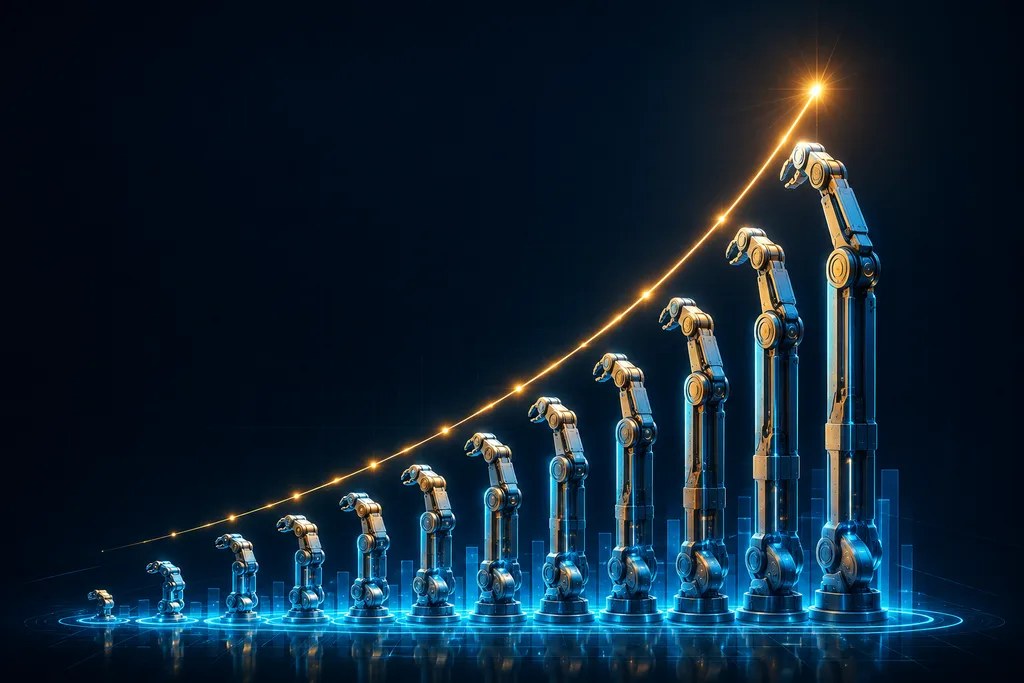
Global venture funding into physical AI — the umbrella term covering humanoid robots, robot “brain” foundation models, warehouse automation, and autonomous systems — totaled $47.4 billion in the first half of 2026 alone, across 521 deals, according to Crunchbase data. That’s nearly 4x the $12 billion raised in the second half of 2025, and 80% higher than the $26.4 billion raised in the first half of 2025.
A number that quadruples in six months isn’t a trend anymore — it’s a stampede.
To put that in real perspective: from 2022 through 2024 combined, investors put a total of $41.9 billion into physical AI companies — meaning the sector raised more capital in the first six months of 2026 than in the previous three years put together. Narrower robotics-only tracking from Crunchbase puts the figure at $18.8 billion raised so far in 2026, already eclipsing the $15 billion raised in all of 2025 and the previous record of $14.1 billion set back in 2021.
Records don’t just get broken in this sector anymore — they get lapped.
Other trackers using broader definitions that include drones, defense, and autonomous vehicles put the number even higher — Dealroom estimates $55.8 billion raised globally in robotics through mid-2026, nearly double the prior full-year record. Whichever measuring stick you use, the direction is unmistakable: robots just became the most expensive bet in venture capital.
Definitions may shift, but the size of the check never lies.
Meet the Money: Who’s Actually Winning the Robot Gold Rush

The single loudest funding story of the year belongs to Skild AI, a Pittsburgh-based company founded by two former Carnegie Mellon professors, which raised $1.4 billion in January 2026, tripling its valuation to over $14 billion in just seven months — up from a $4.5 billion valuation the previous summer. SoftBank led the round, joined by Nvidia’s venture arm, Jeff Bezos, Samsung, and LG.
Tripling your value in seven months isn’t growth — it’s a market recalculating in real time.
Figure AI, the humanoid robotics company building machines for logistics and manufacturing, has raised roughly $2.34 billion total and now carries a $39 billion valuation — a 15x jump from its $2.6 billion valuation less than two years earlier. It recently signed a commercial deployment deal with Catalyst Brands, the parent company behind JCPenney, Aéropostale, and Brooks Brothers, moving the story from lab demo to warehouse floor.
Fifteen-x in under two years used to be a software-only story — now it belongs to hardware, too.
Not far behind, Physical Intelligence was reportedly in talks for a $1 billion round that would push its valuation past $11 billion, up from $5.6 billion just months earlier. Germany’s NEURA Robotics closed a Series C worth up to $1.4 billion at a roughly $7 billion valuation, with backers including Tether, Qualcomm, Amazon, Nvidia, Bosch, and the European Investment Bank. And in a category most people overlook entirely, autonomous maritime defense startup Saronic raised a $1.75 billion Series D at a $9.25 billion valuation — proof this gold rush stretches well beyond robots that look like people.
The word “robotics” used to mean one shape; in 2026, it barely means one industry.
The Real Insight — Investors Aren’t Funding Robots, They’re Funding Brains

Here’s the detail almost every headline gets wrong: this isn’t really a story about humanoid hardware. According to a detailed 2026 capital breakdown, Robotic Foundation Models — the “brain” software that can control many different robot bodies — captured 44.9% of all disclosed physical AI capital while representing just 28.1% of the deals. Humanoid robots, despite dominating the public imagination, actually ranked third in total funding behind foundation models and general-purpose robot platforms.
The body gets the headlines; the brain gets the biggest checks.
That distinction matters enormously if you’re trying to understand where this sector is actually heading. Companies like Skild AI and Physical Intelligence aren’t building robots at all — they’re building the “operating system” that any robot, from any manufacturer, can plug into. As Nvidia CEO Jensen Huang has put it, humanoids represent a “multitrillion-dollar economic opportunity” — and increasingly, investors are betting the real value sits in the software layer that makes that opportunity possible at all, not in any single robot’s physical design.
Owning the operating system has always mattered more than owning any one device that runs on it.
This is precisely why a two-year-old, hardware-free software company can raise checks larger than most humanoid manufacturers combined. Investors are writing billion-dollar checks into companies with no robot body at all, a shift that would have seemed almost irrational in the venture world of just three years ago.
Betting on the invisible layer underneath a trend takes a very specific kind of conviction.
Why Enterprises Are Already Betting Real Contracts on Unproven Robots
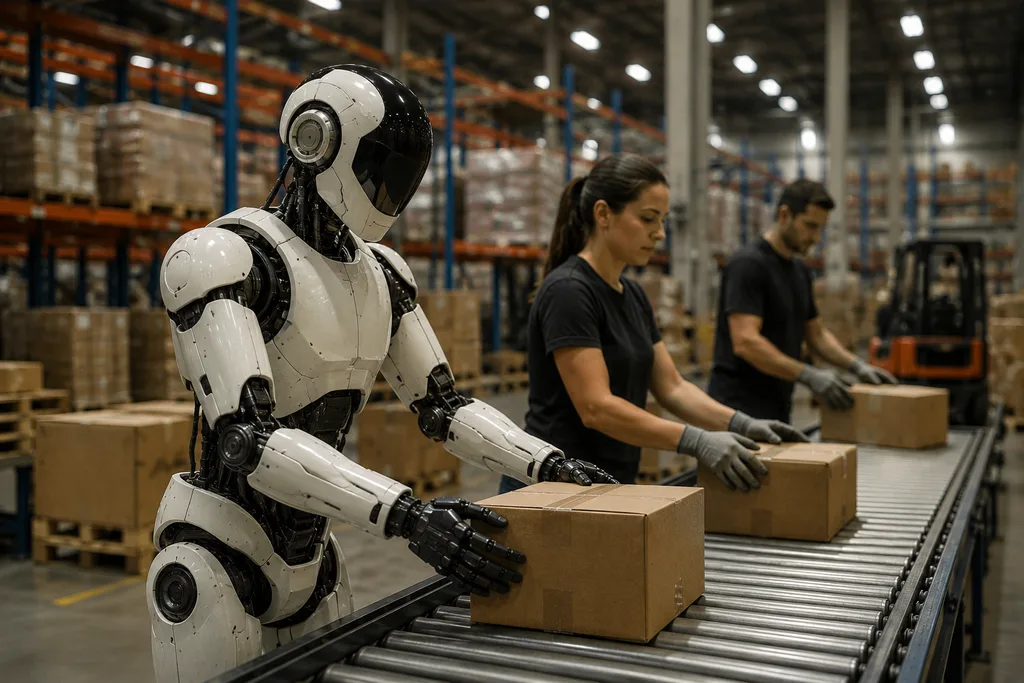
Unlike most speculative tech booms, this one has actual customers writing actual purchase orders. Amazon, Mercedes-Benz, BMW, GXO Logistics, and John Deere aren’t just investing in robotics startups — they’re deploying their hardware directly onto factory floors and warehouse aisles. Agility Robotics’ Digit humanoid is already performing real warehouse tasks for Amazon, GXO, Schaeffler, and Mercado Libre.
Pilots are cheap talk; production deployments are where a technology proves it’s real.
This enterprise pull is reshaping the M&A landscape too. Meta acquired humanoid startup Assured Robot Intelligence, folding the team directly into its Superintelligence Labs division, and Mobileye acquired Israeli humanoid startup Mentee Robotics for roughly $900 million, explicitly framing the deal as part of its push into physical AI. When acquirers this large start buying rather than building, it’s usually a signal that the underlying technology has crossed from experimental into strategically essential.
Big companies rarely buy what they don’t already believe will matter.
Even Tesla, the longest-running player in humanoid robotics, is doubling down — CEO Elon Musk has said Optimus is scaling toward 50,000 units by the end of 2026, with a public market debut for the unit targeted by the end of 2027. Whether or not that specific timeline holds, the ambition itself signals how seriously even the largest tech companies now treat this category.
When the biggest players in the room start racing, it’s rarely because they’re bored.
The Cracks Nobody’s Talking About

For all the record-breaking numbers, physical AI is still wrestling with problems that pure software companies never have to think about. Battery life currently limits most humanoid robots to just 90–120 minutes of continuous operation, far short of the 8–20 hours needed for most real commercial shifts. There’s also a well-documented “sim-to-real” gap — robots that perform with roughly 95% accuracy inside controlled lab environments frequently drop to around 60% accuracy once deployed in messy, unpredictable real-world conditions.
A demo video and a Tuesday-afternoon warehouse floor are two very different tests.
There’s a supply chain vulnerability too that rarely makes the funding headlines: an estimated 90% of robotics components currently come from China, meaning the entire sector’s growth is tightly coupled to a single geopolitical relationship staying stable. Investors chasing valuation multiples rarely price that kind of dependency into a term sheet, but it doesn’t disappear just because it’s inconvenient.
The riskiest ingredient in any supply chain is the one everyone assumes will always be available.
Valuations themselves carry real risk. A company can triple in value in seven months on the strength of a demo and a narrative — but seven months is not enough time to prove out unit economics, reliability at scale, or long-term enterprise retention. The gap between a compelling pilot and a durable, profitable business is exactly where most hardware startups have historically died, long before physical AI ever entered the conversation.
Momentum can fund a company for a year; only durability can fund it for a decade.
What This Means If You’re Building Anything Right Now
If you’re a founder — even one nowhere near robotics — this sector shift is worth paying close attention to, because it reveals something bigger about where investor conviction is heading in 2026. Capital is visibly rotating out of pure-software, chat-interface AI and into embodied systems that act in the physical world. That doesn’t mean software is dying; it means the frontier of “exciting” has physically moved, and founders positioning their pitch around where the frontier was two years ago will feel that gap in every fundraising conversation.
Markets don’t wait for you to catch up to where the excitement moved.
The second lesson is about platform thinking over product thinking. The startups earning the largest valuations aren’t necessarily the ones with the flashiest single product — they’re the ones building infrastructure other companies build on top of. Whether you’re in robotics, SaaS, or an entirely different category, that same instinct — build the layer everyone else needs, not just the product everyone sees — tends to be where the largest outcomes eventually concentrate.
The most valuable company in a gold rush is rarely the one panning for gold — it’s the one selling the pans.
Finally, this boom is a reminder that enterprise validation now moves faster than it used to. Amazon and Mercedes-Benz didn’t wait a decade to deploy this technology; they moved within months of credible demos. For founders in any category, that compressed enterprise sales cycle — when the technology and timing genuinely align — is arguably the biggest structural shift 2026 has produced.
The distance between “impressive demo” and “signed contract” has never been shorter than it is right now.
Suggested Internal Links
- Anthropic is racing toward an IPO before OpenAI.
- Startup IPO Trends 2026: The Shocking Truth Behind SpaceX’s $75 Billion IPO Every Founder Must Know
- 5 Game-Changing AI Unicorn Founder Trends Every Startup Entrepreneur Must Know
- 10 Proven AI Startup Ideas You Can Start With Less Than ₹50,000
- 5 Powerful Ways the IndiaAI Mission Can Save Your Startup Thousands on GPU Costs
- Building AI App at 23-Year-Old making insane dollars Without Coding
- 7 Shocking Signs Traditional Software Is Dying Faster Than Anyone Expected
- 9 Explosive India AI Startup Trends Creating Young Millionaire Founders in 2026
- 10 Powerful AI Startup Tools Replacing Entire 10-Person Teams for Under $300/Month.
- 7 Powerful AI Start up Trends Making Non-Coders Millions Through Vibe Coding in 2026
- 6 Shocking Startup Secrets Behind the $401M Telehealth Company Built by One Person
- 7 Shocking AI Startup Trends Creating One-Person Billion-Dollar Companies in 2026
- Top 5 Shocking Misapprehensions Founders Make When Raising Capital
- Founder Reality Check:6 Brutal Start up Funding Myths Every Founder Must Stop Believing
- Why Start ups Fail to Get Funding from Investors: 28 Hard Truths No One Tells You
- Start up Fundability Explained: 7 Powerful Readiness Signals Founders Must Get Right
- Start up Non-Dilutive & Alternative Funding: 7 Powerful Ways to Raise Capital Without Equity
- Angel Funding and Early-Stage Capital: 5 Core Principles That Shape Start up Growth
- Start Up Funding: 10 Proven Strategies for Massive Growth
- Start Up Success: 7 Powerful Pitch Deck Storytelling Secrets That Win Investors
- From Classroom to Capital: The Ultimate Funding Guide for Student & First-Time Founders
- Founder Guide: 5 Powerful Funding Trends Every Start up Must Know
Conclusion
The rise of Physical AI marks a profound shift in how artificial intelligence is transforming the world. For years, the AI revolution was largely confined to software, algorithms, cloud platforms, and digital experiences. In 2026, that boundary is rapidly disappearing. Robotics startups are bringing intelligence into the physical world, creating machines that can see, reason, learn, move, collaborate, and act—and investors are responding with extraordinary confidence.
The enormous funding flowing into robotics is not simply another technology trend or speculative gold rush. It reflects a growing belief that AI becomes dramatically more valuable when it can perform physical tasks. From industrial automation and logistics to healthcare, agriculture, construction, and disaster response, intelligent machines can address some of humanity’s most difficult challenges. They can operate in environments that are dangerous, repetitive, inaccessible, or physically demanding, while potentially improving productivity, safety, and quality of life.
One of the most important developments is the convergence of generative AI, computer vision, advanced sensors, simulation, edge computing, and robotics. These technologies are giving robots capabilities that were previously difficult to achieve. Instead of programming every movement manually, developers are increasingly building systems that can understand environments, interpret instructions, adapt to unfamiliar situations, and learn from experience. This transition from pre-programmed machines to adaptable intelligent systems could fundamentally redefine automation.
However, extraordinary opportunity also brings significant responsibility. The future of Physical AI should not be measured only by funding raised, valuation, or the number of robots deployed. The real measure of success should be whether these technologies create meaningful human value. Robotics companies must prioritize safety, reliability, affordability, ethical deployment, cybersecurity, and human oversight. Society must also prepare workers for changing job requirements through reskilling, education, and inclusive access to new opportunities.
For investors and entrepreneurs, the message is equally clear: Physical AI represents a potentially transformative market, but winning will require much more than attaching an AI model to a robot. Companies will need strong hardware, dependable software, proprietary data, scalable manufacturing, intelligent autonomy, and a deep understanding of real-world problems.
The robotics funding surge therefore signals something larger than a financial phenomenon. It represents the beginning of a new chapter in the AI revolution—one where intelligence leaves the screen and enters the physical world. If developed responsibly, Physical AI could become one of the most exceptional technological forces of this generation, helping humanity build safer workplaces, more resilient industries, smarter infrastructure, and a more capable future.
Final Thought
The $47 billion flooding into physical AI in just six months isn’t a bubble forming in isolation — it’s venture capital making an explicit bet that the next major platform shift won’t happen on a screen at all. Whether that bet pays off the way the SaaS boom once did, or collapses the way so many capital-intensive hardware dreams have before it, the founders paying attention to this shift right now are the ones most likely to be standing in the right place when it resolves.
Every gold rush eventually separates the miners from the people who were just there for the noise.
Suggested External Do-Follow Links (add naturally within the body when publishing)
- Link the H1 2026 physical AI funding figures → Crunchbase News: https://news.crunchbase.com/venture/physical-ai-funding-startups-robotics-aerospace-h1-2026/
- Link the Skild AI funding details → Crunchbase News sector snapshot: https://news.crunchbase.com/robotics/startup-venture-funding-surges-2026-data/
- Link the NEURA Robotics funding round → CNBC’s coverage: https://www.cnbc.com/2026/06/10/neura-robotics-funding-ai-humanoid-robots.html
FAQ
How much funding did robotics startups actually raise in 2026?
Depending on the definition used, figures range from $18.8 billion (Crunchbase’s narrower robotics-only tracking) to $47.4 billion (Crunchbase’s broader “physical AI” category, covering foundation models and embodied systems) to $55.8 billion (Dealroom’s broadest estimate) — all already exceeding full-year totals from every previous year on record.
Why are investors funding robot “brain” software more than robot hardware?
Foundation-model companies like Skild AI and Physical Intelligence build AI systems that can control multiple robot bodies from different manufacturers, giving investors a platform bet rather than a single-hardware bet — a category that captured nearly 45% of all disclosed physical AI capital in 2026 despite representing a smaller share of total deals.
Which robotics startups have raised the most money in 2026?
Figure AI leads with a $39 billion valuation on roughly $2.34 billion raised, followed by Skild AI at a $14–15 billion valuation after its $1.4 billion Series C, with Physical Intelligence and NEURA Robotics close behind at multi-billion-dollar valuations.
Are companies actually using these robots, or is this still speculative?
It’s already commercial — Amazon, Mercedes-Benz, BMW, GXO Logistics, and John Deere have live deployments, and Figure AI recently signed a commercial agreement with Catalyst Brands (JCPenney, Aéropostale, Brooks Brothers) to deploy humanoids in logistics operations.
What are the biggest risks facing the robotics funding boom?
Battery life currently caps most humanoid robots at 90–120 minutes of operation, a persistent “sim-to-real” performance gap causes lab-tested accuracy to drop sharply in real-world conditions, and roughly 90% of robotics components are sourced from China, creating meaningful supply-chain concentration risk.