By FundingsStartup Editorial Team | May 2026 | 11 min read
The Start up World’s Biggest Lie Is Finally Dead
For years, the startup world repeated the same disqualifying message to non-technical founders: “You cannot build a real startup if you cannot code.” That startup gatekeeping destroyed countless ideas before they became products. In 2026, that lie is permanently, irreversibly dead.
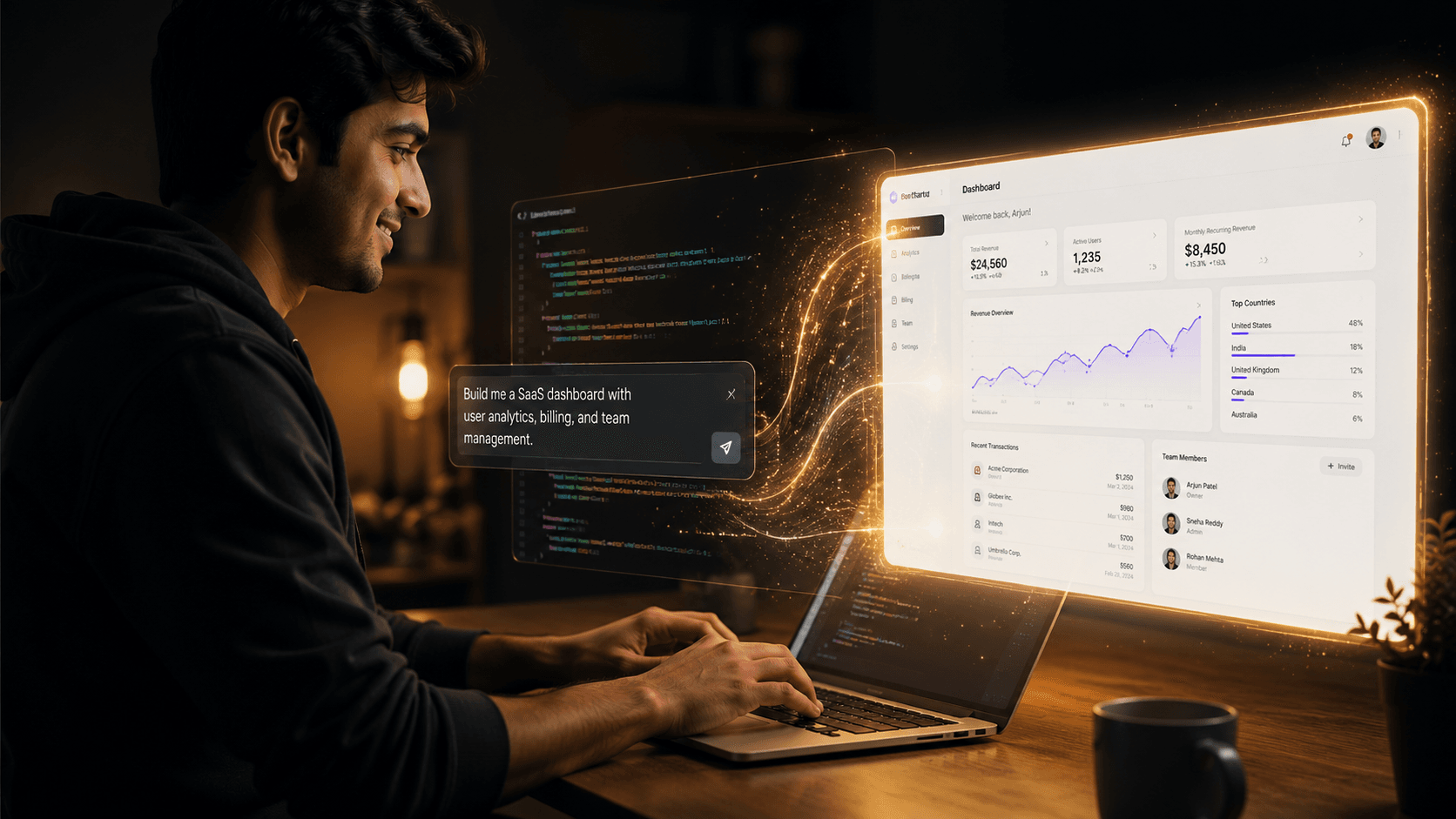
A new startup phenomenon called vibe coding — building startup products using AI tools by describing what you want in plain English — has exploded across the startup community. Non-technical startup founders are generating $50,000/month, $200,000/month, and in some cases millions in annual recurring startup revenue, without writing a single line of code manually.
This article maps the seven most powerful AI startup trends that are making vibe coding the most important startup skill of 2026 — and shows you how each one applies to your startup journey, regardless of your technical background.
What makes this startup moment historically unique is not just the availability of AI coding tools — it is the quality threshold those tools have crossed. In 2023, AI-generated startup code was brittle, inconsistent, and often required significant manual correction. By 2026, the quality of code produced by tools like Cursor, Claude Code, and Lovable is production-grade — meaning it can be shipped directly to startup customers without a technical founder ever reviewing the underlying architecture.
“In 2026, your startup idea does not need a developer. It needs a direction and the right AI tool.”
Start up Vibe Coding Trend 1 — AI Code Editors Are Becoming Every Start up’s CTO
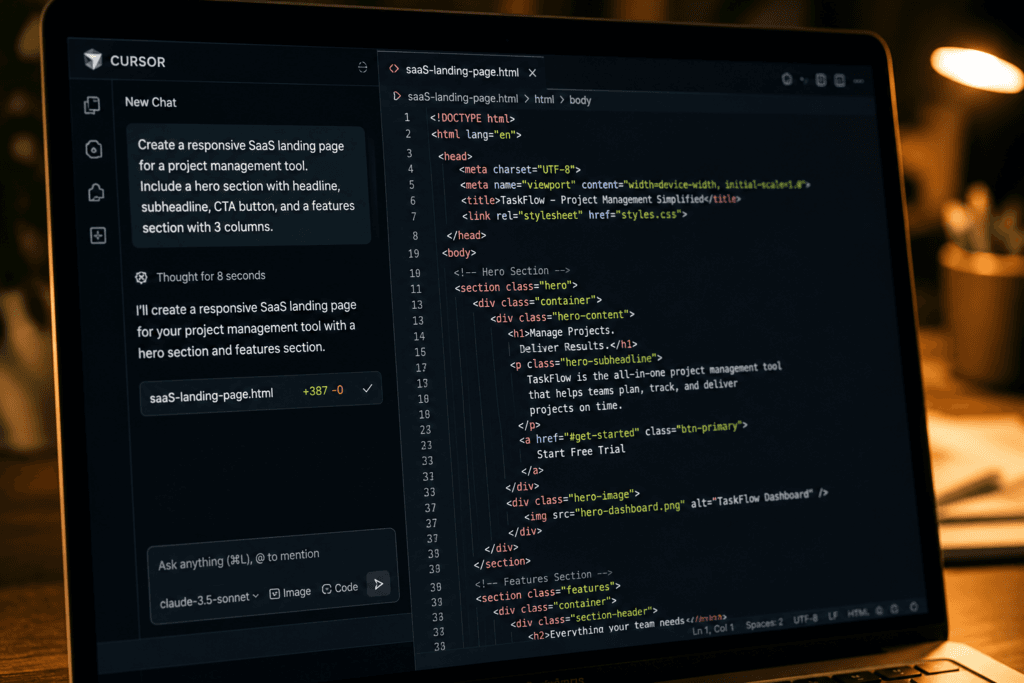
The first startup trend powering the vibe coding revolution is the rapid maturation of AI-assisted code editors. Tools like Cursor and Claude Code now allow any startup founder to describe a feature in plain language, watch the AI generate the code, test it, and deploy it — all without understanding the underlying technical architecture.
A solo startup founder building a B2B SaaS startup can now prototype, iterate, and ship features in the time it used to take a startup to hire a developer and schedule their first sprint. The startup competitive speed advantage this creates is enormous.
The more profound startup implication is what happens when speed of execution is no longer a function of team size. A solo startup founder using Cursor can now ship startup features 3 to 5 times faster than a traditionally-staffed startup with a full engineering team — because every startup iteration requires a description rather than a specification, a review meeting, and a deployment cycle. The startup that moves fastest in the early market typically wins that market. Vibe coding gives every solo startup founder that startup speed advantage.
“The startup CTO of 2026 is not always a person. Sometimes it is a subscription that costs $20 a month.”
Start up Vibe Coding Trend 2 — Full-Stack App Builders Are Braking Entire Start up Dev Teams

The second startup trend is the rise of full-stack AI app builders that generate, host, and deploy complete startup applications from a single natural language prompt. Platforms like Lovable, Bolt.new, and Replit Agent have moved beyond toy demos into serious startup-grade product development tools.
Lovable, the most prominent startup success story in this category, reached unicorn status in just 8 months from founding. According to Fortune’s 2026 report on Gen Z startup founders, startups using full-stack AI builders are reaching revenue milestones two to three times faster than traditionally developed startup products.
The startup economics of full-stack AI app builders are transformative. A traditionally-built startup MVP typically requires $50,000–$150,000 in development costs and three to six months of build time before the startup has anything to show a real customer. A vibe-coded startup MVP built on Lovable or Bolt.new costs $0–$50 in tool fees and can be in front of real startup customers within 48 hours. This startup cost differential changes the entire risk profile of building a startup — and makes experimentation something every aspiring startup founder can afford.
“A startup built with a vibe coding tool in 2026 can reach paying customers in days, not months.”
Start up Vibe Coding Trend 3 — Non-Technical Start up Founders Are Outperforming Technical Ones
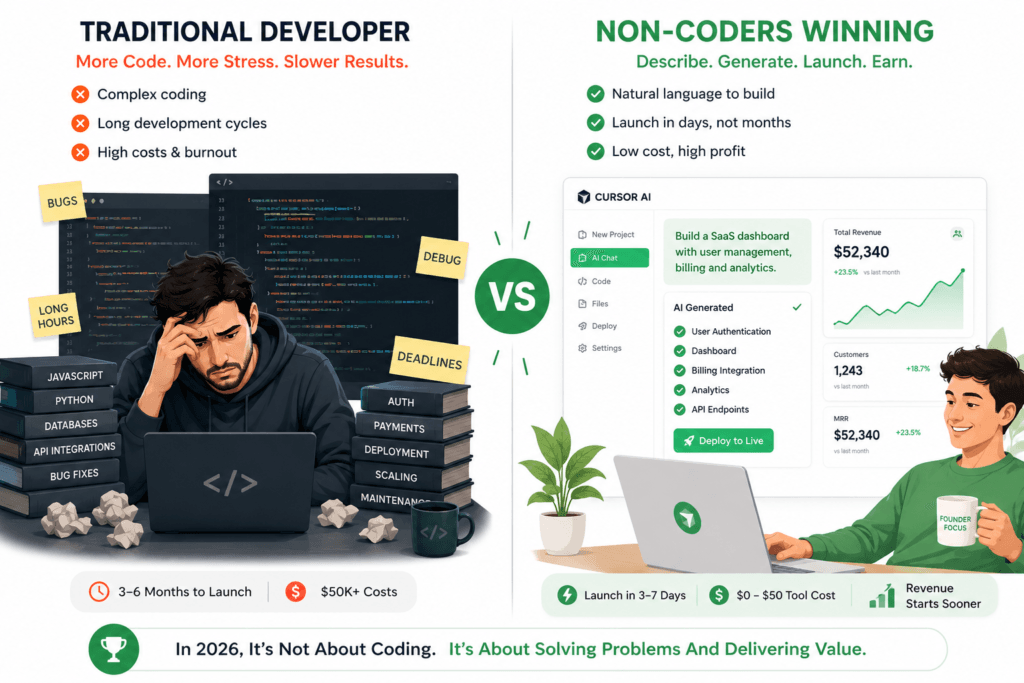
One of the most counterintuitive startup trends of 2026 is that non-technical startup founders are outperforming technical ones in several key metrics. Why? Because the execution bottleneck that once made technical skill the most valuable startup asset has been removed.
What remains as the primary startup differentiator is: customer empathy, startup distribution thinking, startup positioning, and speed of startup iteration. These are startup skills that do not require coding.
A significant Stanford study of startup founder performance published in early 2026 found that among startups using AI coding tools, non-technical founders achieved first revenue 40% faster than technical founders on average. The researchers hypothesised that technical founders spent more startup time on architecture quality and code elegance, while non-technical startup founders shipped faster because their only measure of success was whether a customer would pay. This startup finding has profound implications for how we should think about startup founder qualifications going forward.
“The best startup founder in 2026 is not necessarily the one who can build. It is the one who understands the customer deeply enough to know exactly what to build.”
Start up Vibe Coding Trend 4 — AI Screenshot-to-Start up Is a Real Launch Strategy
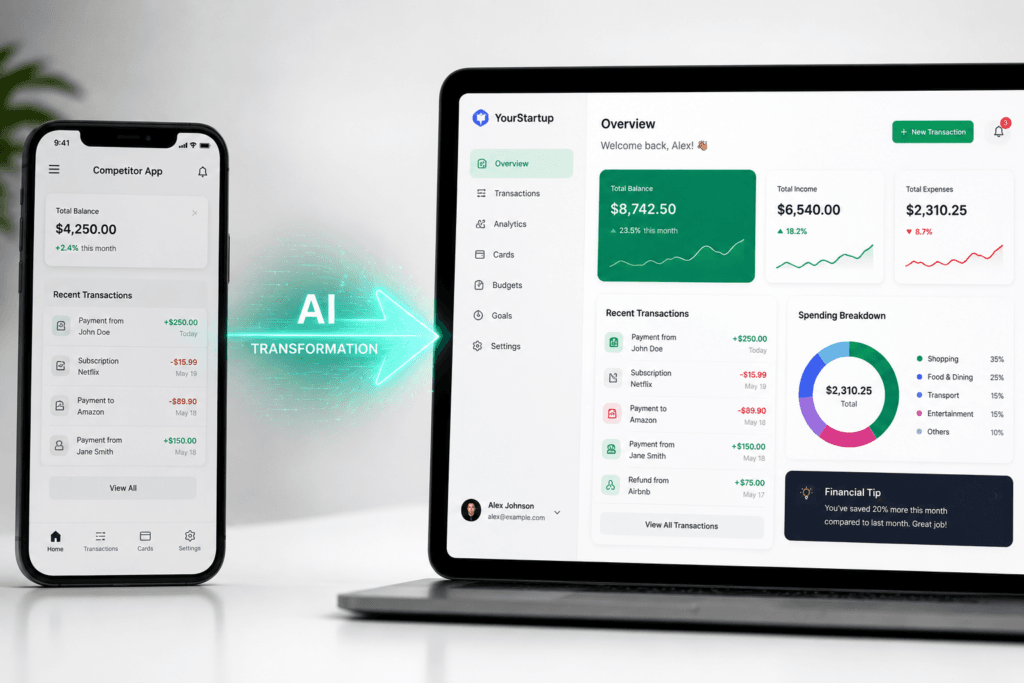
Perhaps the most jaw-dropping vibe coding startup trend of 2026 is the emergence of “screenshot-to-startup” as a legitimate product development strategy. Using tools like Claude Code and Cursor, startup founders can take a screenshot of a competitor’s product, describe the improvements they want, and receive a working prototype within hours.
The 23-year-old founder who built a startup generating $2M in annual recurring revenue began his startup journey exactly this way — by taking screenshots of an existing startup’s product and asking Claude Code to build something better. His startup had its first paying customer within a week of having the idea.
According to Crunchbase data, AI-native startups are reaching their first revenue milestone significantly faster than their traditionally-built counterparts.
The startup validation power of screenshot-to-startup is that it completely collapses the idea-to-feedback cycle. Traditional startup validation requires building a landing page, collecting email signups, and then spending months building a product before you know if anyone actually wants it. Screenshot-to-startup validation gives you a working product in a customer’s hands in 24–48 hours — which means your startup gets real feedback from real users in a real product context, not just interest expressed on a waiting list.
“The fastest startup validation in 2026 is not a landing page. It is a working prototype built with AI overnight.”
Start up Vibe Coding Trend 5 — Vibe Coding Is Creating a New Start up Creator Economy
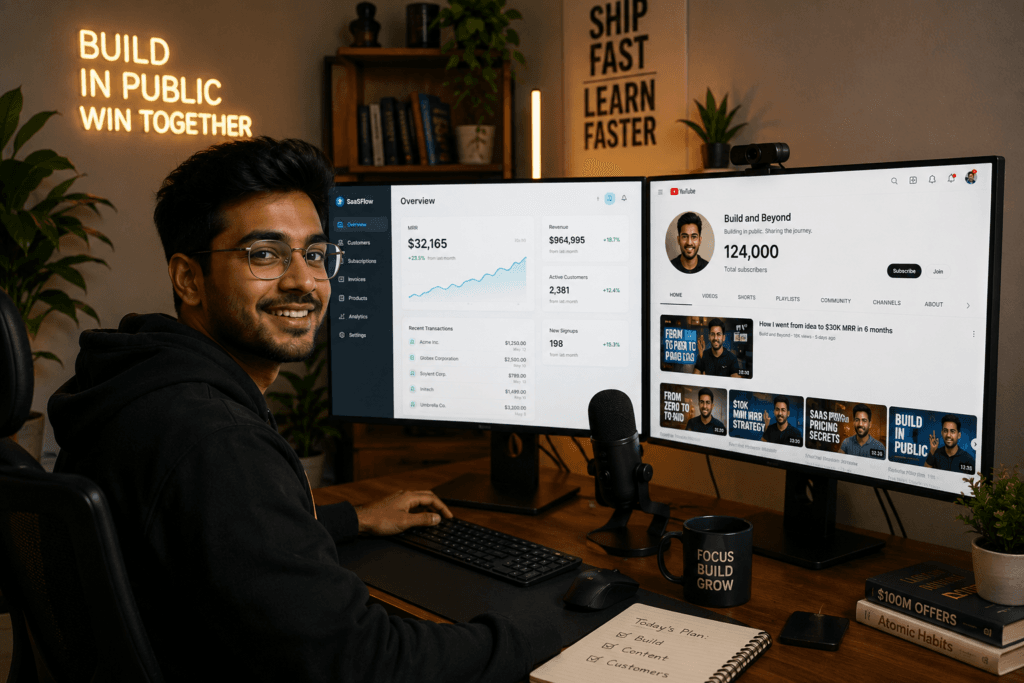
The fifth startup trend is the emergence of a startup creator economy built entirely around vibe coding. Startup founders who build products using AI tools are also documenting their startup journey on YouTube, Twitter/X, and LinkedIn — generating significant audiences and turning their startup content into a second revenue stream.
This creates a compounding startup advantage: the startup product generates revenue, and the startup founder’s content documenting the creation process generates audience, distribution, and additional startup revenue. Several vibe coding startup founders have crossed $100,000/month in combined product and content revenue within their first year.
The strategic startup insight here is that building in public is itself a distribution strategy. Every tutorial, every revenue update, every startup challenge you share publicly builds an audience that is pre-sold on your startup’s authenticity and value. By the time you launch your startup’s next product or your startup’s next feature, you have an audience of thousands who already trust you — and that audience costs nothing to build except the consistency of showing up and sharing honestly.
“Build your startup in public. Document your startup process. The audience is the distribution channel.”
Start up Vibe Coding Trend 6 — Start up Tool Stacks Are Becoming Plug-and-Play
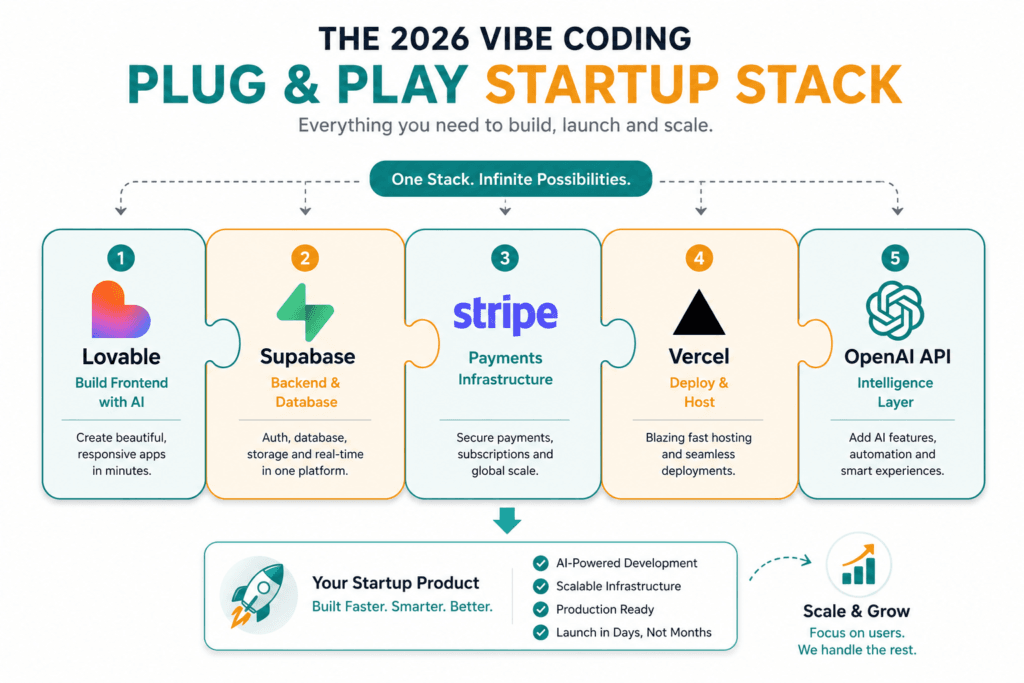
The sixth startup trend enabling the vibe coding revolution is the rapid standardisation of startup infrastructure. In 2024, connecting your startup’s frontend, backend, database, payments, and authentication required significant technical knowledge. In 2026, it is a plug-and-play startup setup that takes thirty minutes.
The 2026 Vibe Coding Startup Stack
- Frontend startup UI: Lovable or Bolt.new — zero code required
- Startup backend logic: Supabase — point-and-click database and auth
- Startup payments: Stripe — three-line integration available in all AI builders
- Startup AI features: Anthropic or OpenAI API — plug directly into any vibe-coded startup
- Startup deployment: Vercel — instant, automatic, free tier for early startups
The startup implication of this infrastructure standardisation is significant: for the first time in startup history, a startup founder can focus 100% of their mental energy on the customer problem rather than dividing their attention between the customer problem and the technical infrastructure. The startup founder of 2026 who masters this plug-and-play stack can run experiments, validate startup ideas, and pivot their startup faster than any team-based startup can even plan its sprint.
“In 2026, the startup infrastructure that took a $500,000 seed round to build in 2018 takes a weekend and a $50 subscription.”
Start up Vibe Coding Trend 7 — Investors Are Actively Funding Vibe-Coded Start ups
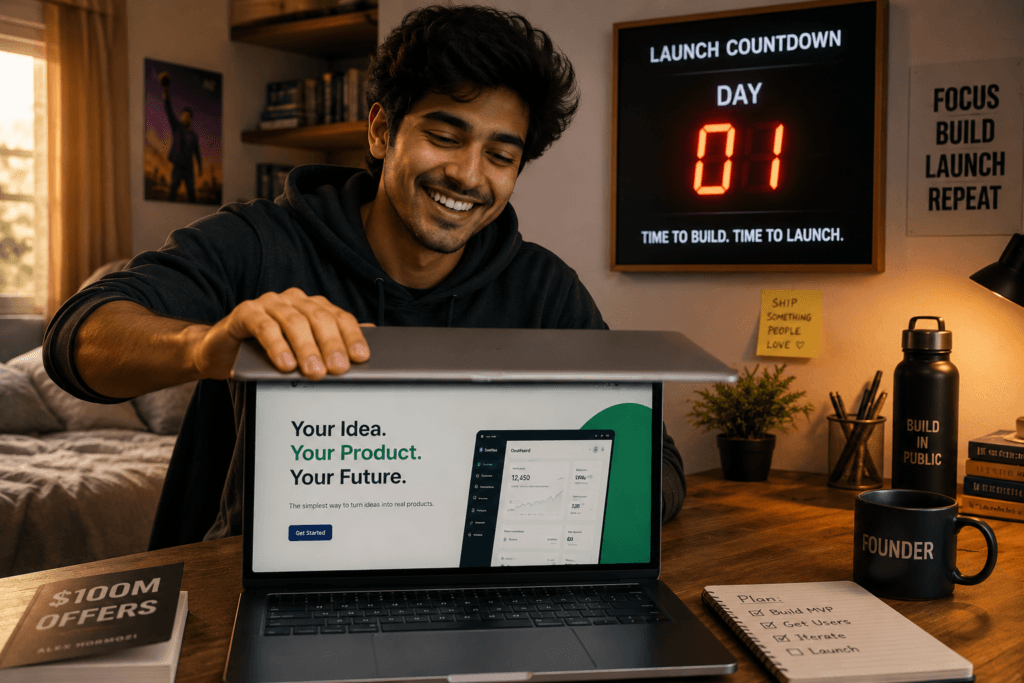
The seventh and perhaps most validating startup trend is that serious investors are actively backing vibe-coded startups. Y Combinator’s most recent cohort included multiple startups whose entire product was built using vibe coding tools. Several of those startups raised seed rounds of $1–3 million.
Investors have shifted their startup evaluation criteria: they no longer primarily ask how a startup was built. They ask “does this startup have paying customers and does it grow?” A startup with 500 paying customers and $20,000 MRR built with vibe coding tools is more fundable than a startup with a proper engineering team and zero revenue.
The deeper shift in startup investor thinking that this reflects is the decoupling of startup quality from technical architecture. Investors have realised that the highest-quality startup product is the one that best solves the customer problem — not the one with the cleanest codebase. A vibe-coded startup that customers love and pay for is categorically superior to a perfectly-engineered startup that nobody uses. This startup shift in investor psychology is one of the most important changes in the startup funding landscape of 2026.
“The startup funding market of 2026 does not care how you built it. It cares that customers pay for it.”
Conclusion: The Future Belongs to Founders Who Move Fast
The rise of vibe coding represents one of the most significant shifts in startup history. For decades, building a startup required technical expertise, large development budgets, and months of engineering effort before an idea could reach the market. In 2026, that reality has changed dramatically. The barriers that once prevented millions of aspiring entrepreneurs from launching products have been reduced to a laptop, an internet connection, and the willingness to learn how to work effectively with AI.
What makes this transformation so powerful is that startup success is increasingly being determined by customer understanding rather than coding ability. The founders who win are not necessarily the ones who can write the cleanest code or design the most sophisticated architecture. They are the founders who identify real problems, validate demand quickly, and iterate faster than everyone else.
AI-powered development tools are accelerating this trend at an unprecedented pace. Platforms such as Cursor, Claude Code, Lovable, Bolt.new, and Replit Agent continue to improve every month, making product creation more accessible than ever before. As these tools evolve, the gap between technical and non-technical founders will continue to shrink. In many cases, the founder with stronger market insight and distribution skills may have a greater advantage than a traditional software engineer.
This shift is also changing how investors evaluate opportunities. Venture capital firms and startup accelerators increasingly focus on traction, customer retention, and revenue growth rather than the technical background of the founding team. Programs such as Y Combinator have already funded multiple AI-native startups built with modern AI development workflows, signalling a broader change in startup investing.
For aspiring founders, the opportunity is enormous. Instead of spending months planning the perfect startup, the modern approach is to build quickly, test rapidly, gather feedback, and improve continuously. The cost of experimentation has never been lower, which means the potential upside of taking action has never been higher.
If you are interested in exploring the technologies behind this movement, consider reviewing resources from industry leaders such as OpenAI, Anthropic, Y Combinator, and Stripe. These organisations are helping shape the infrastructure that powers the next generation of AI-first startups.
The most important lesson is simple: the startup landscape no longer rewards those who wait. Every week, new founders are launching products, validating ideas, acquiring customers, and generating revenue using tools that did not exist just a few years ago. The entrepreneurs who embrace this shift today will gain experience, audience, and momentum while others remain stuck in analysis mode.
Vibe coding is not just another startup trend. It is a fundamental redefinition of who gets to build, who gets to launch, and who gets to compete. The startup founders who thrive in the coming decade will not necessarily be the best programmers. They will be the fastest learners, the closest to their customers, and the most willing to turn ideas into reality.
The question is no longer whether you can build a startup without coding. The evidence of 2026 suggests that you can. The real question is: what will you build first?
you must know these topics which are so important before you start a start up:
- 6 Shocking Startup Secrets Behind the $401M Telehealth Company Built by One Person
- 7 Shocking AI Startup Trends Creating One-Person Billion-Dollar Companies in 2026
- Top 5 Shocking Misapprehensions Founders Make When Raising Capital
- Founder Reality Check:6 Brutal Start up Funding Myths Every Founder Must Stop Believing
- Why Start ups Fail to Get Funding from Investors: 28 Hard Truths No One Tells You
- Start up Fundability Explained: 7 Powerful Readiness Signals Founders Must Get Right
- Start up Non-Dilutive & Alternative Funding: 7 Powerful Ways to Raise Capital Without Equity
- Angel Funding and Early-Stage Capital: 5 Core Principles That Shape Start up Growth
- Start Up Funding in India: 10 Proven Strategies for Massive Growth
- Start Up Success: 7 Powerful Pitch Deck Storytelling Secrets That Win Investors
- From Classroom to Capital: The Ultimate Funding Guide for Student & First-Time Founders
- Founder Guide: 5 Powerful Funding Trends Every Start up Must Know
FAQ
What is vibe coding and how does it relate to building a start up?
Vibe coding is the practice of building startup products using AI tools by describing what you want in plain English, without writing code manually. In 2026, tools like Cursor, Claude Code, and Lovable allow any startup founder to build, test, and deploy real startup products using this method.
Can a non-coder really build a profitable start up in 2026?
Yes. Multiple non-technical startup founders have built startups generating $1M-$2M in annual recurring revenue using only vibe coding tools. The technical barrier that once blocked non-developers from launching a startup has been effectively eliminated.
What vibe coding tools should a first-time start up founder use?
The best entry-point vibe coding startup tools in 2026 are: Bolt.new or Lovable for full-stack startup app building, Cursor for more advanced startup product development, Supabase for your startup database, Stripe for startup payments, and Vercel for startup deployment — all requiring zero traditional coding knowledge.
How long does it take to build a start up MVP using vibe coding?
A basic startup MVP — one that can take payments from real startup customers — can be built in 24–72 hours using vibe coding tools. The average vibe-coded startup founder has their first paying customer within the first week of starting to build their startup product.
Are investors interested in funding start ups built with vibe coding tools?
Yes. Y Combinator’s recent cohorts included multiple vibe-coded startups that raised $1–3M seed rounds. Startup investors in 2026 evaluate traction and customer revenue, not the technical approach used to build the startup product.
1 thought on “7 Powerful AI Start up Trends Making Non-Coders Millions Through Vibe Coding in 2026”
Comments are closed.