
By FundingsStartup Editorial Team | May 2026 | 11 min read
What Separates Today’s AI Unicorn Founder From Every Generation Before Them
The profile of the typical AI unicorn founder has changed more dramatically in the last three years than in the previous three decades combined. Founders who reach a $1 billion valuation in 2026 look, think, and operate fundamentally differently than the unicorn founders of 2015 or even 2020 — and understanding exactly how is essential for any entrepreneur hoping to follow a similar path.
This article breaks down five surprising, data-backed trends defining the modern AI unicorn founder — covering age, speed, geography, team structure, and funding sources. Each trend carries direct, practical implications for how you should think about building your own startup in 2026.
“The AI unicorn founder of 2026 is not a rarer version of the old archetype. They are a fundamentally new kind of entrepreneur.”
AI Unicorn Founder Trend 1 — The Average Age Has Dropped From 40 to 29
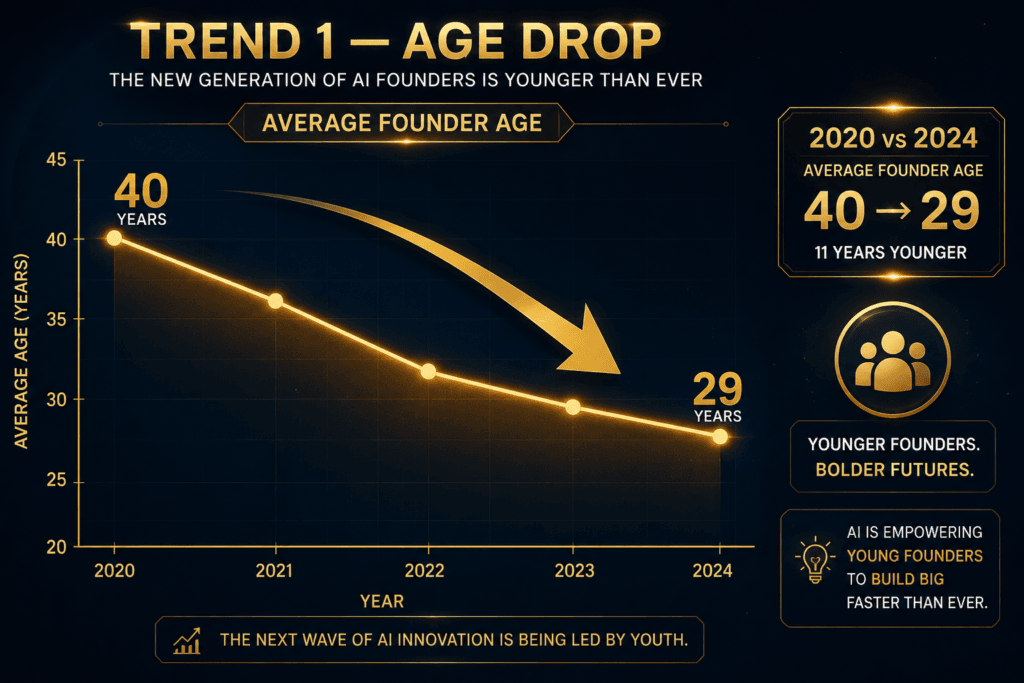
According to Antler’s 2026 “Anatomy of Greatness” research, the average age of an AI unicorn founder who reached a billion-dollar valuation has fallen from 40 in 2020 to just 29 in 2024. This is not a minor shift — it represents an eleven-year compression in the typical entrepreneurial timeline within just four years.
The reasons behind this shift are structural, not coincidental. A modern AI unicorn founder no longer needs decades of industry experience or an extensive professional network to build a category-defining company, because AI tools have flattened many of the experience-based advantages that older founders previously held. Younger AI unicorn founder candidates adopt new AI tools faster, carry fewer outdated assumptions about “how software gets built,” and are statistically more willing to bet early on emerging platforms before they become mainstream.
“If you are 24 and building seriously in 2026, you are not too young to become an AI unicorn founder. You are exactly on schedule.”
AI Unicorn Founder Trend 2 — Time to Unicorn Status Has Compressed From 7 Years to 4.7 Years
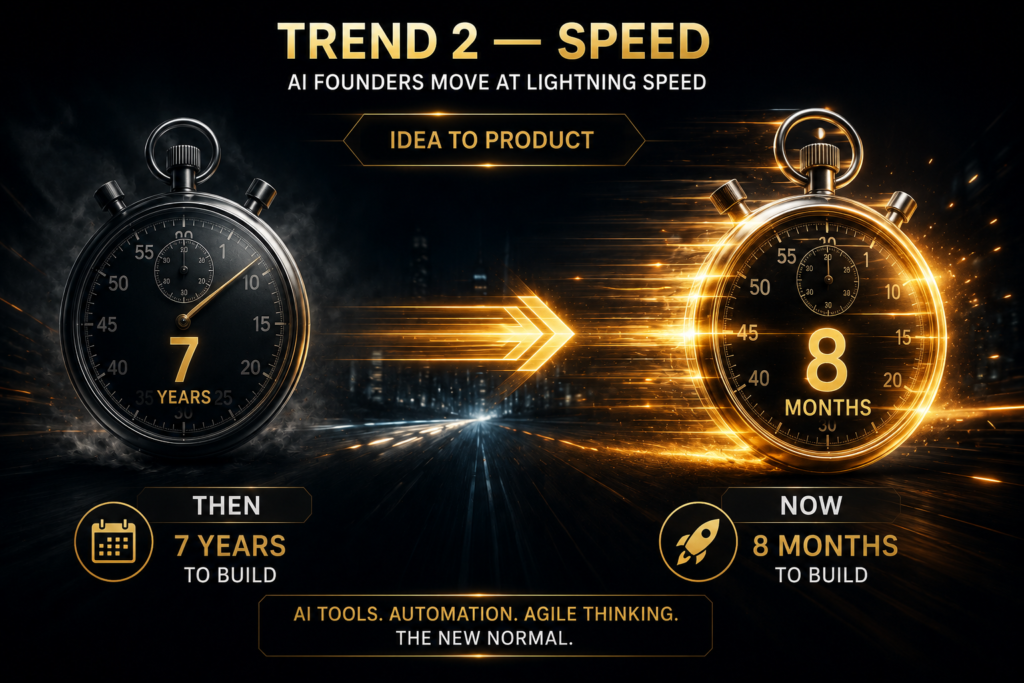
The traditional path to becoming an AI unicorn founder historically required roughly seven years from founding to reaching a billion-dollar valuation. In 2026, that average has compressed to just 4.7 years — and several individual cases have shattered that average entirely.
Swedish AI company Lovable, an AI app-building platform backed by Antler, reached unicorn status in just 8 months from founding — among the fastest unicorn trajectories in startup history. Every modern AI unicorn founder candidate is now operating in a market where speed of execution and speed of customer acquisition compound far faster than in any previous startup era, largely because AI tools dramatically shorten the gap between idea, product, and paying customer.
You can review the full methodology behind these figures directly in Fortune’s coverage of Antler’s 2026 founder research, which confirms this compression is one of the defining shifts of the current startup era.
“The modern AI unicorn founder does not wait seven years for validation. They build for months, not decades.”
AI Unicorn Founder Trend 3 — Solo and Tiny-Team Founders Are Increasingly Common
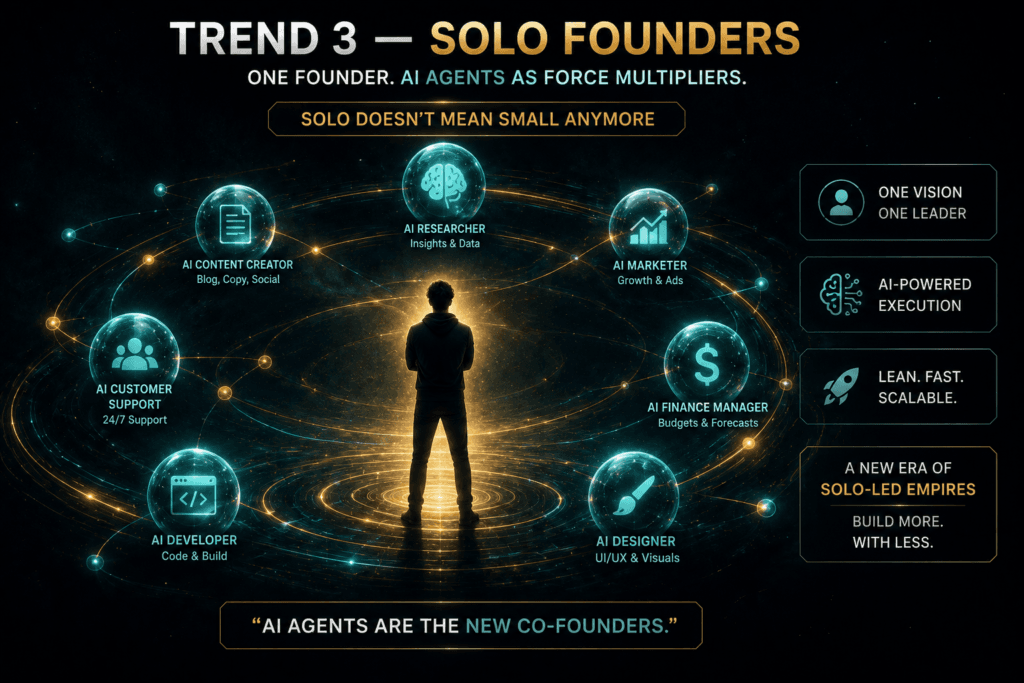
Perhaps the most surprising shift among today’s AI unicorn founder population is team size. While traditional unicorn narratives assumed large founding teams and rapid headcount growth, an increasing number of AI unicorn founder stories now begin with one or two people building almost entirely with AI agents rather than human employees.
Solo-founded startups now represent 36.3% of all new ventures, up from 23.7% just five years ago — and AI is the direct enabler of this shift. An aspiring AI unicorn founder today can replace what once required a 10-person team with an AI tool stack costing a few hundred dollars a month, fundamentally changing the capital and headcount requirements needed to reach unicorn-scale outcomes.
- Maor Shlomo built Base44 solo for six months before its $80M acquisition by Wix
- Multiple vibe-coded startups have reached seven-figure revenue with founding teams of one or two people
- AI agents now perform coding, marketing, and support functions that previously required dedicated hires
“Becoming an AI unicorn founder no longer requires building a large team. It increasingly requires building a smart one — even if that team is just you.”
AI Unicorn Founder Trend 4 — Sovereign Wealth Funds Are Now Major Backers of AI Unicorns
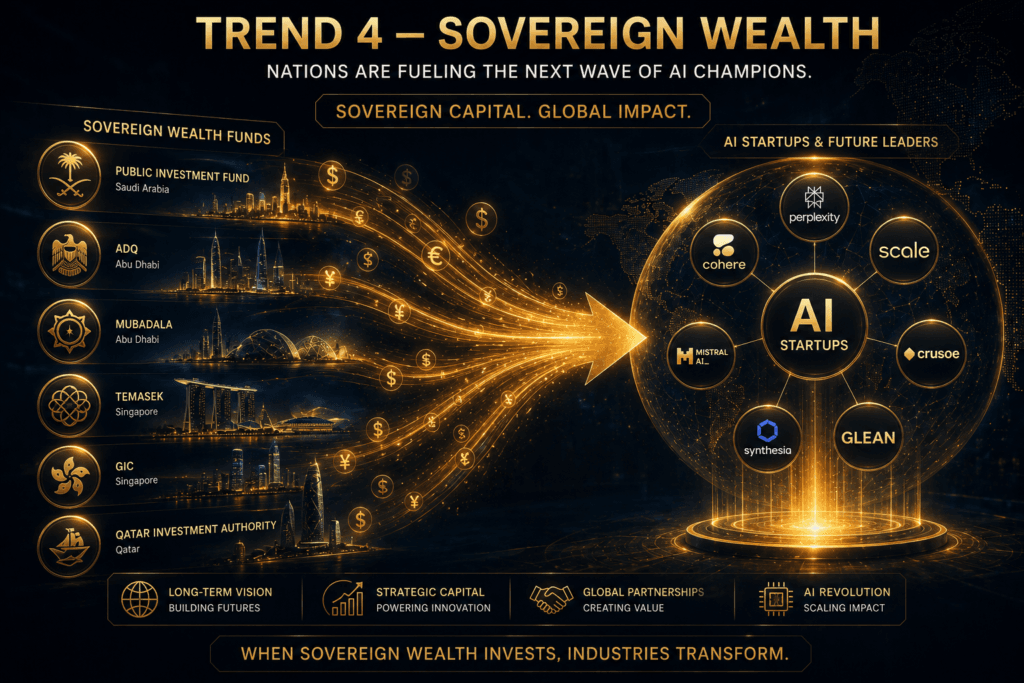
The capital sources behind today’s AI unicorn founder population have shifted dramatically. Mega-rounds for companies like OpenAI ($122 billion), Anthropic ($30 billion), and xAI ($20 billion) are increasingly backed by sovereign wealth funds — Singapore’s Temasek, Qatar’s Investment Authority, Saudi Arabia’s Public Investment Fund, and UAE’s Mubadala — rather than purely traditional venture capital firms.
This creates what investors describe as a “bifurcated market”: a handful of mega-companies absorbing enormous sovereign wealth checks, alongside a highly competitive early-stage market where angels and micro-VCs compete aggressively to discover the next AI unicorn founder before they become obvious. For early-stage founders, this downstream pressure has translated into pre-seed and seed deals representing 67% of all Q1 2026 deal activity — meaning more capital is chasing first-time founders than at almost any previous point in startup history.
“The capital chasing the next AI unicorn founder has never been more abundant at the earliest stages of a startup’s life.”
AI Unicorn Founder Trend 5 — Geographic Diversity Is Expanding Beyond Silicon Valley
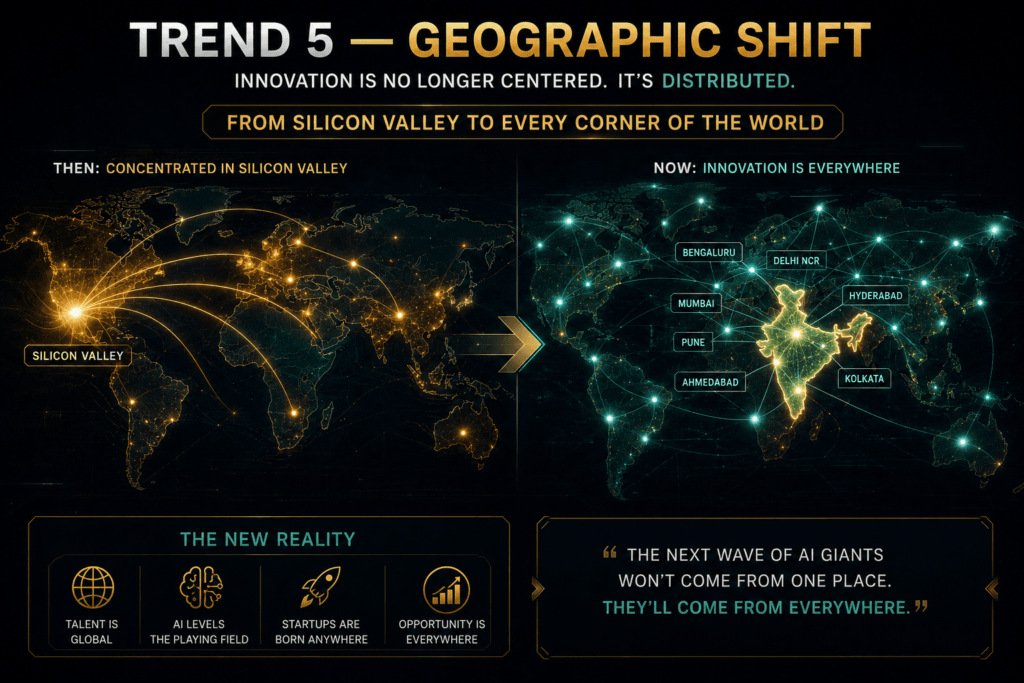
The final and perhaps most encouraging trend is geographic. The next generation of AI unicorn founder stories is no longer concentrated almost exclusively in San Francisco. India is now the world’s second-largest Generative AI startup ecosystem, with approximately 890 GenAI startups and a 23% year-on-year increase in total startup funding in 2025.
Cities like Hyderabad, Pune, Chennai, and Ahmedabad collectively now represent more than 35% of all Indian startup deal volume, meaning the next AI unicorn founder is increasingly likely to be building from a Tier-2 Indian city rather than a Bay Area garage. Government programmes like the IndiaAI Mission, offering subsidised GPU compute at a fraction of commercial cloud rates, are actively lowering the geographic barriers that once made Silicon Valley nearly mandatory for serious AI startup building.
“The next AI unicorn founder is statistically more likely than ever to be building from outside Silicon Valley.”
What These Trends Mean for Your Own Founder Journey
Taken together, these five trends paint a clear picture of who becomes an AI unicorn founder in 2026: younger, faster-moving, often solo or working in tiny teams, backed by an increasingly global and abundant capital landscape, and building from anywhere in the world rather than a single concentrated hub.
- Your age is not a disadvantage — the average AI unicorn founder is younger than ever before
- Speed matters more than ever — unicorn timelines have compressed from years to months in extreme cases
- You do not need a large team to become an AI unicorn founder — AI agents can replace much of the traditional headcount
- Early-stage capital is genuinely abundant right now, regardless of where you are building from
- Your geography — including a Tier-2 Indian city — is no longer the barrier it once was
Every structural advantage that once favoured an older, well-connected, Silicon Valley-based founder has eroded. The next AI unicorn founder reading this article could just as easily be building from a college dorm in Pune as a co-working space in Palo Alto.
“The path to becoming an AI unicorn founder has never been shorter, cheaper, or more globally accessible than it is right now.”
You must know these topics which are so important before you start a start up:
- 10 Proven AI Startup Ideas You Can Start With Less Than ₹50,000
- 5 Powerful Ways the IndiaAI Mission Can Save Your Startup Thousands on GPU Costs
- Building AI App at 23-Year-Old making insane dollars Without Coding
- 7 Shocking Signs Traditional Software Is Dying Faster Than Anyone Expected
- 9 Explosive India AI Startup Trends Creating Young Millionaire Founders in 2026
- 10 Powerful AI Startup Tools Replacing Entire 10-Person Teams for Under $300/Month.
- 7 Powerful AI Start up Trends Making Non-Coders Millions Through Vibe Coding in 2026
- 6 Shocking Startup Secrets Behind the $401M Telehealth Company Built by One Person
- 7 Shocking AI Startup Trends Creating One-Person Billion-Dollar Companies in 2026
- Top 5 Shocking Misapprehensions Founders Make When Raising Capital
- Founder Reality Check:6 Brutal Start up Funding Myths Every Founder Must Stop Believing
- Why Start ups Fail to Get Funding from Investors: 28 Hard Truths No One Tells You
- Start up Fundability Explained: 7 Powerful Readiness Signals Founders Must Get Right
- Start up Non-Dilutive & Alternative Funding: 7 Powerful Ways to Raise Capital Without Equity
- Angel Funding and Early-Stage Capital: 5 Core Principles That Shape Start up Growth
- Start Up Funding: 10 Proven Strategies for Massive Growth
- Start Up Success: 7 Powerful Pitch Deck Storytelling Secrets That Win Investors
- From Classroom to Capital: The Ultimate Funding Guide for Student & First-Time Founders
- Founder Guide: 5 Powerful Funding Trends Every Start up Must Know
Conclusion: The Future Belongs to Founders Who Adapt Faster Than Everyone Else

The startup landscape is evolving at a pace that has never been witnessed before. Artificial Intelligence has dramatically changed how businesses are built, scaled, funded, and managed. Looking at the world’s most successful AI-driven companies reveals one undeniable truth—success is no longer determined by who has the biggest budget, the largest team, or decades of experience. Instead, success belongs to founders who can identify problems quickly, leverage AI intelligently, and execute relentlessly.
The five founder trends discussed throughout this article highlight a clear shift in entrepreneurial thinking. Today’s founders focus on speed over perfection, customer value over unnecessary features, and continuous learning over fixed expertise. These characteristics are becoming the defining factors behind high-growth startups across industries.
“The winners of tomorrow will not be those with the best ideas, but those who turn ideas into solutions faster than everyone else.”
AI Is Changing the Rules of Entrepreneurship
Only a few years ago, launching a technology company required significant funding, a large engineering team, and months of software development. Today, AI has dramatically reduced those barriers.
Modern entrepreneurs can validate ideas within days, automate repetitive tasks, create marketing campaigns, build prototypes, analyze customer behavior, and even write production-ready code using AI-powered tools. This allows founders to spend more time solving customer problems instead of getting stuck in operational challenges.
However, simply using AI tools is not enough. The real competitive advantage comes from combining human creativity with AI efficiency. Founders who understand this balance are building companies that grow faster while keeping operational costs under control.
“Artificial Intelligence does not replace entrepreneurs—it amplifies the entrepreneurs who know how to use it wisely.”
Execution Matters More Than Inspiration
Many aspiring entrepreneurs spend months searching for the perfect business idea. In reality, successful founders rarely begin with perfect ideas. They begin with a real problem, launch quickly, gather customer feedback, and improve continuously.
This mindset separates successful startups from those that never leave the planning stage.
Instead of asking,
“Is my idea perfect?”
Successful founders ask,
- Does this solve a genuine customer problem?
- Can I launch a simple version today?
- What can I improve after receiving feedback?
The willingness to execute consistently often creates a much larger advantage than waiting for perfect conditions.
The Most Valuable Skill Is Continuous Learning
Technology changes every year, but learning speed has become one of the most valuable competitive advantages for founders.
AI models evolve rapidly.
Customer expectations change.
Markets shift unexpectedly.
Business models become obsolete.
Founders who dedicate time to learning new technologies, understanding customer needs, and adapting their strategies remain ahead of competitors regardless of market conditions.
Rather than becoming experts in every technical field, successful entrepreneurs learn how to ask better questions, analyze data intelligently, and make faster decisions.
“Your greatest startup asset is not your current knowledge—it is your ability to keep learning.”
Building Trust Will Always Outperform Building Hype
While AI enables companies to move faster than ever, customers continue to value one thing above everything else—trust.
Businesses that focus only on rapid growth often struggle to build lasting customer relationships. On the other hand, founders who prioritize transparency, ethical AI practices, product quality, and customer satisfaction create brands that survive changing market trends.
Trust is earned through consistent execution, honest communication, and delivering real value.
In an era where AI-generated content is everywhere, authenticity has become one of the strongest competitive advantages.
Every Entrepreneur Can Start Today
Perhaps the most encouraging trend is that entrepreneurship has become more accessible than ever before.
You no longer need millions in funding.
You no longer need hundreds of employees.
You no longer need years of software development experience.
With today’s AI ecosystem, entrepreneurs can begin with a laptop, a clear understanding of customer problems, and a commitment to continuous improvement.
The founders building tomorrow’s most influential companies are often ordinary people solving ordinary problems in extraordinary ways.
“Small beginnings often create extraordinary businesses.”
Final Thoughts
The startup ecosystem will continue evolving as Artificial Intelligence becomes even more powerful. New tools will emerge, industries will transform, and customer expectations will continue rising. Yet the principles behind successful founders are unlikely to change.
The entrepreneurs who succeed will be those who remain curious, adaptable, customer-focused, data-driven, and committed to solving meaningful problems.
Instead of trying to copy every successful founder, focus on developing the habits that consistently lead to long-term success. Learn quickly, experiment fearlessly, embrace AI responsibly, and continuously improve your product based on real customer feedback.
Remember that every globally recognized company once started as a simple idea backed by determined founders who refused to stop learning.
“The future does not belong to the biggest companies—it belongs to the fastest learners, the boldest problem-solvers, and the founders who never stop building.”
As you begin or continue your entrepreneurial journey, let these founder trends serve as practical guidance rather than fixed rules. Use AI as a powerful partner, keep your customers at the center of every decision, stay resilient through challenges, and never underestimate the impact of consistent execution. The next generation of breakthrough companies will be created by founders who combine innovation with persistence—and there is no better time than now to become one of them.
FAQ
What is the average age of an AI unicorn founder in 2026?
According to Antler’s 2026 research, the average age of an AI unicorn founder has dropped from 40 in 2020 to just 29 in 2024 — making youth less of a disadvantage and more of an advantage in the current AI startup landscape.
How long does it typically take to become an AI unicorn founder now?
The average time to reach a $1 billion valuation has compressed from roughly 7 years to 4.7 years for AI-native companies. Some AI unicorn founder stories, like Lovable’s, have reached unicorn status in as little as 8 months.
Can a solo founder realistically become an AI unicorn founder?
Yes. Solo-founded startups now represent 36.3% of new ventures, up from 23.7% five years ago. AI agents increasingly replace functions once requiring full teams, meaning a single determined founder can build toward unicorn-scale outcomes using AI tools.
Where are most new AI unicorn founders building their companies?
While Silicon Valley remains significant, India has emerged as the world’s second-largest GenAI startup ecosystem, with Tier-2 cities like Hyderabad, Pune, and Chennai representing over 35% of Indian startup deal volume — meaning the next AI unicorn founder is increasingly likely to be building outside traditional hubs.
Is early-stage funding really more available to aspiring AI unicorn founders right now?
Yes. Pre-seed and seed deals represented 67% of all Q1 2026 deal activity, reflecting intense competition among angels and micro-VCs to find the next AI unicorn founder early — a direct result of mega-rounds being increasingly dominated by sovereign wealth funds at the top of the market.
1 thought on “5 Game-Changing AI Unicorn Founder Trends Every Startup Entrepreneur Must Know”
Comments are closed.