The Dirty Truth About Start up Funding: Myths Founders Desperately Believe
Every year, thousands of ambitious founders chase funding based on half-truths and Hollywood narratives. It’s time to separate the myth from the money.
Start up funding is one of the most mythologized subjects in the entrepreneurial world. From Silicon Valley success stories to binge-worthy founder documentaries, the narrative around raising money has been so dramatized that most first-time founders walk into pitch rooms carrying a suitcase full of dangerous misconceptions. The gap between what founders believe about funding and what actually happens in the real world can be the difference between building a thriving company and burning out chasing capital that was never meant for them.
- Most start ups are not VC-fundable — and that’s perfectly fine
- Funding is not validation — it’s a bet with interest attached
- The majority of funded start ups still fail within 5 years
- Angels and VCs have fundamentally different motivations
- Bootstrapping often produces more sustainable businesses
- Your network matters more than your pitch deck in most cases
- Revenue is the most underrated form of funding available
0.05%Start ups that get VC funding
90%Funded start ups still fail
$3.5MAvg. seed round size (2024)
57%Founders bootstrap initially
✦Myth1:- “Every Great Start up Needs Venture Capital Funding”
The Myth
Walk into any start up meetup and you’ll feel it — an almost religious belief that venture capital funding is the only legitimate path to building a great company. The culture glorifies the term sheet, the pitch meeting, the term “funded start up.” Social media feeds are flooded with announcements: “Thrilled to share we’ve raised our Series A!” It creates an illusion that VC funding equals success.
Venture capital is a tool, not a trophy. Most great companies were never VC-backed — they were just quietly profitable.— Jason Fried, Co-founder of Basecamp.
The Reality
The reality is sobering: fewer than 0.05% of start ups ever receive venture capital funding. VCs are not in the business of funding good companies — they’re in the business of funding companies that can return their entire fund through a single bet. That means they’re looking for businesses with the potential to become billion-dollar outcomes. If your start up doesn’t have that kind of exponential growth potential built into its DNA, VC is simply not the right tool for you — and that’s not a failure, it’s a fit problem.
Companies like Mailchimp, Basecamp, and Spanx built billion-dollar enterprises without a single dollar of venture capital. Mailchimp was bootstrapped for nearly two decades before its $12 billion acquisition. The lesson: VC funding is a specific financial instrument designed for a specific type of company, not a badge of honor for every entrepreneur.
Raising money is the easiest thing a start up can do. The hard part is building something people actually want.— Paul Graham, Y Combinator.
✦Myth2:- “If You Have a Great Idea, Funding Will Follow”
The Myth
Founders often believe that a breakthrough idea is the primary currency of the funding world. “If my concept is strong enough, investors will line up.” This belief leads many entrepreneurs to spend months perfecting their idea in isolation, building elaborate decks, and rehearsing their elevator pitch — while neglecting the one thing investors actually care about.
Ideas are cheap. Execution is everything. A great idea poorly executed is worth less than a mediocre idea brilliantly built.— Reid Hoffman, Co-founder of LinkedIn.
The Reality
Investors do not fund ideas — they fund teams, traction, and timing. A mediocre idea executed by a world-class team will almost always beat a brilliant idea in the hands of an unproven founder. What serious investors are evaluating when they look at your pitch is: Does this team have the resilience, domain expertise, and execution capacity to navigate the brutal reality of building a company?
The concept of “traction” is the single most underestimated factor in start up funding. Even a handful of paying customers, a growing waitlist, or compelling early user engagement can transform a pitch from interesting to investable. Revenue is the most persuasive slide in any pitch deck. Data beats narrative every single time.
- Investors fund teams and traction, rarely pure ideas
- Even 5–10 paying customers dramatically improve fundability
- Your market timing matters as much as your product
- Serial founders raise 3x faster than first-time founders on average
The best pitch is a product that sells itself. Investors don’t bet on potential — they bet on proof.— Marc Andreessen, Andreessen Horowitz.
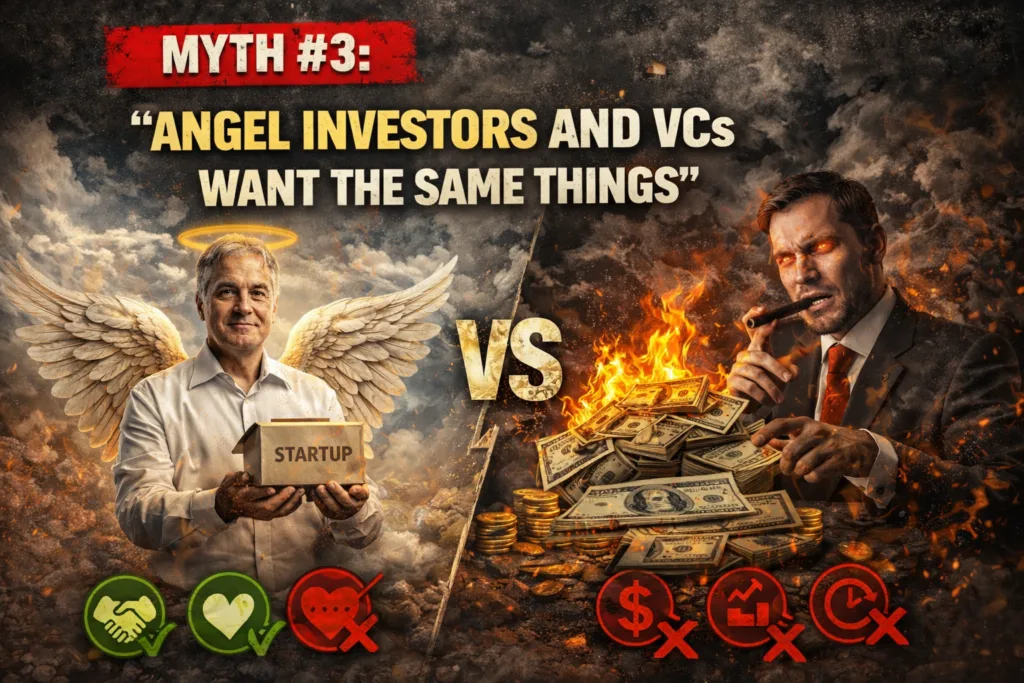
✦Myth3:- “Angel Investors and VCs Want the Same Things”
The Myth
Many founders treat angel investors and venture capitalists as interchangeable — just different sized checkbooks. They approach both with the same pitch, the same expectations, and the same timeline assumptions. This fundamental misunderstanding leads to wasted time, misaligned partnerships, and funding relationships that eventually poison the cap table.
The Reality
Angel investors and VCs operate from entirely different incentive structures. Angel investors are typically high-net-worth individuals investing their personal capital. They often have emotional motivations — passion for a sector, desire to mentor, or personal connection to a problem. They tend to be more flexible, faster to decide, and more tolerant of early-stage ambiguity. Their checks are smaller ($10K–$500K typically) but their involvement can be deeply valuable.
Venture capitalists, on the other hand, are managing institutional money — capital from pension funds, university endowments, and family offices. They have a legal obligation to their Limited Partners (LPs) to seek outsized returns. A VC fund that returns 3x is considered mediocre. They need home runs. This means VCs must say no to 99% of deals, even good ones, simply because those companies don’t fit their return model. Understanding this is not demoralizing — it’s empowering, because it helps you target the right investors for your stage.
Choosing the wrong investor is like hiring the wrong co-founder — except you can’t fire them.— Naval Ravikant, AngelList.
✦Myth4:- “More Funding Means More Success”
The Myth
There’s a common belief that the size of a funding round correlates directly with the probability of success. Founders celebrate large raises, the press amplifies them, and the start up community often measures ambition in dollars raised. “We raised $50M” has become a proxy for “we’re winning.”
Abundance is a disease for start ups. Constraints breed creativity; capital abundance breeds complacency.— Eric Ries, Author of The Lean Start up.
The Reality
Research consistently shows that overfunded start ups are among the most likely to fail. Excess capital creates a false sense of security. It delays the critical discipline of finding product-market fit. It encourages premature scaling — hiring aggressively before the business model is validated, running expensive marketing campaigns before the retention metrics justify them. More money often masks the very problems that need to be solved.
The story of Quibi is one of the most instructive cautionary tales in start up history. The platform raised $1.75 billion from top-tier investors before launching — and shut down just six months after going live. Meanwhile, companies like Craigslist, Duolingo, and GitHub in their early days built extraordinary value with minimal capital by staying lean and forcing creative problem-solving.
- Overfunded start ups often delay finding product-market fit
- Capital efficiency is a stronger predictor of success than round size
- Investors increasingly value “default alive” start ups over burn-heavy ones
- The best metric is revenue per dollar raised, not total funds raised
The start ups that succeed on less tend to build better habits that serve them for life.— Sam Altman, Open AI CEO & Former YC President.
✦Myth5:- “A Strong Pitch Deck is All You Need to Raise Funding”
The Myth
The pitch deck has become mythologized to the point where founders spend months perfecting slide aesthetics, agonizing over font choices, and rehearsing transitions. There’s an entire cottage industry of pitch deck consultants promising to unlock investor doors. The myth: if your deck is polished enough, the money will follow.
The Reality
The pitch deck is a door opener, not a deal closer. In reality, the vast majority of start up funding is driven by warm introductions through trusted networks. Research by DocSend found that the average investor spends just 3 minutes and 44 seconds reviewing a pitch deck before deciding whether to take a meeting. The deck gets you in the room — your credibility, network, and traction close the deal.
Relationships are the real currency of the funding ecosystem. Investors fund people they know, people who were referred by people they trust, and people they’ve watched build something over time. Cold email open rates for pitch decks hover around 1–3%. Warm introductions convert at rates 10 to 20 times higher. This means the most valuable fundraising activity isn’t perfecting your deck — it’s building genuine relationships with founders who’ve already raised, with advisors who sit on relevant boards, and with angels in your space months before you ever need their money.
- Investors spend an average of under 4 minutes on a cold pitch deck
- Warm introductions are 10–20x more effective than cold outreach
- Network building should begin 12–18 months before you plan to raise
- Your founder reputation precedes your pitch every time
The best fundraisers don’t pitch — they have conversations. They make investors feel like they’re being invited in, not sold to.— Aileen Lee, Founder of Cowboy Ventures.
✦Myth6:- “Once You’re Funded, the Hard Work is Done”
The Myth
There’s a pervasive belief among aspiring founders that the closing of a funding round represents arrival — that once the wire clears, the start up has crossed a critical threshold and success is only a matter of execution. Founders celebrate publicly, press releases go out, and a kind of euphoria sets in. The fundraising grind is over.
The Reality
Raising a funding round is the beginning of a new set of pressures, not the end of the old ones. The moment you accept outside capital, you’ve entered into a legal and ethical obligation to generate returns for your investors. You’re now on a clock. Venture-backed companies are typically expected to raise their next round within 18–24 months, which means the fundraising process never truly ends — it just resets at a higher bar.
Furthermore, 90% of funded start ups still fail. Funding provides runway, but runway alone doesn’t guarantee product-market fit, customer acquisition, team retention, or any of the dozens of variables that determine whether a start up survives. The post-funding period is often the most dangerous phase, precisely because the false security of capital in the bank can dull the urgency that drove the company’s early momentum.
- Funded companies face board accountability and investor reporting obligations
- The next raise clock starts the moment the current round closes
- Dilution compounds with every subsequent round
- Post-funding culture changes are a common start up killer
Funding is jet fuel. It accelerates whatever is already happening — good or bad. If your model is broken, funding just helps you fail faster.— Mark Suster, Upfront Ventures.
Reality Check
✦ The Funding Paths Founders Actually Overlook
Bootstrapping: The Underrated Giant
Bootstrapping — building a company using revenue generated from your own business — is perhaps the most undervalued funding strategy in start up culture. It preserves full equity ownership, forces discipline around unit economics, and creates businesses built on real value rather than investor enthusiasm. Founders who bootstrap develop a fundamentally different relationship with money: every dollar spent is scrutinized, every dollar earned is celebrated. This instinct is an enormous competitive advantage.
Revenue-Based Financing
Revenue-based financing (RBF) has emerged as a powerful alternative to dilutive equity funding. In this model, investors provide capital in exchange for a percentage of future revenues until a predetermined amount is repaid. For companies with predictable recurring revenue, RBF can be faster to close, non-dilutive, and far better aligned with the founder’s interests.
Grants and Non-Dilutive Funding
Billions of dollars in government grants, innovation awards, and non-dilutive funding go unclaimed every year simply because founders don’t know they exist. Programs like the SBIR/STTR in the US, Innovate UK, and the EU Horizon program provide significant funding to start ups working in science, technology, and social impact — with no equity taken in return. For the right companies, this is the most underutilized form of funding in existence.
The founders who win aren’t the ones who raised the most money. They’re the ones who found the right money at the right time.— Kathryn Minshew, Co-founder of The Muse.
The Bottom Line: A Smarter Relationship With Funding
The start up funding landscape is neither as glamorous nor as accessible as popular culture suggests — but it is far more navigable when you approach it with clear eyes and realistic expectations. The founders who build enduring companies are not necessarily the ones who raise the most money. They are the ones who understand what kind of capital their business actually needs, when to raise it, from whom, and — crucially — whether to raise it at all.
The myths around funding persist because they serve a narrative. They make for better content, better headlines, and better drama. But the reality of building a company is quieter, harder, and more nuanced than any TechCrunch funding announcement suggests.
Your job as a founder is not to raise money. Your job is to build something valuable. If you do that well, the right capital — whether it’s a customer’s first payment, a grant, an angel check, or a Series A — will find its way to you. And when it does, you’ll be ready to use it wisely because you understand what it truly represents: not a destination, but a responsibility.
Remember: The most powerful form of validation is not a term sheet —
it’s a customer who pays, returns, and tells their friends.
🔗Further Reading & Valuable Resources
If you want to go deeper into the realities of start up funding and make smarter decisions as a founder, it’s important to learn from both credible external sources and practical insights. For a data-backed understanding of how investors actually evaluate start ups, explore resources like Y Combinator’s Start up Library and fundraising guides from Sequoia Capital, which break down what truly matters beyond the pitch. Platforms like Andreessen Horowitz also publish in-depth articles on market dynamics, scaling, and capital strategy that every founder should study.
To flourish more you must know these:-
- Top 5 Shocking Misapprehensions Founders Make When Raising Capital
- Why Start ups Fail to Get Funding from Investors: 28 Hard Truths No One Tells You
- Start up Fundability Explained: 7 Powerful Readiness Signals Founders Must Get Right
- Start up Non-Dilutive & Alternative Funding: 7 Powerful Ways to Raise Capital Without Equity
- Angel Funding and Early-Stage Capital: 5 Core Principles That Shape Start up Growth
- Start Up Funding in India: 10 Proven Strategies for Massive Growth
- Start Up Success: 7 Powerful Pitch Deck Storytelling Secrets That Win Investors
- From Classroom to Capital: The Ultimate Funding Guide for Student & First-Time Founders
- Founder Guide: 5 Powerful Funding Trends Every Start up Must Know
FAQ
How should a founder decide whether to raise funds or bootstrap?
Decide based on growth speed vs control:
Choose funding if your market demands rapid scaling and competition is intense.
Choose bootstrapping if you can grow steadily with revenue and want full ownership.
If you don’t need external capital to survive or win, don’t take it.
What are the biggest red flags investors look for in early-stage start ups?
Key red flags include:
No clear customer demand, Weak or incomplete founding team, Lack of focus (trying to solve too many problems), No understanding of unit economics, Overly optimistic projections without data.
When is the right time to start fundraising?
Start fundraising when you have proof, not just an idea:
Early traction (users, revenue, or growth signals)
A working MVP
Clear problem-solution fit
Raising too early reduces valuation and increases dilution.
How much equity should a founder give away in early funding rounds?
Typically:
Pre-seed/Seed: 10–20% per round
Avoid giving away too much too early—excessive dilution can reduce long-term control and motivation.
What should founders do if they keep getting rejected by investors?
Treat rejection as feedback:
Identify common concerns across investors
Improve traction or metrics
Refine positioning and clarity
Consider alternative funding (revenue, grants, angels)
If multiple investors say no, the issue is usually in the business—not the pitch.