
By FundingsStartup Editorial Team | May 2026 | 11 min read
The Government Programme Quietly Saving Indian Startups Lakhs in Compute Bills
If you are building any kind of AI product in India in 2026 and you have not yet explored the IndiaAI Mission, you are almost certainly overpaying for the single largest line item in your startup budget: GPU compute. The IndiaAI Mission is a Rs 10,371.92 crore (~$1.25 billion) government programme that has already deployed over 38,000 GPUs available to Indian founders at a fraction of commercial cloud pricing.
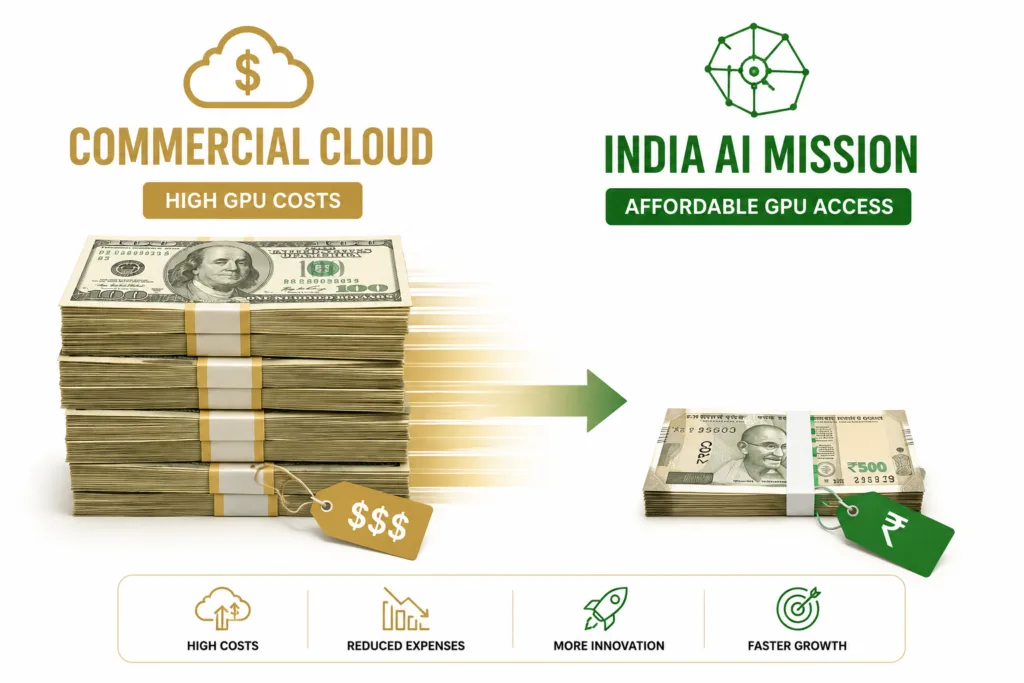
While most aspiring AI founders default to AWS, Google Cloud, or Azure — paying $2.50 to $4.00 per GPU-hour — the IndiaAI Mission offers subsidised access at rates as low as ₹65 to ₹150 per GPU-hour, with eligible projects receiving up to an additional 40% subsidy bringing effective costs below ₹100 per hour. For context, that is roughly a 70% cost reduction compared to what founders building in San Francisco routinely pay.
This article breaks down the five most powerful, practical ways the IndiaAI Mission can save your startup thousands of dollars — and exactly how to access each one.
“The IndiaAI Mission is not a future promise. The compute is live, the savings are real, and applications are open today.”
IndiaAI Mission Way 1 — Subsidised GPU Compute at One-Third of Commercial Cloud Rates
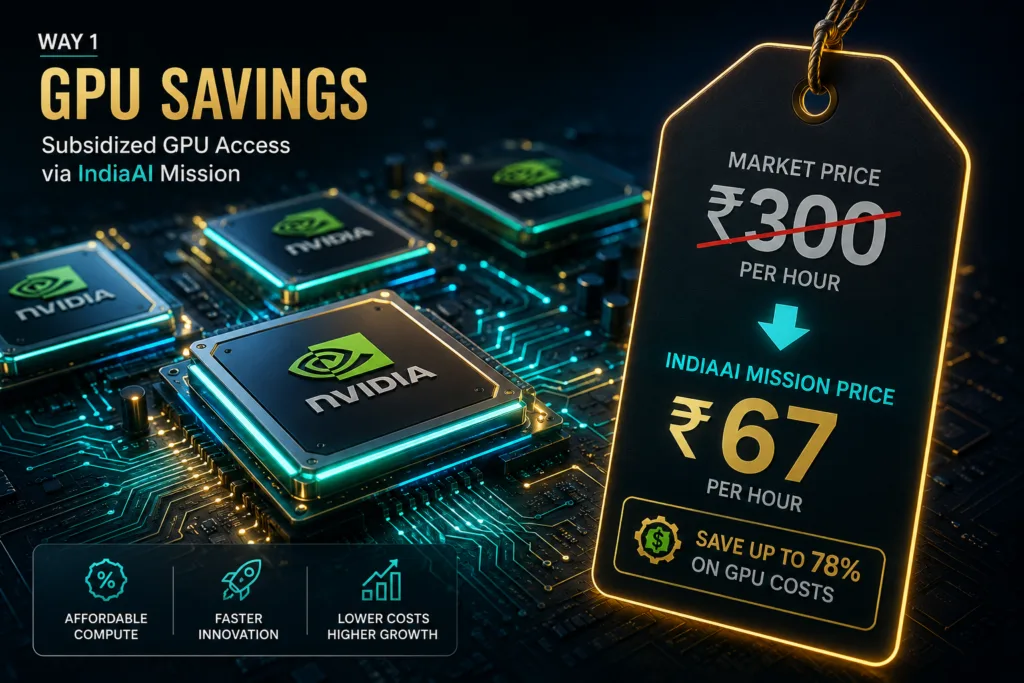
The core benefit of the IndiaAI Mission is straightforward and dramatic: access to high-end NVIDIA H100 and H200 GPUs, plus Google Trillium TPUs, at subsidised hourly rates. According to government pricing data, low-end GPU access starts at ₹115.85 per hour and high-end GPU access at ₹150 per hour — roughly 42% below standard market pricing even before additional subsidies.
For eligible founders — including DPIIT-registered startups, researchers, and MSMEs — government subsidies covering up to 40% of compute costs bring effective rates under ₹100 per GPU-hour, and IT Minister Ashwini Vaishnaw has publicly cited a rate as low as ₹67 per GPU-hour for the most subsidised tier. Compare that to the ₹210–₹335 per hour that commercial cloud providers like AWS and Azure charge for equivalent H100 access, and the IndiaAI Mission savings become impossible to ignore for any compute-intensive AI startup.
- A startup training a model that would cost ₹1,00,000 on commercial cloud could pay as little as ₹60,000 through the IndiaAI Mission
- Long training runs compound these savings into lakhs of rupees over a single product development cycle
- 38,000+ GPUs are already deployed, with the government targeting 100,000 GPUs by the end of 2026
“Every rupee an Indian founder saves on GPU compute through the IndiaAI Mission is a rupee that extends their startup’s runway.”
IndiaAI Mission Way 2 — Priority Subsidies for Projects of National Importance
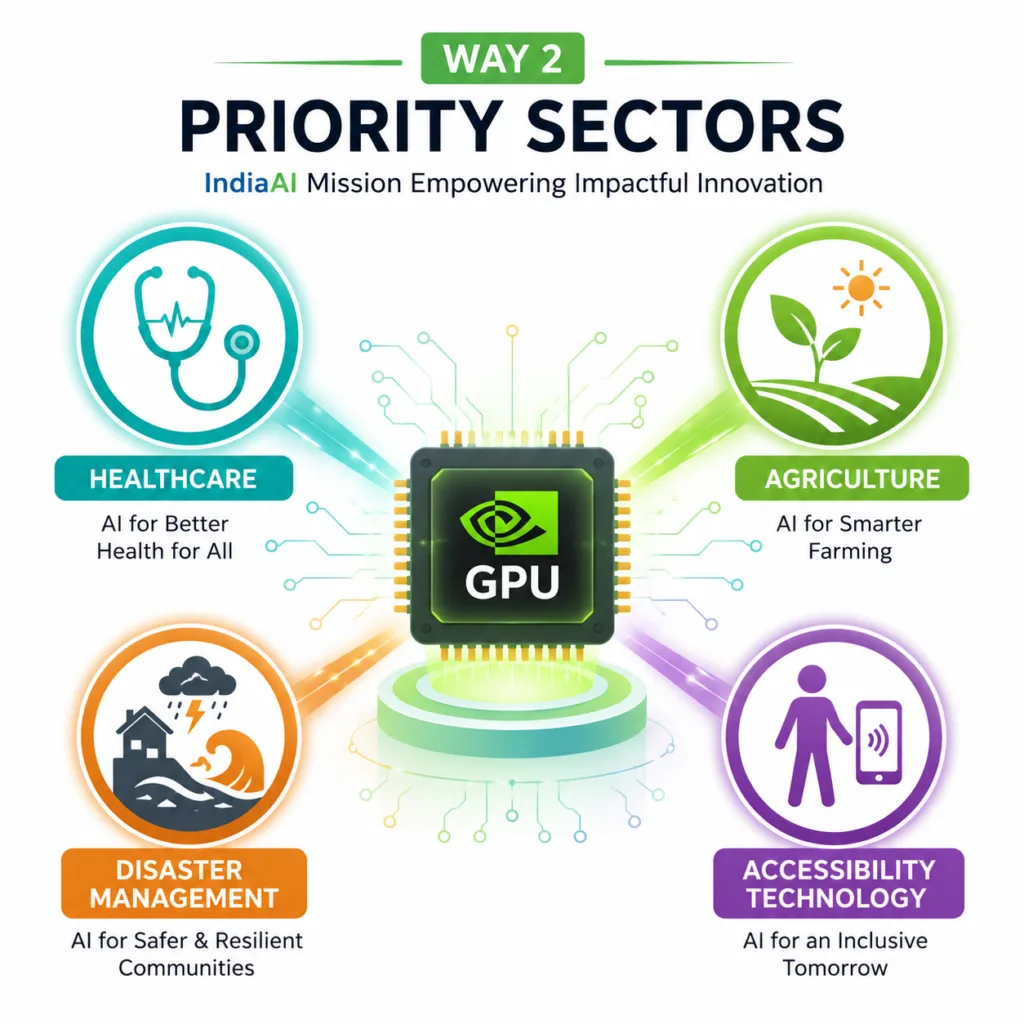
Not every applicant receives the same level of subsidy under the IndiaAI Mission. A government-appointed Project Management Evaluation Committee assesses applications, and projects deemed of “national importance” — spanning healthcare, agriculture, climate, governance, and assistive technologies — receive priority access to the maximum 40% subsidy tier.
For an Indian founder building in one of these priority sectors, the IndiaAI Mission is not just a generic compute discount — it is a targeted, founder-friendly incentive structure designed specifically to reward startups solving problems the government has identified as strategically valuable. If your startup idea touches healthcare diagnostics, agricultural yield optimisation, disaster response, or accessibility technology, your IndiaAI Mission application carries meaningfully stronger odds of receiving maximum compute subsidies.
Sectors the IndiaAI Mission Prioritises for Maximum Subsidy
- Healthcare AI: diagnostic tools, patient triage systems, and medical imaging analysis
- Agritech AI: crop yield prediction, pest detection, and irrigation optimisation
- Disaster management AI: early warning systems and emergency response coordination
- Assistive technology AI: tools supporting learning disabilities and accessibility needs
“The IndiaAI Mission rewards founders who build for national impact with the deepest compute subsidies available.”
IndiaAI Mission Way 3 — Free Access to AIKosh, India’s Government Dataset Platform

GPU compute alone is not enough to build a serious AI product — you also need quality training data. The IndiaAI Mission addresses this through AIKosh, India’s unified AI dataset platform, which currently hosts over 890 datasets, 208 pre-trained AI models, and 13+ development toolkits — all freely accessible to registered founders.
For a startup that would otherwise need to spend significant time and money sourcing, cleaning, and licensing training data, AIKosh represents another substantial layer of IndiaAI Mission savings that compounds on top of the direct GPU compute subsidy. According to official government clarifications, there are no current plans to monetise this dataset platform, meaning Indian founders have free, ongoing access to a continuously expanding data resource.
“The IndiaAI Mission does not just subsidise your compute. It removes one of your startup’s biggest hidden costs entirely: data.”
IndiaAI Mission Way 4 — Sovereign LLM Access Through Sarvam AI Reduces Your API Costs
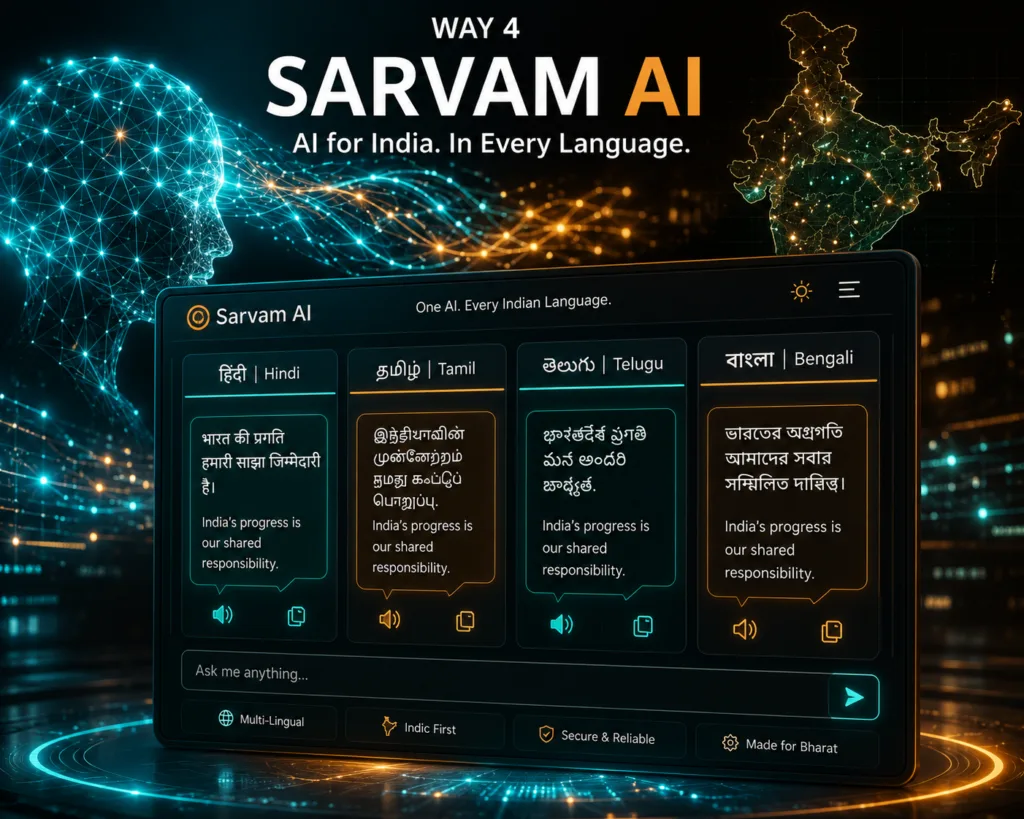
One of the most underappreciated savings under the IndiaAI Mission comes from Sarvam AI, the first startup selected under the programme to build India’s sovereign large language models. In February 2026, Sarvam launched two open-source models — Sarvam-30B and Sarvam-105B — the latter supporting a 128,000-token context window and over 10 Indian languages.
For founders building Indian-language AI products, using Sarvam’s open-source models instead of defaulting to expensive proprietary APIs like GPT-4 or Gemini represents another significant IndiaAI Mission-driven cost reduction. Open-source, India-trained models eliminate ongoing per-token API fees that can quickly accumulate into thousands of dollars per month for any startup operating at scale.
You can read more about Sarvam’s model releases directly on the IndiaAI Mission Compute Capacity page before applying for your own startup’s compute access.
“The IndiaAI Mission gives Indian founders a sovereign alternative to expensive foreign AI APIs — built specifically for Indian languages and use cases.”
IndiaAI Mission Way 5 — Tier 2 and Tier 3 City Infrastructure Lowers Your Total Operating Costs
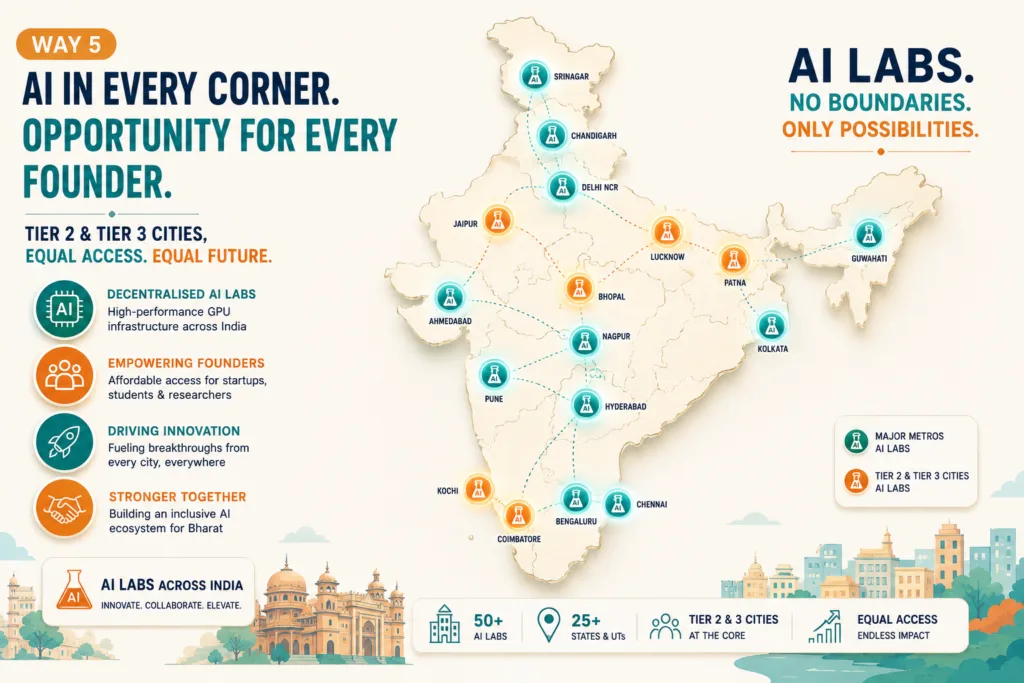
Beyond compute and data, the IndiaAI Mission includes “IndiaAI FutureSkills,” a programme establishing dedicated Data and AI labs in Tier 2 and Tier 3 cities across India. For founders building outside Bengaluru, Mumbai, or Delhi-NCR, this means access to local AI infrastructure, training resources, and a growing pool of AI-skilled talent without the inflated operating costs of India’s most expensive startup hubs.
Combined with the direct compute subsidies, the IndiaAI Mission effectively levels the geographic playing field — a founder building their AI startup from Jaipur, Kochi, or Coimbatore now has meaningfully similar access to subsidised compute, datasets, and emerging AI talent pools as a founder operating from a Tier-1 metro, while paying significantly less in office space, salaries, and overall cost of living.
“The IndiaAI Mission does not just subsidise GPUs. It is building the infrastructure that makes India’s smaller cities genuinely competitive startup hubs.”
How to Apply for IndiaAI Mission Compute Access
Accessing these IndiaAI Mission savings requires a structured but manageable application process:
- Register through Meri Pehchaan using DigiLocker, Parichay, or ePramaan credentials
- Submit a project proposal through the IndiaAI Mission portal outlining your technical approach and intended impact
- Specify your estimated compute requirements clearly to speed up evaluation
- Wait for assessment by the Project Management Evaluation Committee, which prioritises projects of national importance
- Access subsidised GPUs through one of 14 empanelled service providers once approved
The process involves more friction than instantly spinning up an AWS instance, but for any compute-intensive AI startup, the IndiaAI Mission‘s savings — often tens of thousands of rupees per training cycle — make the application well worth the time investment.
“A few weeks of IndiaAI Mission paperwork can save your startup months of runway. That is a trade every founder should take.”
Conclusion: The IndiaAI Mission Is More Than a Government Initiative—It’s India’s Startup Superpower
For decades, one of the biggest barriers preventing ambitious founders from building world-class AI startups wasn’t talent or ideas—it was infrastructure. Training advanced AI models required access to expensive GPUs, cloud computing credits, high-performance data centers, and enormous capital. While startups in Silicon Valley could raise millions to purchase computing resources, most Indian founders were forced to compromise, delay innovation, or abandon ambitious AI projects altogether.
Today, that reality is changing.
The IndiaAI Mission represents one of the most significant shifts in India’s technology ecosystem. Rather than simply funding research or announcing policy reforms, the mission directly tackles one of the largest operational costs faced by modern AI companies: GPU computing expenses.
Whether you’re building an AI SaaS platform, a healthcare diagnostic model, a legal AI assistant, an agritech solution, or an enterprise automation startup, access to affordable computing can determine whether your company grows rapidly or struggles to survive.
As we’ve explored throughout this article, there are multiple ways founders can dramatically reduce their infrastructure costs through:
- Subsidized GPU access
- Government-supported AI compute infrastructure
- Affordable cloud computing
- Startup-focused AI ecosystem support
- Open datasets and AI innovation programs
These initiatives collectively reduce one of the biggest financial burdens for early-stage companies.
“The future belongs to founders who spend money building products—not renting GPUs.”
That single idea perfectly captures why the IndiaAI Mission is so important.
Why Lower GPU Costs Can Completely Change a Startup’s Future

Every rupee saved on infrastructure is another rupee that can be invested into:
- Hiring better engineers
- Improving customer acquisition
- Building superior AI products
- Marketing and growth
- Research and development
- Scaling faster than competitors
Instead of burning through investor capital on cloud bills, startups can redirect those savings toward activities that actually generate revenue.
For bootstrapped founders, this advantage becomes even more significant.
Many promising startups fail—not because the founders lacked talent—but because they ran out of money before achieving product-market fit. High GPU costs have historically accelerated this problem.
By lowering infrastructure expenses, the IndiaAI Mission effectively extends a startup’s financial runway, giving founders more time to experiment, iterate, and build products that customers truly need.
This shift could dramatically increase the survival rate of Indian AI startups over the next decade.
The Biggest Opportunity Isn’t Saving Money—It’s Building Bigger
Although cost savings are important, they’re only part of the story.
The real advantage lies in unlocking innovation.
When computing becomes affordable, founders stop asking:
“Can we afford to train this model?”
Instead, they begin asking:
“How can we build the best AI product possible?”
That psychological shift changes everything.
Innovation accelerates when experimentation becomes inexpensive.
Teams can train multiple model versions.
Developers can fine-tune open-source LLMs.
Researchers can test larger datasets.
Products improve faster.
Customers receive better experiences.
This is exactly how mature AI ecosystems develop.
India Is Entering Its AI Startup Era
India has already demonstrated its ability to build globally competitive technology companies.
From fintech and edtech to SaaS and e-commerce, Indian startups have repeatedly shown that they can compete on the global stage.
Artificial Intelligence represents the next major wave.
With the government’s investment in AI infrastructure, semiconductor initiatives, public datasets, and startup support, India is positioning itself to become one of the world’s largest AI innovation hubs.
This creates unprecedented opportunities for:
- Student founders
- First-time entrepreneurs
- Bootstrapped startups
- Deep-tech companies
- Enterprise AI builders
- Small development teams
- Independent AI researchers
Unlike previous technology revolutions, AI no longer belongs exclusively to billion-dollar companies.
It is becoming accessible to anyone with a great idea and the willingness to execute.
Founders Who Act Early Will Benefit the Most
Government initiatives often reward early adopters.
Founders who begin exploring the IndiaAI Mission today are more likely to benefit from:
- Limited GPU allocations
- Pilot programs
- Research collaborations
- Startup grants
- Academic partnerships
- Cloud infrastructure support
- Networking opportunities
Waiting until AI infrastructure becomes mainstream may mean facing significantly greater competition for these resources.
Early movers generally build stronger products, establish market leadership faster, and attract investors more easily.
As the AI startup ecosystem matures, founders who began experimenting today may become tomorrow’s market leaders.
AI Infrastructure Is Becoming a Competitive Advantage
Over the next few years, startup success won’t depend solely on coding skills or fundraising ability.
Instead, founders who know how to access affordable AI infrastructure will possess a major competitive advantage.
Understanding government programs, cloud credits, compute subsidies, and AI partnerships may become just as valuable as understanding machine learning itself.
The smartest founders won’t necessarily spend the most money.
They’ll simply use available resources more efficiently.
“In the AI economy, efficiency is often a stronger competitive advantage than funding.”
That philosophy perfectly reflects the purpose behind the IndiaAI Mission.
What Should Startup Founders Do Next?
If you’re serious about building an AI startup, don’t wait until infrastructure becomes a bottleneck.
Start preparing now.
Consider taking these practical steps:
- Study the IndiaAI Mission and its latest initiatives.
- Identify where GPU costs impact your current development process.
- Explore government-supported compute resources before purchasing expensive cloud infrastructure.
- Build MVPs using subsidized AI infrastructure whenever possible.
- Stay updated on new grants, accelerator programs, and AI ecosystem announcements.
- Collaborate with universities, incubators, and innovation hubs participating in AI initiatives.
- Invest the money you save into improving your product, team, and customer acquisition strategy.
The founders who combine technical expertise with smart resource management will be best positioned for long-term success.
You must know these topics which are so important before you start a start up:
- Building AI App at 23-Year-Old making insane dollars Without Coding
- 7 Shocking Signs Traditional Software Is Dying Faster Than Anyone Expected
- 9 Explosive India AI Startup Trends Creating Young Millionaire Founders in 2026
- 10 Powerful AI Startup Tools Replacing Entire 10-Person Teams for Under $300/Month.
- 7 Powerful AI Start up Trends Making Non-Coders Millions Through Vibe Coding in 2026
- 6 Shocking Startup Secrets Behind the $401M Telehealth Company Built by One Person
- 7 Shocking AI Startup Trends Creating One-Person Billion-Dollar Companies in 2026
- Top 5 Shocking Misapprehensions Founders Make When Raising Capital
- Founder Reality Check:6 Brutal Start up Funding Myths Every Founder Must Stop Believing
- Why Start ups Fail to Get Funding from Investors: 28 Hard Truths No One Tells You
- Start up Fundability Explained: 7 Powerful Readiness Signals Founders Must Get Right
- Start up Non-Dilutive & Alternative Funding: 7 Powerful Ways to Raise Capital Without Equity
- Angel Funding and Early-Stage Capital: 5 Core Principles That Shape Start up Growth
- Start Up Funding: 10 Proven Strategies for Massive Growth
- Start Up Success: 7 Powerful Pitch Deck Storytelling Secrets That Win Investors
- From Classroom to Capital: The Ultimate Funding Guide for Student & First-Time Founders
- Founder Guide: 5 Powerful Funding Trends Every Start up Must Know
Final Thoughts
The IndiaAI Mission is far more than a government policy—it is a strategic investment in the future of Indian innovation. By making GPU computing, AI infrastructure, and advanced resources more affordable, it lowers one of the greatest barriers that has historically prevented startups from competing on a global scale.
For entrepreneurs, this means the conversation is no longer limited to “Can we afford to build an AI startup?” Instead, it becomes “How fast can we build, iterate, and scale?” That change in mindset is transformative. Lower infrastructure costs give founders the freedom to experiment, refine their products, and pursue bold ideas without exhausting their budgets on compute alone.
The startups that thrive over the coming decade will be those that recognize this opportunity early. They will leverage government-backed AI resources, invest savings into innovation, and focus relentlessly on solving real-world problems. As AI adoption accelerates across industries, founders who act today will be better positioned to lead tomorrow’s markets.
“The next generation of billion-dollar Indian AI startups won’t just be built with brilliant ideas—they’ll be built by founders who know how to make every GPU hour, every rupee, and every opportunity count.”
If you’re planning to launch an AI startup in India, now is the time to explore what the IndiaAI Mission has to offer. The support is growing, the infrastructure is expanding, and the ecosystem is becoming more founder-friendly than ever before. Those who embrace these opportunities today won’t just save thousands on GPU costs—they’ll gain the momentum needed to build products that can compete on a global stage.
FAQ
What exactly is the IndiaAI Mission?
The IndiaAI Mission is a Rs 10,371.92 crore (~$1.25 billion) Indian government initiative launched in March 2024 to build sovereign AI infrastructure, including subsidised GPU compute, the AIKosh dataset platform, startup financing support, and AI skilling programmes for Indian founders, researchers, and institutions.
How much can a startup actually save using the IndiaAI Mission?
IndiaAI Mission GPU rates range from roughly ₹65 to ₹150 per hour compared to ₹210–₹335 per hour on commercial clouds like AWS and Azure — a savings of up to 70%. Eligible projects can receive up to 40% additional subsidy, bringing some training runs to nearly half their original cost.
Who is eligible to apply for IndiaAI Mission compute access?
Eligible applicants under the IndiaAI Mission include DPIIT-registered startups, MSMEs, researchers, academic institutions, IndiaAI fellowship awardees, and government entities. Applications are submitted through the official IndiaAI compute portal using Meri Pehchaan credentials.
Does the IndiaAI Mission only help with GPU costs?
No. Beyond GPU compute subsidies, the IndiaAI Mission provides free access to AIKosh’s 890+ datasets and 208 AI models, sovereign LLM access through Sarvam AI’s open-source models, and dedicated AI infrastructure in Tier 2 and Tier 3 cities — all reducing different categories of startup costs.
How long does the IndiaAI Mission application process take?
The IndiaAI Mission application process involves registration, a project proposal submission, and evaluation by a Project Management Evaluation Committee. While not instant like commercial cloud sign-up, most founders report the process is manageable within a few weeks, especially for projects aligned with priority national sectors.