
By FundingsStartup Editorial Team | May 2026 | 11 min read
He Had Never Written a Single Line of Code. Then He Built a $2M AI App
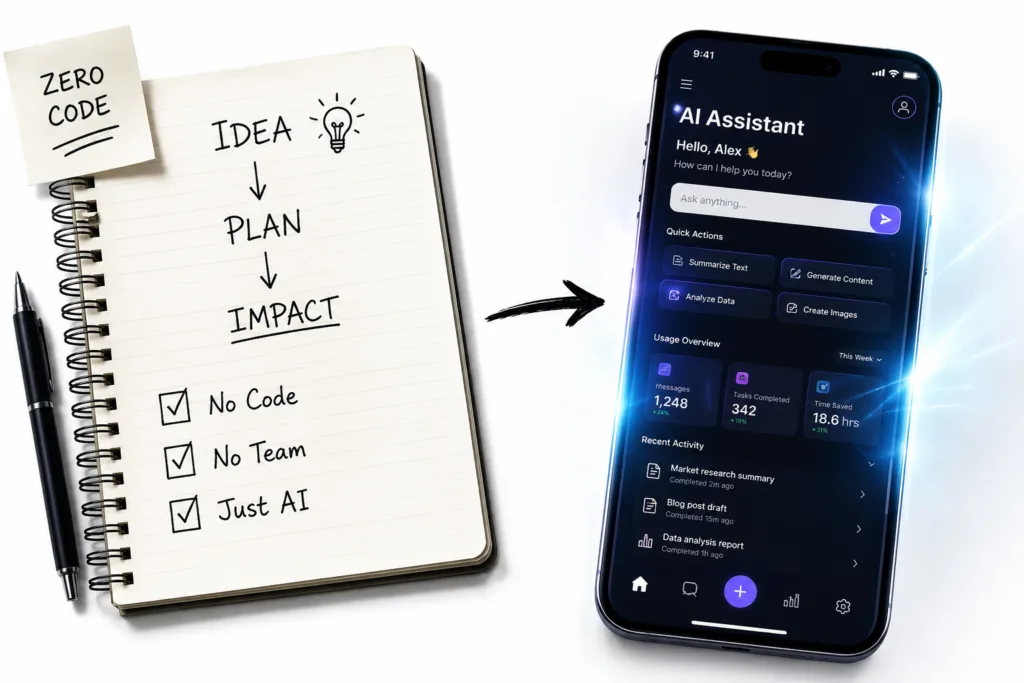
There is a story circulating through startup communities right now that perfectly captures what has changed in 2026: a 23-year-old founder with zero programming background took screenshots of a competitor’s product, described his improvements in plain English, and used AI tools to build an AI app that now generates approximately $2 million in annual recurring revenue. He never opened a textbook on software engineering. He never took a computer science class. He simply described what he wanted, and the AI built it.
This is not an isolated miracle. It is part of a documented, accelerating pattern. Take George Lampropolis, an 18-year-old college freshman who, using a lean stack of AI tools, built Wrestle AI — a video analysis AI app for wrestlers — and reached $17,000 per month within his first 30 days. Or consider the case of “David,” a non-technical founder who built an AI app called formulate bot that now generates roughly $226,000 per month from 5,000 paying subscribers — built entirely through self-taught, no-code methods learned primarily on YouTube.
This article tells the story behind this new category of founder, explains exactly how a non-technical person builds a profitable AI app in 2026, and gives you the precise playbook to follow if you want to do the same.
“Your AI app does not need a developer. It needs a clear idea and the discipline to describe it precisely.”
How a Non-Coder Builds a Production-Grade AI App in 2026
The technical revolution behind these stories is called vibe coding — describing what you want an AI app to do in plain English and letting AI tools generate, test, and deploy the actual code. In 2023, AI-generated code was unreliable and required heavy correction. By 2026, tools like Cursor, Claude Code, Lovable, and Bolt.new produce production-grade code that can be shipped directly to real customers.
The founder behind this $2M AI app began with nothing more than screenshots of an existing competitor product. He described, feature by feature, what he wanted his version to look like and do differently. Within hours, he had a working prototype. Within a week, he had his first paying customer. This compressed AI app development cycle — from idea to revenue in days rather than months — is the single biggest shift in startup history for non-technical builders.
“The execution bottleneck that once blocked every non-coder from building an AI app is gone in 2026.”
Step One — He Found a Real Problem Before Touching Any AI Tool
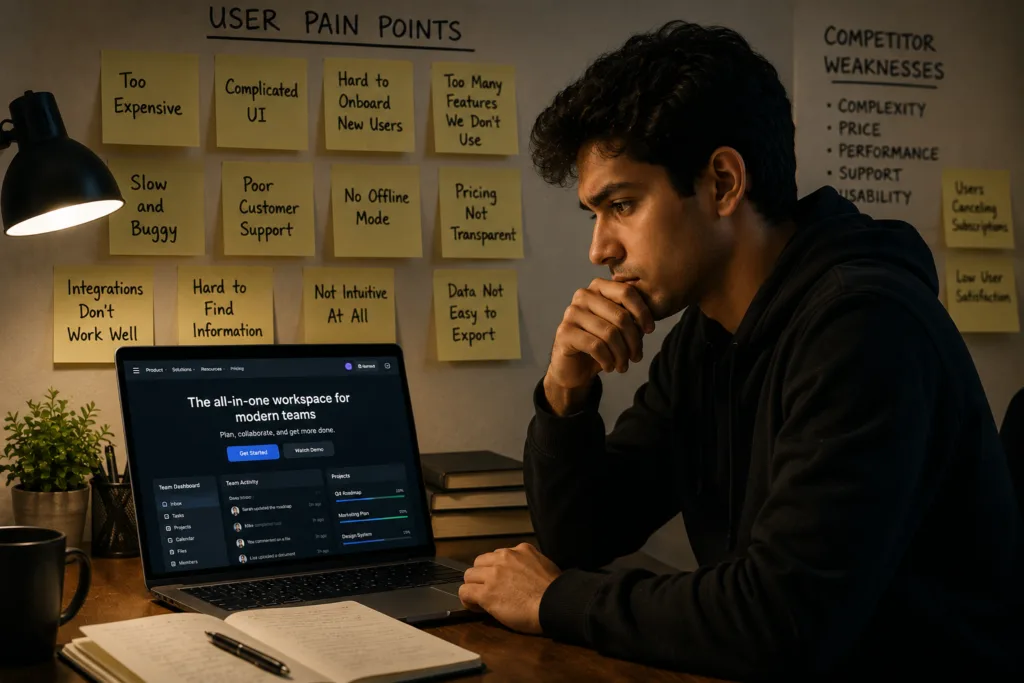
Before writing a single prompt, the founder spent weeks studying an existing product category where users were visibly frustrated. He did not chase a novel AI app idea nobody had heard of — he chose a category with proven demand and built a noticeably better AI app experience inside it.
This mirrors exactly what worked for George Lampropolis with Wrestle AI: he built his AI app inside the wrestling niche, a community he personally understood, rather than guessing at a generic mass-market idea. The lesson for any aspiring AI app builder is identical — pick a problem you understand intimately, not a trend you read about online.
“The best AI app idea is not the most original one. It is the one built by someone who deeply understands the customer’s pain.”
Step Two — He Used the 2026 Vibe Coding Stack to Build Without Code
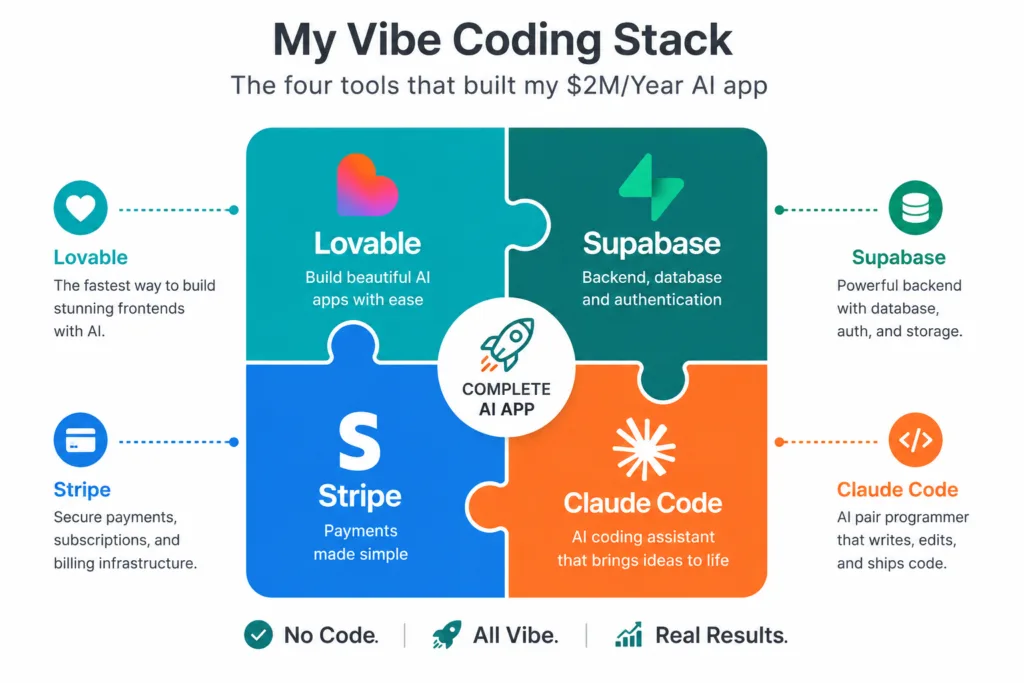
The technical foundation of his AI app relied on a now-standard toolkit available to any aspiring non-technical founder in 2026:
- Lovable or Bolt.new: for generating the full-stack frontend of the AI app from natural language descriptions
- Supabase: for handling the AI app’s backend, database, and user authentication, starting around $30/month
- Stripe: for processing payments inside the AI app with a simple, AI-assisted integration
- Claude Code or Cursor: for fixing bugs and refining AI app functionality through plain-English prompts
Crucially, even the most successful non-technical AI app founders are honest that vibe coding gets you roughly 90% of the way to a finished product. For the final, more delicate pieces — like complex payment logic — many founders pay a freelance developer a modest fee to finish the remaining details. George Lampropolis paid roughly $250 on Fiverr to finalise his AI app‘s paywall setup, proving that even minimal outside help keeps total costs extraordinarily low.
“Vibe coding gets your AI app 90% finished. The last 10% costs a few hundred dollars, not a few hundred thousand.”
Step Three — When the AI App Broke, He Used AI as His Technical Advisor
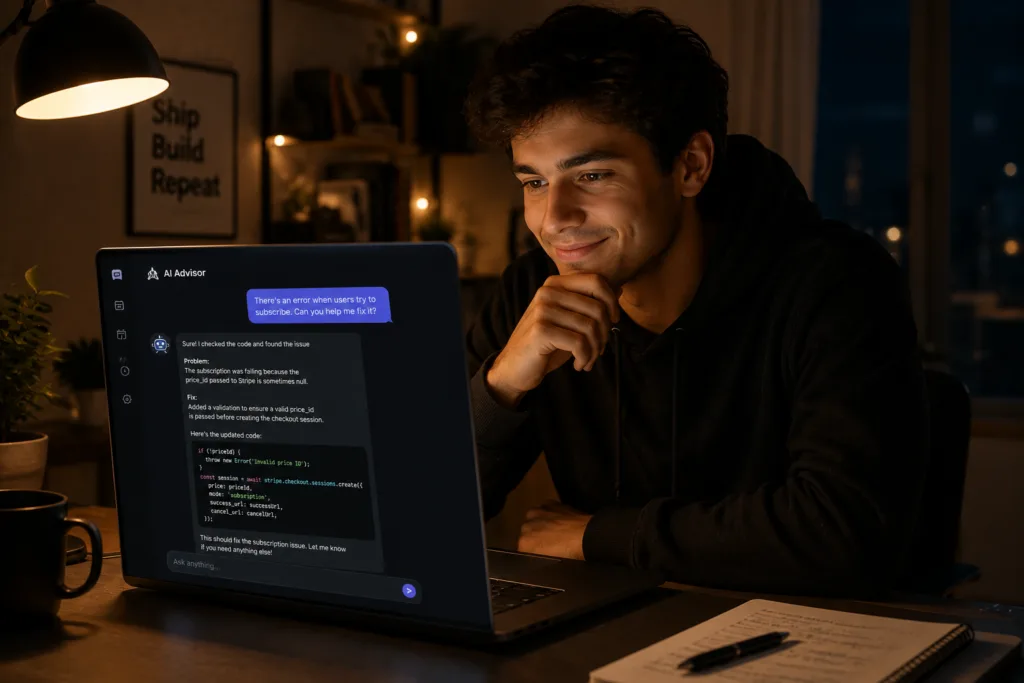
Every AI app encounters bugs, API errors, and unexpected behaviour during development — that part of building software has not changed. What has changed is how a non-technical founder solves those problems. Instead of hiring a developer for every error, founders building an AI app in 2026 copy the full error log directly into an AI assistant and ask for a beginner-friendly explanation and fix.
This iterative loop — error appears, AI explains it, AI fixes it, founder tests again — allows a complete non-coder to resolve technical issues that would have required a computer science degree just a few years ago. As one vibe coding founder put it, AI is the great equalizer of education: if you are relentless and specific in how you prompt, there is no bug in your AI app you cannot eventually fix.
“Your AI app’s biggest technical advisor in 2026 does not charge a salary. It answers in seconds, any hour of the day.”
Step Four — He Launched Before the AI App Was Perfect
Perhaps the most important lesson from every successful non-coder AI app story is speed of launch. The $2M founder did not spend six months refining his AI app in private before showing anyone. He had a working prototype in front of real users within days, collected feedback immediately, and iterated in public.
This same urgency defined Wrestle AI’s rise: George built his AI app on a strict 30-day timeline, refusing to let perfectionism delay the launch. The discipline of shipping an imperfect AI app quickly and improving it based on real user feedback consistently outperforms the instinct to polish a product no customer has ever touched.
“An AI app in a customer’s hands today beats a perfect AI app still being built six months from now.”
Step Five — Distribution Made the AI App a Business, Not Just a Product

Building the AI app itself was only half the work. George Lampropolis reached over 2 million impressions for Wrestle AI by partnering with a co-founder who already had a substantial following inside the wrestling niche — strategic influencer marketing rather than generic paid advertising. The formulate bot founder, “David,” relied heavily on viral organic growth through demonstration videos posted to social platforms, attracting hundreds of thousands of users within days of launch.
The shared lesson across every successful AI app founder story is that distribution strategy matters as much as the product itself. An AI app with brilliant functionality and zero distribution earns nothing. An AI app with modest functionality and a sharp distribution plan can reach six and seven figures in annual revenue.
For founders studying these patterns, CNBC’s coverage of vibe-coding success stories confirms that even technical founders are now choosing AI-native, vibe-coded approaches over traditional engineering teams because of how dramatically they accelerate time to revenue.
“Your AI app needs two things to succeed: a real solution and a real audience that hears about it.”
What Every Aspiring Builder Should Take From This AI App Story
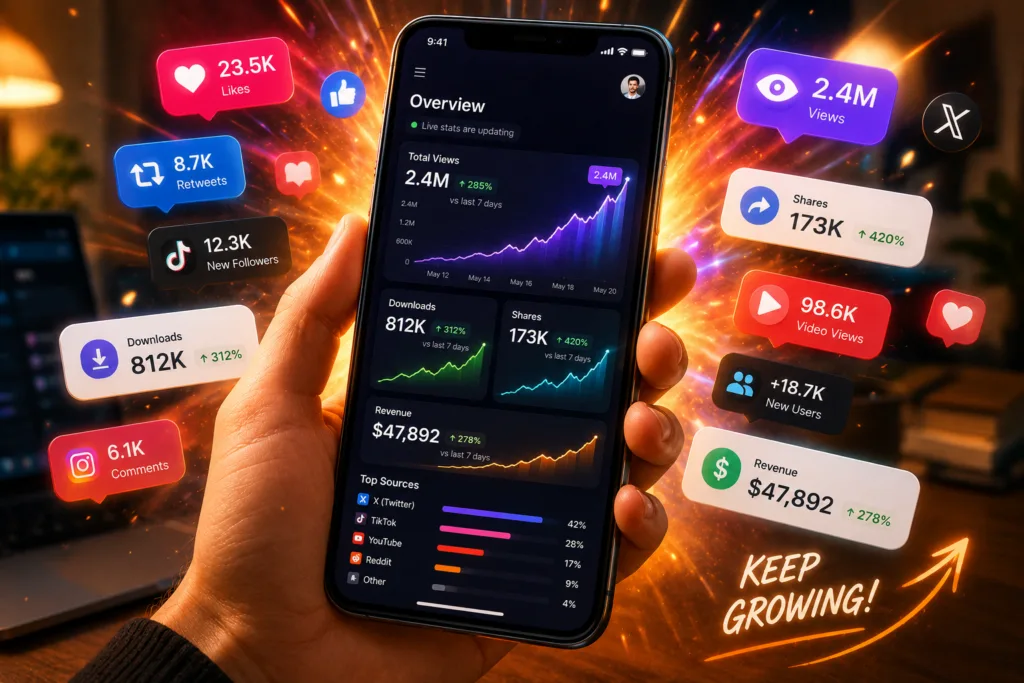
The story of a 23-year-old building a $2 million AI app without writing code is not an outlier anymore — it is a documented, repeatable pattern. The barriers that once made software development the exclusive domain of trained engineers have been dismantled by AI tools that anyone willing to learn can use.
- Pick a problem you understand personally, not a trend you read about
- Use Lovable, Bolt.new, or Cursor to build your AI app’s first version this week, not next year
- Use AI itself as your technical advisor when your AI app breaks
- Launch your imperfect AI app fast and let real users guide your next iteration
- Plan your AI app’s distribution strategy with the same seriousness as the product itself
The only thing separating you from your own $2M AI app story in 2026 is the decision to start building this week.
“Every non-coder AI app success story in 2026 started the same way: with someone who simply began.”
Your startup does not need more planning. It needs a launch date.
You must know these topics which are so important before you start a start up:
- 7 Shocking Signs Traditional Software Is Dying Faster Than Anyone Expected
- 9 Explosive India AI Startup Trends Creating Young Millionaire Founders in 2026
- 10 Powerful AI Startup Tools Replacing Entire 10-Person Teams for Under $300/Month.
- 7 Powerful AI Start up Trends Making Non-Coders Millions Through Vibe Coding in 2026
- 6 Shocking Startup Secrets Behind the $401M Telehealth Company Built by One Person
- 7 Shocking AI Startup Trends Creating One-Person Billion-Dollar Companies in 2026
- Top 5 Shocking Misapprehensions Founders Make When Raising Capital
- Founder Reality Check:6 Brutal Start up Funding Myths Every Founder Must Stop Believing
- Why Start ups Fail to Get Funding from Investors: 28 Hard Truths No One Tells You
- Start up Fundability Explained: 7 Powerful Readiness Signals Founders Must Get Right
- Start up Non-Dilutive & Alternative Funding: 7 Powerful Ways to Raise Capital Without Equity
- Angel Funding and Early-Stage Capital: 5 Core Principles That Shape Start up Growth
- Start Up Funding: 10 Proven Strategies for Massive Growth
- Start Up Success: 7 Powerful Pitch Deck Storytelling Secrets That Win Investors
- From Classroom to Capital: The Ultimate Funding Guide for Student & First-Time Founders
- Founder Guide: 5 Powerful Funding Trends Every Start up Must Know
Conclusion: The Age of Builders Has Only Just Begun

The story of a 23-year-old building a $2 million-per-year AI business without writing code is far more than an inspiring startup success. It represents a fundamental shift in how businesses are created, how innovation happens, and who gets the opportunity to become an entrepreneur.
For decades, launching a successful software company required years of programming experience, large engineering teams, significant funding, and expensive infrastructure. Today, AI-powered no-code tools have dramatically lowered those barriers, allowing determined individuals to transform ideas into real businesses faster than ever before.
But this story is not really about AI.
It’s about courage, curiosity, and the willingness to solve real problems.
Technology Is the Tool—Vision Is the Advantage
Many people believe that success comes from mastering every programming language or understanding every technical framework. While technical expertise remains valuable, today’s startup ecosystem proves that the ability to identify a genuine problem is often more important than the ability to write every line of code yourself.
AI can generate code.
AI can automate workflows.
AI can accelerate product development.
What AI cannot replace is human creativity, critical thinking, customer empathy, and the determination to keep improving when challenges arise.
The entrepreneurs who succeed in this new era won’t necessarily be the best programmers. They’ll be the people who understand customers deeply and build solutions that genuinely improve lives.
The Opportunity Has Never Been More Accessible
One of the most exciting aspects of the AI revolution is that innovation is no longer limited to Silicon Valley or billion-dollar corporations.
Students, freelancers, creators, designers, marketers, and professionals from every industry now have access to tools that were unimaginable just a few years ago.
A laptop, an internet connection, and a clear vision can be enough to validate an idea, build a product, reach customers, and generate revenue.
That doesn’t mean success is guaranteed.
Building a sustainable business still requires discipline, continuous learning, customer feedback, and relentless execution.
However, the biggest obstacle today is often mindset, not technology.
Success Isn’t Measured by Code Written
It’s easy to become distracted by revenue numbers like $2 million per year, but those figures are only the outcome of solving a meaningful problem exceptionally well.
Customers never pay because an app was built with traditional coding or no-code tools.
They pay because the product saves time, increases productivity, reduces costs, or improves their lives.
That’s the lesson every aspiring founder should remember.
Whether your product is built with AI, no-code platforms, or custom software, the true measure of success is the value you create for others.
Technology changes constantly.
Customer problems remain.
The founders who focus on solving those problems will always stay relevant.
The Future Belongs to Continuous Learners
AI is evolving at an incredible pace, and today’s tools will undoubtedly look very different in the next few years.
Instead of fearing that change, embrace it.
Learn how AI works.
Experiment with new platforms.
Develop communication skills.
Understand your industry deeply.
Most importantly, stay curious.
The entrepreneurs who thrive in the AI era won’t be the ones who know everything today. They’ll be the ones who never stop learning tomorrow.
Every technological revolution rewards people who adapt faster than everyone else.
This one will be no different.
A Final Thought
Perhaps the most inspiring part of this story isn’t the impressive revenue or the founder’s young age.
It’s the reminder that extraordinary opportunities often begin with ordinary people who decide to take the first step.
You don’t need to have every answer before you start.
You don’t need to be the world’s best programmer.
You don’t need permission to build something meaningful.
You simply need the willingness to learn, create, and keep moving forward even when success feels uncertain.
Because in the age of AI, the greatest competitive advantage isn’t code—it’s the courage to turn an idea into reality.
“The future won’t belong to those who know the most code. It will belong to those who solve the most meaningful problems with imagination, resilience, and the courage to begin.”
FAQ
Can someone with zero coding experience really build a profitable AI app?
Yes. Multiple documented cases — including an 18-year-old who built Wrestle AI to $17,000/month and a founder whose formulate bot AI app generates $226,000/month — prove that non-technical founders can build and scale a profitable AI app using vibe coding tools available in 2026.
What tools are best for building an AI app without coding?
The most effective AI app building stack in 2026 includes Lovable or Bolt.new for the frontend, Supabase for backend and database needs, Stripe for payments, and Claude Code or Cursor for fixing bugs and refining functionality — all usable through plain English prompts.
How long does it take to build an AI app using vibe coding?
A working AI app prototype can typically be built within days using vibe coding tools. George Lampropolis built Wrestle AI on a strict 30-day timeline from concept to a revenue-generating AI app, and several founders report having paying customers within their first week.
Does a non-coder need to hire a developer at all to launch an AI app?
Most founders report vibe coding gets an AI app roughly 90% finished without any coding help. For the remaining technical details, such as complex payment integrations, many founders hire an inexpensive freelance developer for a few hundred dollars rather than building a full technical team.
What is the most important factor in making an AI app profitable?
Distribution is just as critical as the AI app itself. The most successful non-coder AI app founders pair a working product with a clear distribution strategy — whether through niche influencer partnerships, organic social content, or word-of-mouth inside a community they already understand.
1 thought on “The Incredible Story of a 23-Year-Old Who Built a $2M/Year AI App Without Coding”
Comments are closed.