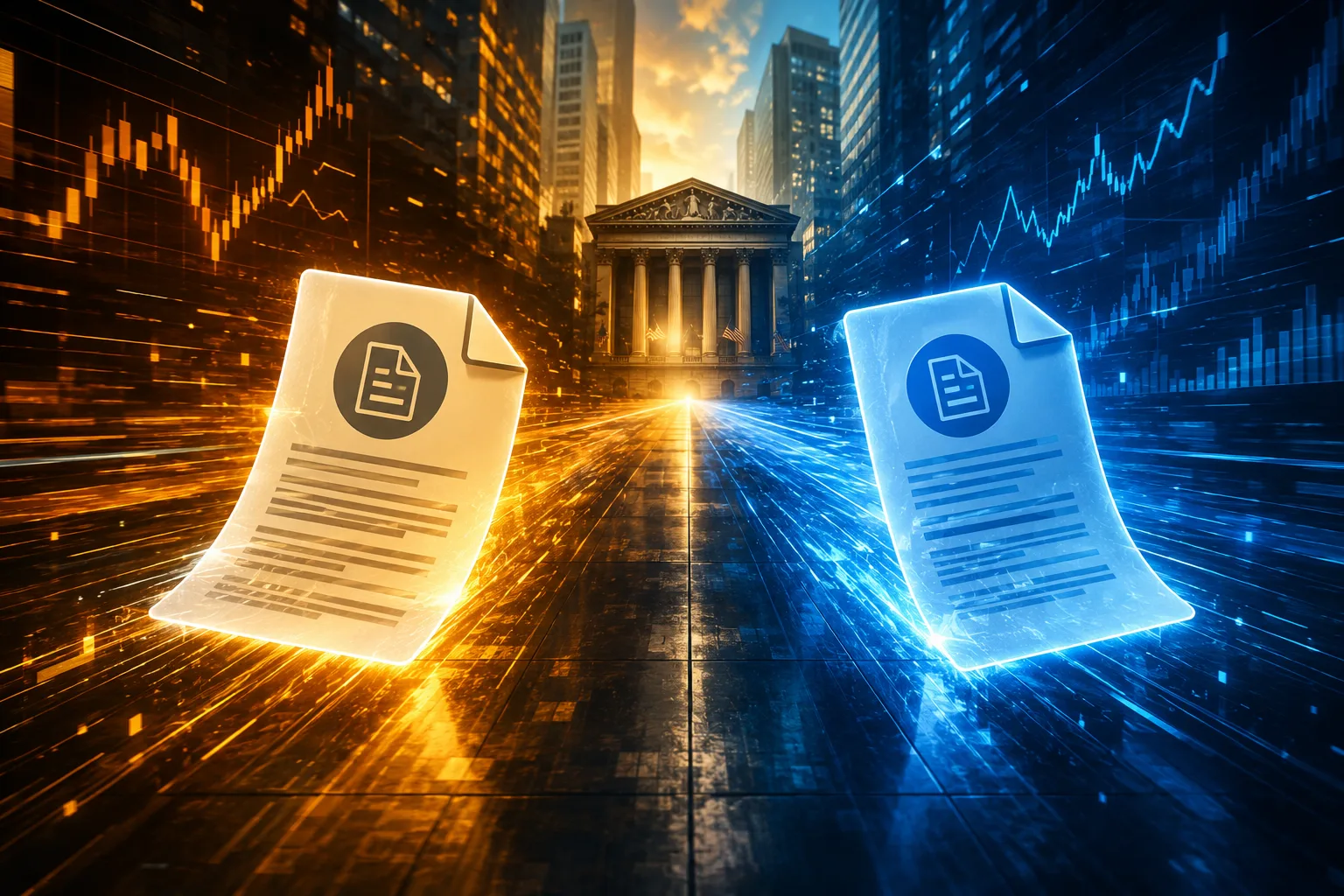
Two companies built the same technology, chased the same customers, and are now racing toward the same finish line — a public listing that could redefine what “startup” even means. But only one of them filed the paperwork first, and it wasn’t the one everyone expected.
Sometimes the underdog isn’t really an underdog — it just moved before anyone was watching.
The Filing Race No One Expected — Anthropic’s Surprise Head Start

On June 1, 2026, Anthropic confidentially filed its S-1 with the SEC — a full week ahead of OpenAI, which filed its own confidential paperwork on June 8. That single week of timing is now being read across Wall Street as a symbolic power shift in an industry that, eighteen months ago, treated OpenAI as the undisputed category leader.
A week doesn’t sound like much until it becomes the headline everyone remembers.
The filing came just four days after Anthropic closed a $65 billion Series H at a $965 billion valuation — the single largest private venture round in history, and enough to make Anthropic, for a moment, the most valuable private AI company on Earth. The banks steering the offering — Goldman Sachs, JPMorgan, and Morgan Stanley — began scheduling pre-IPO investor meetings in July, a step that typically precedes a formal roadshow by only a matter of weeks.
Momentum, once it starts compounding, tends to attract its own gravity.
The target date circled on every banker’s calendar is October 2026, on the Nasdaq. Prediction markets currently put the odds of an Anthropic listing by December 31, 2026 at roughly 76.5% — a number that would have sounded absurd for a company that was valued at just $61.5 billion in its Series E round barely fourteen months earlier.
Fourteen months is not long enough to build a track record — unless the growth curve does the talking for you.
AI Startup IPO Race 2026: Inside the Numbers That Are Reshaping Wall Street
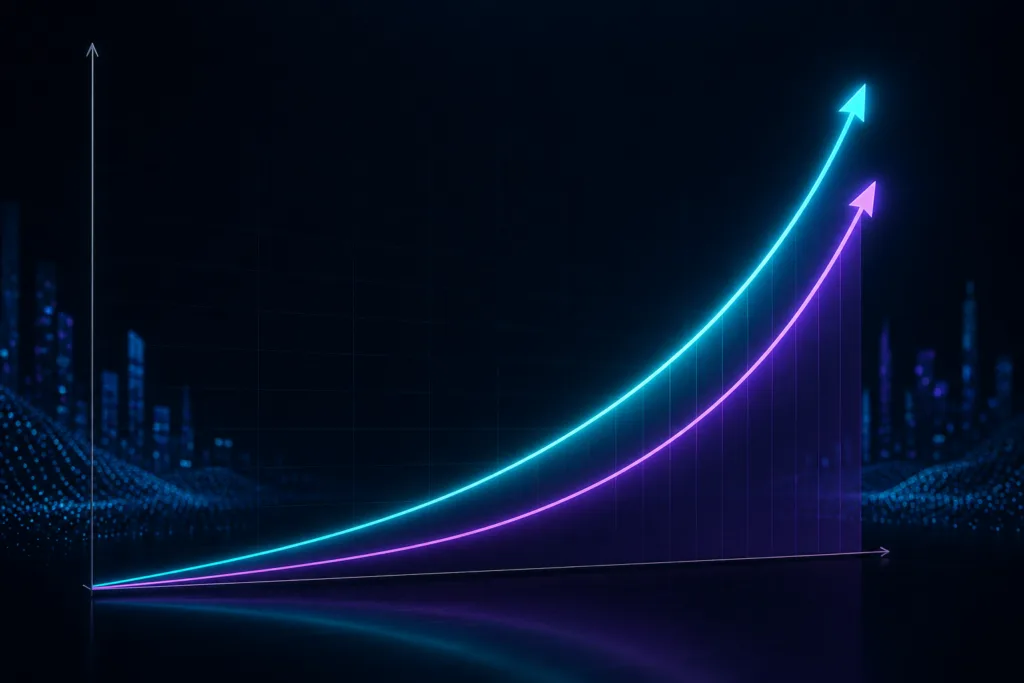
The number driving all of this is Anthropic’s annualized revenue run rate, which hit $47 billion in May 2026, up from roughly $1 billion in December 2024 — a 47x increase in seventeen months. For comparison, it took Salesforce two decades to reach $30 billion in annual revenue. Anthropic did it, from a standing start, in under three years.
Growth curves like that don’t just win deals — they rewrite what “fast” is even allowed to mean.
The most striking detail buried in the filings is the crossover point: in April 2026, Anthropic overtook OpenAI in annualized revenue, and by May 2026, its $965 billion valuation surpassed OpenAI’s $852 billion for the first time. Claude Code, the company’s coding assistant, has been singled out by investors as a major driver of that enterprise growth, alongside deep infrastructure commitments from Amazon and Google.
Being first to a milestone matters less than being first to the milestone everyone is watching for.
By August 2026, investor chatter had escalated even further — six Anthropic backers told the Financial Times they now expect the October IPO to land near $2 trillion, potentially reaching $3 trillion, which would make it larger than SpaceX’s record-breaking $75 billion debut just months earlier. That figure hinges on run-rate revenue reaching $100–120 billion by December 2026, more than double where it stood in May.
The gap between what a company earns today and what investors are pricing in for tomorrow is where every real risk hides.
It’s worth being precise here: “run rate” is a snapshot of current sales pace, not booked, audited revenue — and no senior Anthropic executive has confirmed a specific IPO valuation target even in private conversations, according to the same reporting. The $2 trillion number currently belongs to the market’s imagination, not to Anthropic’s own guidance.
Optimism is contagious in a boardroom long before it’s confirmed on a balance sheet.
Why Sam Altman Won’t Blink on $1 Trillion

OpenAI’s side of this story reads very differently. The company’s last private valuation stood between $730 billion and $852 billion after its March 2026 round, and reports say Sam Altman has told advisers that any IPO valuation below $1 trillion is a “non-starter.” Advisers reportedly laid out two paths — wait until 2027 to defend that number, or list sooner at a lower one — and Altman chose to wait.
Holding a line is easy in a memo and expensive in a market downturn.
The financial pressure behind that decision is real. OpenAI reported around $13 billion in 2025 revenue, but burned $3.7 billion in the first quarter of 2026 alone — more than half of that quarter’s $5.7 billion in revenue. Projected cash burn has since been revised upward to roughly $27 billion for 2026 and $63 billion for 2027 under its renegotiated Microsoft partnership.
A company can be the most famous name in its industry and still be the most fragile one on paper.
There’s also a governance wrinkle no other IPO of this size has ever carried: OpenAI’s nonprofit Foundation retains structural control even after a public listing, an arrangement public-market investors have essentially never priced before. Whether that becomes a discount for misaligned incentives or a premium for long-term stability is, in the words of one analyst, “genuinely untested.”
Untested structures make for fascinating case studies and nervous underwriters in equal measure.
The SoftBank Deadline Nobody’s Talking About

Here’s the detail most headlines skip entirely: SoftBank arranged a $40 billion unsecured bridge loan that matures in March 2027, taken out specifically to fund its expanded stake in OpenAI. That loan needs a liquidity event to be repaid comfortably — which means SoftBank has every incentive to want OpenAI’s IPO to happen sooner, even at a valuation lower than Altman’s trillion-dollar floor.
Debt has a way of setting deadlines that ambition would rather ignore.
This creates a genuine standoff inside OpenAI’s own cap table: Altman wants to wait for a stronger valuation story, while one of the company’s largest backers is racing against a repayment clock. Prediction markets reflect the uncertainty directly — Kalshi traders currently put roughly 59% odds on OpenAI formally announcing an IPO by March 2027, rising to 73% by June 2027.
When your own investors disagree on the timeline, the timeline stops being yours alone to set.
Bankers involved in both deals have reportedly told each company something blunt: the first frontier AI lab to actually go public gets to define the comparables, the metrics, and the multiple everyone else trades against. That single sentence may explain more about Anthropic’s urgency than any revenue chart.
Whoever writes the rulebook first rarely has to play by anyone else’s rules.
What Happens If Anthropic Wins the Race First

If Anthropic lists in October as planned, it would become the first pure-play AI company to trade publicly above a trillion-dollar valuation, months ahead of OpenAI. That “first mover” status carries real weight — it sets the valuation multiple, the disclosure standards, and the investor expectations that every AI IPO afterward, including OpenAI’s, will be measured against.
Being the reference point is its own kind of victory, independent of the final stock price.
There’s a cautionary parallel worth remembering, though: SpaceX’s own record IPO priced at roughly $1.77 trillion in June, closed its first day near $2.1 trillion, and had settled back to roughly $1.5 trillion by late July — a nearly 30% pullback once the market had time to digest the number against actual financials. If Anthropic follows a similar arc, the headline figure investors celebrate in October and the valuation that actually holds three months later could be two very different numbers.
The opening bell rings loudest exactly when the real test hasn’t started yet.
For context on scale: at $47 billion ARR, even a comparatively “modest” $1 trillion valuation would price Anthropic at roughly 21 times forward revenue — aggressive, but not unprecedented for enterprise software growing this fast. A $2 trillion print would essentially double that multiple, betting heavily on the leap to $100–120 billion in run-rate revenue actually materializing by year-end.
Multiples are just a polite way of asking how much faith you’re willing to pay for.
The Real Lesson for Founders Watching From the Sidelines

Strip away the trillion-dollar headlines, and there’s a genuinely useful lesson here for any founder building a company today, regardless of size: speed of filing became a strategic weapon. Anthropic didn’t necessarily have a stronger long-term story than OpenAI — it had a faster-moving one, and in a market this hungry for AI exposure, faster proved more valuable than bigger.
Momentum, once you have it, becomes an asset you can spend.
The second lesson is about valuation discipline versus valuation pride. Altman’s refusal to accept anything below $1 trillion is either visionary conviction or a costly miscalculation — the market won’t know which until 2027. Founders raising far smaller rounds face a smaller version of the exact same choice constantly: hold your price and risk losing the moment, or move at a lower number and risk leaving value on the table.
Every founder eventually has to decide what they’re actually optimizing for — the number, or the timing.
The third lesson is the quietest but maybe the most important: capital structure can trap even the most successful company. OpenAI’s SoftBank loan deadline is a reminder that how you raise money doesn’t just affect your cap table — it can eventually dictate your calendar, whether or not the business itself is ready.
The money you take today can end up writing your schedule two years from now.
Final Thought
Whoever crosses the public-market finish line first — Anthropic in October 2026 or OpenAI sometime in 2027 — will do more than cash out early investors. They’ll set the price tag the entire AI industry gets measured against for years, and right now, the company that moved a week faster is the one writing that number first.
In a race this large, being early isn’t just an advantage — it’s the whole game.
Suggested Internal Links
- Startup IPO Trends 2026: The Shocking Truth Behind SpaceX’s $75 Billion IPO Every Founder Must Know
- 5 Game-Changing AI Unicorn Founder Trends Every Startup Entrepreneur Must Know
- 10 Proven AI Startup Ideas You Can Start With Less Than ₹50,000
- 5 Powerful Ways the IndiaAI Mission Can Save Your Startup Thousands on GPU Costs
- Building AI App at 23-Year-Old making insane dollars Without Coding
- 7 Shocking Signs Traditional Software Is Dying Faster Than Anyone Expected
- 9 Explosive India AI Startup Trends Creating Young Millionaire Founders in 2026
- 10 Powerful AI Startup Tools Replacing Entire 10-Person Teams for Under $300/Month.
- 7 Powerful AI Start up Trends Making Non-Coders Millions Through Vibe Coding in 2026
- 6 Shocking Startup Secrets Behind the $401M Telehealth Company Built by One Person
- 7 Shocking AI Startup Trends Creating One-Person Billion-Dollar Companies in 2026
- Top 5 Shocking Misapprehensions Founders Make When Raising Capital
- Founder Reality Check:6 Brutal Start up Funding Myths Every Founder Must Stop Believing
- Why Start ups Fail to Get Funding from Investors: 28 Hard Truths No One Tells You
- Start up Fundability Explained: 7 Powerful Readiness Signals Founders Must Get Right
- Start up Non-Dilutive & Alternative Funding: 7 Powerful Ways to Raise Capital Without Equity
- Angel Funding and Early-Stage Capital: 5 Core Principles That Shape Start up Growth
- Start Up Funding: 10 Proven Strategies for Massive Growth
- Start Up Success: 7 Powerful Pitch Deck Storytelling Secrets That Win Investors
- From Classroom to Capital: The Ultimate Funding Guide for Student & First-Time Founders
- Founder Guide: 5 Powerful Funding Trends Every Start up Must Know
Suggested External Do-Follow Links
- Link Anthropic’s valuation and revenue figures → Fortune’s coverage: https://fortune.com/2026/08/13/anthropic-ipo-2-trillion-october-largest-ever-spacex/
- Link OpenAI’s valuation standoff → The Motley Fool’s coverage: https://www.fool.com/investing/2026/08/13/sam-altman-is-pushing-for-a-1-trillion-ipo-valuati/
- Link OpenAI’s 2027 delay reporting → BusinessToday’s coverage: https://www.businesstoday.in/technology/artificial-intelligence/story/openai-may-delay-ipo-to-2027-as-sam-altman-holds-firm-on-1-trillion-valuation-539340-2026-06-26
Conclusion
The race between Anthropic and OpenAI is no longer simply about building the most powerful AI model. It is increasingly becoming a race to prove which company can transform extraordinary technological progress into a sustainable, profitable public business. Anthropic’s decision to move aggressively toward an IPO reflects the changing economics of the AI industry, where investors are beginning to demand more than impressive models and enormous funding rounds.
Anthropic enters this race with significant momentum. Its annualized revenue run rate reportedly exceeded $65 billion by July 2026, while the company has confidentially prepared for a public offering. Its strong position in enterprise AI and the growing adoption of Claude and Claude Code have strengthened the argument that Anthropic can compete not just on technology, but also on commercial execution.
Meanwhile, OpenAI remains an enormous force, but its path toward the public markets appears more complicated. The company has also confidentially filed for an IPO, with reports suggesting a potential valuation of up to $1 trillion, yet investors are watching its increasing costs, organizational changes, and profitability challenges closely.
That is why being first could matter enormously for Anthropic. A successful IPO could provide massive access to capital, strengthen its competitive position, attract enterprise customers, and establish Anthropic as one of the defining companies of the AI era before OpenAI reaches Wall Street.
However, investors should not confuse rapid growth with guaranteed success. AI remains an extremely expensive industry, competition is intensifying, and both companies face questions surrounding infrastructure costs, regulation, model commoditization, and long-term profitability. Anthropic’s potential valuation—reportedly reaching discussions around the $2 trillion level—would create enormous expectations that the company would eventually need to justify.
Ultimately, the Anthropic-versus-OpenAI IPO race could become one of the most important financial stories of 2026. The winner may not simply be the company that reaches the stock market first. It may be the company that convinces investors that AI can become a durable, profitable business rather than an endless race for capital.
“The next AI winner will not necessarily be the company with the biggest model, but the one that turns intelligence into lasting economic value.”
FAQ
1. Why did Anthropic file for an IPO before OpenAI?
Anthropic filed its confidential S-1 on June 1, 2026, one week ahead of OpenAI’s June 8 filing, after closing a record $65 billion Series H at a $965 billion valuation — giving it a faster, cleaner growth story to bring to public markets first.
2. What is Anthropic’s expected IPO valuation?
Investor chatter reported by the Financial Times in August 2026 points toward a valuation near $2 trillion, potentially reaching $3 trillion, contingent on Anthropic’s run-rate revenue reaching $100–120 billion by December 2026, up from $47 billion in May.
3. Why is OpenAI delaying its IPO to 2027?
CEO Sam Altman has reportedly rejected any IPO valuation below $1 trillion, calling it a “non-starter,” and advisers presented the company with a choice between waiting until 2027 for a stronger valuation story or listing sooner at a lower price.
4. How does SoftBank’s loan affect OpenAI’s IPO timeline?
SoftBank holds a $40 billion bridge loan maturing in March 2027, tied to its OpenAI stake, giving it a strong incentive to want OpenAI’s IPO to happen sooner rather than later — creating internal tension over the exact listing date.
5. Does Anthropic’s revenue actually exceed OpenAI’s?
Yes — reports indicate Anthropic overtook OpenAI in annualized revenue run rate in April 2026, and its private valuation surpassed OpenAI’s the following month, though OpenAI still reported higher total 2025 revenue at roughly $13 billion.
1 thought on “The Trillion-Dollar Question: Why Anthropic Is Racing to IPO Before OpenAI in 2026”
Comments are closed.