
By FundingsStartup Editorial Team | May 2026 | 11 min read
The Collapse Nobody Saw Coming — Except the AI Startup Founders Who Built It
In February 2026, something happened that every AI startup founder should have seen coming, yet almost no one in traditional enterprise software did. Within thirty days, approximately $2 trillion evaporated from software company valuations. Atlassian fell 35%. Salesforce dropped 28%. The iShares Expanded Tech-Software ETF crashed harder than it did during the dot-com bust. Wall Street gave this moment a name: the “SaaSpocalypse.”
For two decades, traditional software companies built what looked like unbreakable moats — recurring revenue, sticky workflows, per-seat pricing. Then AI agents arrived and began quietly doing the exact same jobs those software seats were paying for, except without needing a human to click a single button. Every AI startup founder reading this article right now is staring directly at the largest market opening in the history of enterprise software.
This is not speculation. This is documented, ongoing market history. And the seven signs below are not abstract trends — they are concrete, fundable opportunities for any AI startup willing to build into the gap traditional software is leaving behind.
“The death of old software is not a tragedy for the AI startup founder. It is the opening chapter of their story.”
Sign 1 — Traditional Software Stocks Just Had Their Worst Quarter Since the Dot-Com Crash
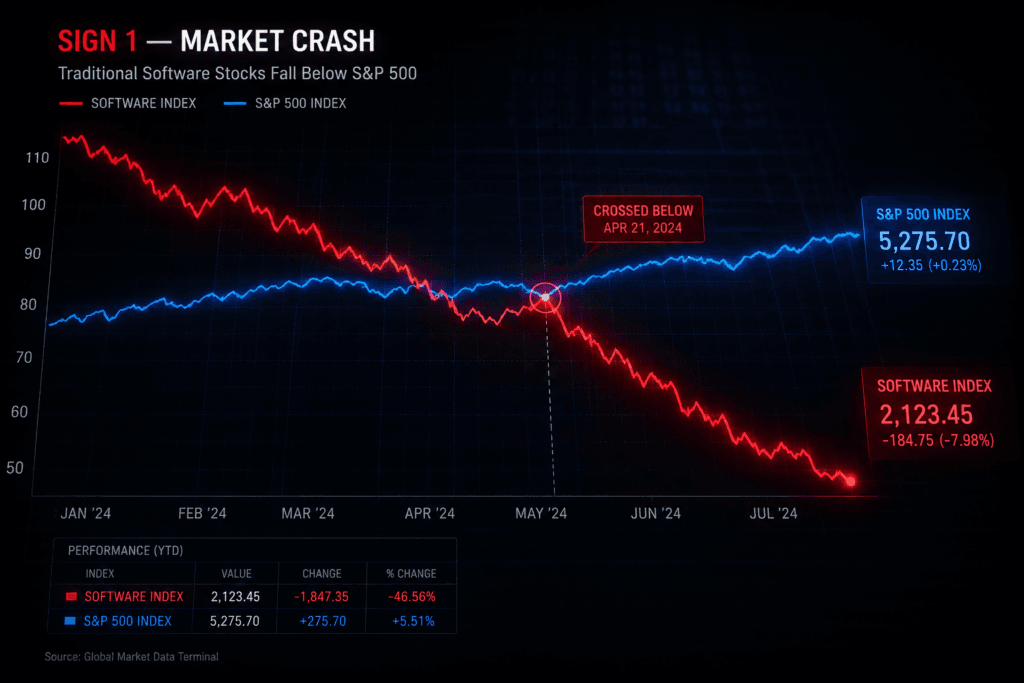
The first and most undeniable sign is the raw market data. Software forward price-to-earnings multiples fell to 22.7x by early 2026 — below the S&P 500 average for the first time in recorded history. The software-heavy IGV ETF dropped over 21% year-to-date, a decline that, relative to the broader market, exceeded both the 2008 financial crisis and the 2022 rate-hike shock.
For any AI startup founder, this data point matters enormously. When public markets stop rewarding the traditional software model with premium valuations, it signals that investors — the same investors who fund early-stage AI startup rounds — are recalibrating where they believe future value will be created. That recalibration is already flowing toward agent-native AI startups building outcome-based products rather than per-seat software.
“When the market stops paying a premium for the old model, it starts paying a premium for the new one.”
Sign 2 — Enterprise Customers Are Cancelling Seats, Not Adding Them

Atlassian reported its first-ever systemic decline in enterprise seat counts in early 2026. This single data point explains the entire crisis. Companies are not switching away from project management or CRM tools because they hate them — they are reducing headcount that uses them, because AI agents now perform the underlying tasks directly.
Workday announced 8.5% layoffs explicitly attributed to AI efficiency gains. If ten AI agents can now do the work of one hundred sales representatives, an enterprise simply does not need one hundred Salesforce seats anymore. Every AI startup founder building a leaner, agent-native alternative to a bloated legacy tool is building directly into this exact shift.
“Customers are not abandoning software. They are abandoning the number of humans needed to operate it.”
Sign 3 — Anthropic’s Claude Cowork Proved Entire Software Categories Can Be Replaced Overnight

The single catalytic event of the SaaSpocalypse was the January 2026 launch of Claude Cowork, which demonstrated that one AI agent could autonomously execute multi-step workflows spanning legal document management, compliance automation, financial analysis, and project coordination — tasks that previously required several separate enterprise software subscriptions.
Enterprise leaders who watched the demonstration immediately began questioning why they were paying for five or six separate SaaS tools when one well-orchestrated AI system could perform the same underlying work. For an AI startup founder, this is the clearest possible signal of where enterprise budgets are heading in 2026 and beyond.
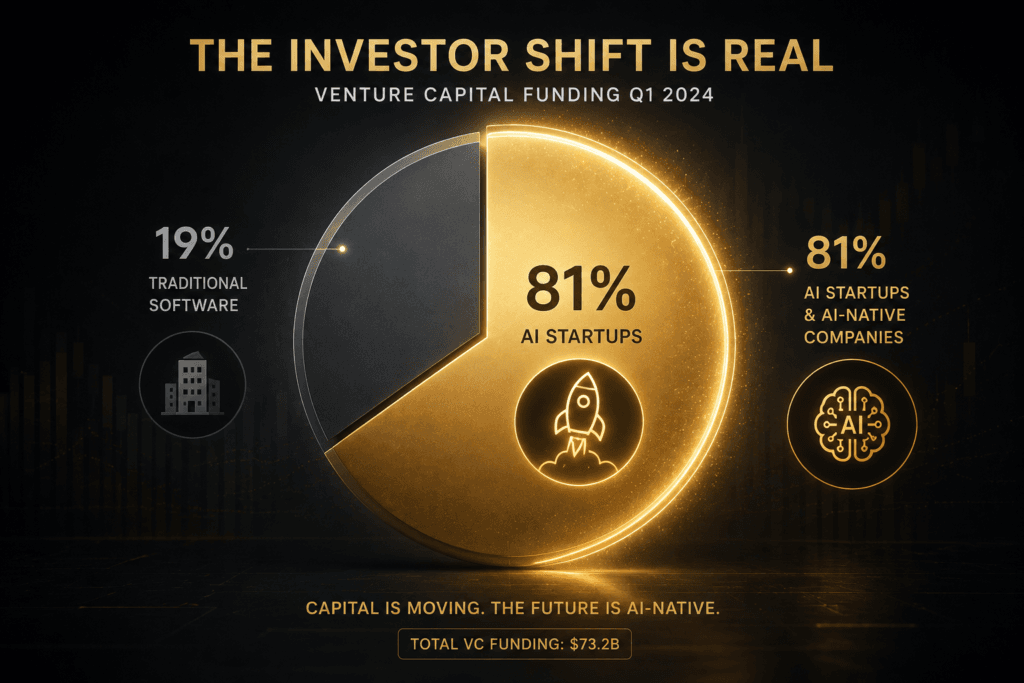
According to Crunchbase’s Q1 2026 funding analysis, capital allocators have responded to this shift by directing 81% of all venture capital toward AI-native companies — the funding market has already made its bet on which model wins.
“One demonstration changed enterprise software forever. Every AI startup founder watching closely saw the opening.”
Sign 4 — Per-Seat Pricing Is Being Replaced by Usage and Outcome-Based Models
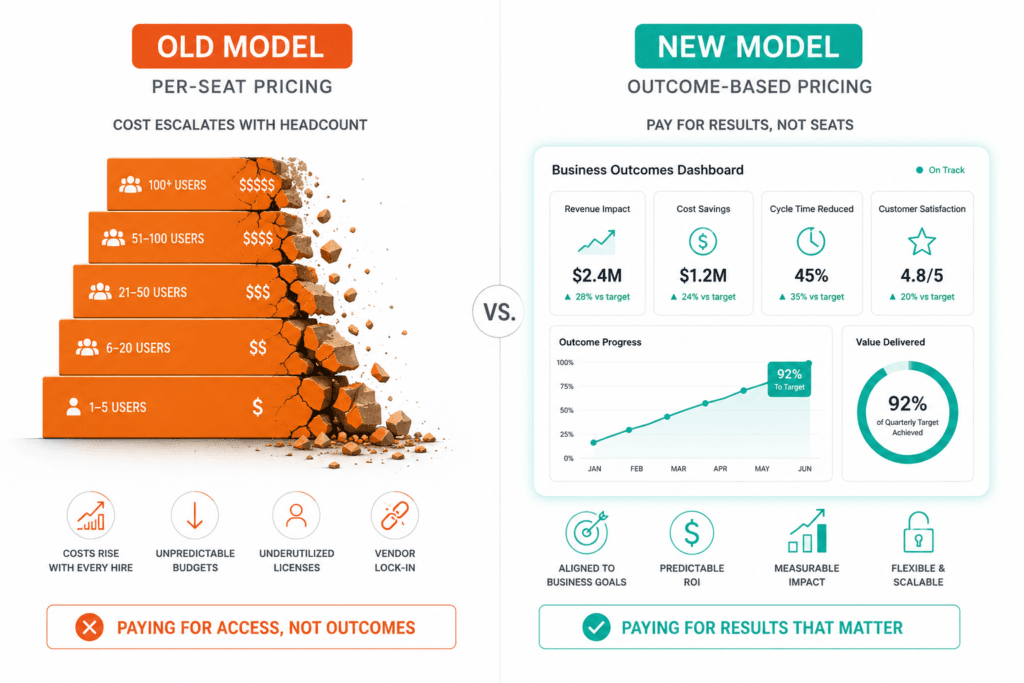
The traditional SaaS pricing model — charge per user, per month — assumed that more users meant more value delivered. AI agents broke that assumption completely. A single agent can now handle the workload of dozens of human “seats,” which means the entire economic logic underpinning SaaS pricing for two decades no longer holds.
Forward-thinking AI startup founders are building pricing models around outcomes delivered rather than seats occupied — charging based on tickets resolved, leads converted, or revenue generated. This shift in itself is creating an entirely new category of AI startup that legacy SaaS vendors, locked into their existing pricing infrastructure and investor expectations, structurally cannot match.
- Customer support AI startup: charge per resolved ticket, not per agent seat
- Sales automation AI startup: charge per qualified meeting booked, not per CRM login
- Marketing AI startup: charge per campaign performance result, not per software user
“The AI startup that prices on outcomes will always win against the software that prices on logins.”
Sign 5 — Software Giants Are Spending Billions to Defend Themselves, Not to Grow
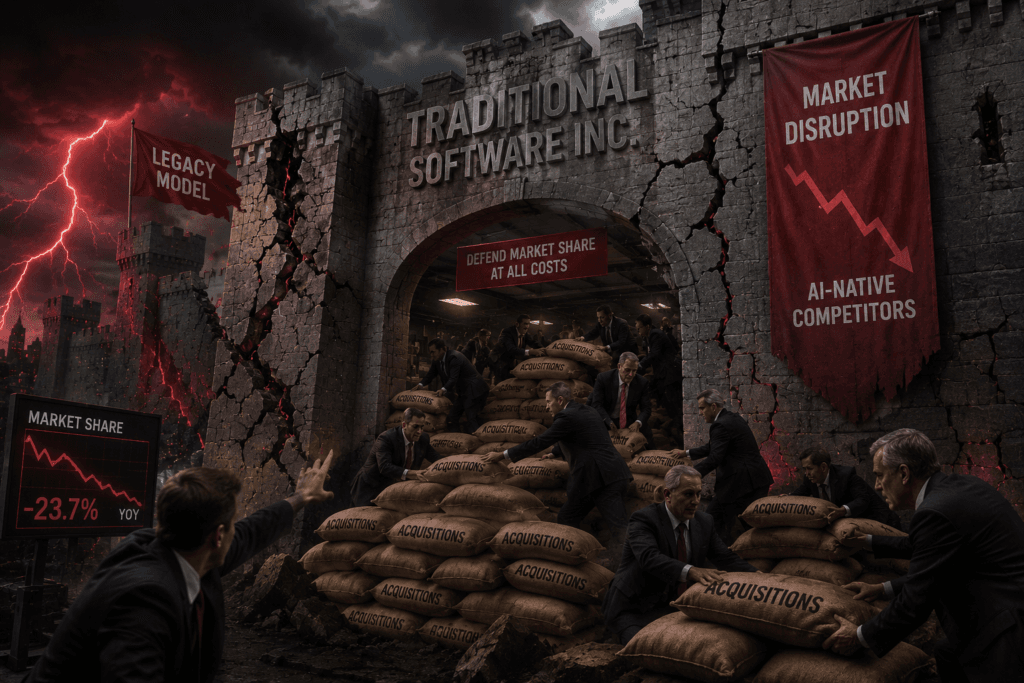
Enterprise SaaS M&A activity hit $83.7 billion across 245 deals in Q4 2025 alone — but this was not growth-driven acquisition. According to PitchBook data, much of this consolidation reflects larger software companies acquiring AI capabilities purely to defend their existing pricing power before the market forces their hand.
When an industry spends tens of billions of dollars on defensive acquisitions rather than offensive expansion, that industry is signalling something important: it knows it is under existential threat. For an AI startup founder, watching where legacy software giants are spending defensively tells you precisely which categories are ripe for agent-native disruption.
“When an industry spends to defend rather than to grow, the smartest AI startup founders are already building the replacement.”
Sign 6 — Investors Now Rate AI-Native Companies Above Legacy SaaS for the First Time Ever
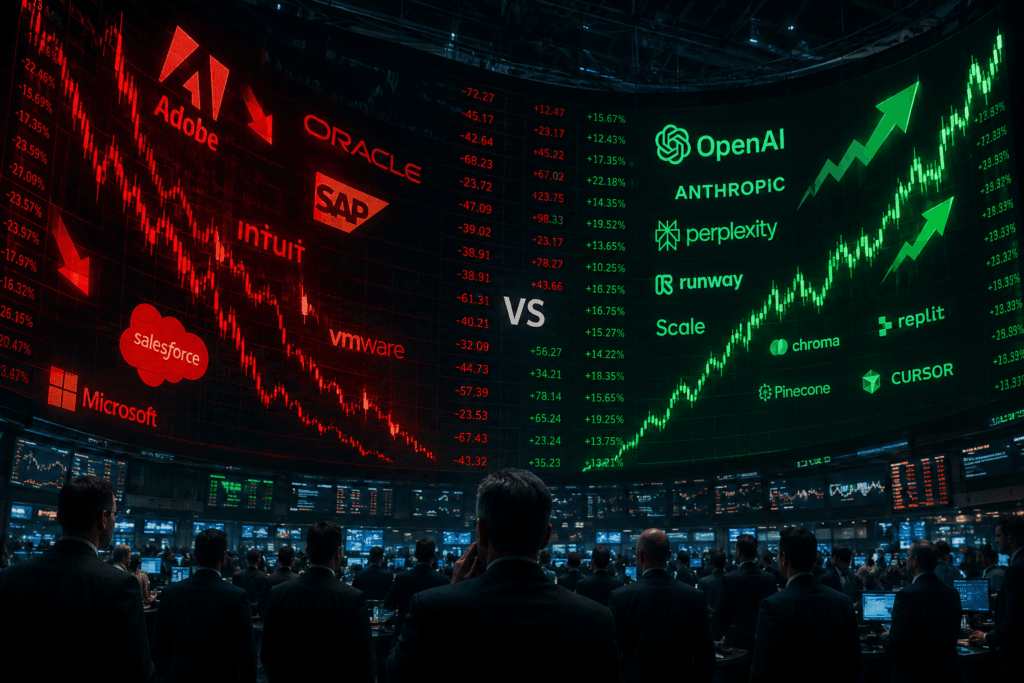
For the first time in software market history, software forward earnings multiples have fallen below the broader S&P 500 average. This means investors no longer believe a recurring-revenue SaaS business automatically deserves a premium valuation purely for being subscription-based software.
Meanwhile, capital is flooding into AI-native and agent-native startups at a pace that dwarfs anything seen in traditional software funding history. Q1 2026 alone saw global venture capital hit $297 billion, with AI startups capturing 81% of all of it. Every dollar that used to chase a traditional SaaS startup pitch deck is now chasing the founder who can demonstrate an agent-native AI startup with genuine automation at its core.
“Capital follows conviction. In 2026, conviction has moved decisively toward the AI startup, not the SaaS incumbent.”
Sign 7 — A New Generation of Agent-Native Startups Is Already Winning Customers Away From Giants
The final and most important sign for any aspiring founder: this is not theoretical. Agent-native AI startups are already winning real enterprise customers away from established SaaS giants. New companies built from day one around AI-first workflows are offering lower costs, faster implementation, and better automation than the legacy vendors they are replacing.
Deloitte’s 2026 technology predictions describe this evolution clearly: software is moving toward “a federation of real-time workflow services” rather than discrete applications. That is precisely the architecture an AI startup is built around from inception — while legacy SaaS companies must retrofit decades-old codebases to even attempt to compete.
“The AI startup founder of 2026 is not trying to disrupt software. They are simply building what software is already becoming.”
What This Collapse Means for Your Next AI Startup Idea
Every sign in this article points toward the same conclusion: traditional software is not dying because customers stopped needing solutions to their problems. It is dying because AI startup founders figured out how to solve those same problems with radically less overhead, radically lower cost, and radically faster iteration cycles.
- Identify a SaaS category where customers are visibly frustrated with per-seat pricing
- Build your AI startup as agent-native from day one, not as an AI feature bolted onto old software
- Price your AI startup around outcomes delivered, not seats occupied
- Move fast — the AI startup founders moving now will define the categories for the next decade
The SaaSpocalypse is not an ending. For the right AI startup founder, it is the best possible beginning.“Every collapsing software giant in 2026 is leaving behind a market. The AI startup that claims it first wins it.”
Your startup does not need more planning. It needs a launch date.
You must know these topics which are so important before you start a start up:
- 9 Explosive India AI Startup Trends Creating Young Millionaire Founders in 2026
- 10 Powerful AI Startup Tools Replacing Entire 10-Person Teams for Under $300/Month.
- 7 Powerful AI Start up Trends Making Non-Coders Millions Through Vibe Coding in 2026
- 6 Shocking Startup Secrets Behind the $401M Telehealth Company Built by One Person
- 7 Shocking AI Startup Trends Creating One-Person Billion-Dollar Companies in 2026
- Top 5 Shocking Misapprehensions Founders Make When Raising Capital
- Founder Reality Check:6 Brutal Start up Funding Myths Every Founder Must Stop Believing
- Why Start ups Fail to Get Funding from Investors: 28 Hard Truths No One Tells You
- Start up Fundability Explained: 7 Powerful Readiness Signals Founders Must Get Right
- Start up Non-Dilutive & Alternative Funding: 7 Powerful Ways to Raise Capital Without Equity
- Angel Funding and Early-Stage Capital: 5 Core Principles That Shape Start up Growth
- Start Up Funding: 10 Proven Strategies for Massive Growth
- Start Up Success: 7 Powerful Pitch Deck Storytelling Secrets That Win Investors
- From Classroom to Capital: The Ultimate Funding Guide for Student & First-Time Founders
- Founder Guide: 5 Powerful Funding Trends Every Start up Must Know
Conclusion: The Future Isn’t About Replacing Humans—It’s About Redefining Human Potential
The seven signs we’ve explored aren’t just signals that traditional software is struggling—they’re evidence that the way humans create, work, and solve problems is entering an entirely new chapter. Every technological revolution has been met with fear, uncertainty, and resistance. Yet history has repeatedly shown that innovation doesn’t eliminate human value; it transforms where that value is created.
Today, artificial intelligence is doing exactly that.
Many people see headlines about layoffs, shrinking software companies, or AI replacing jobs and assume the future belongs only to machines. But that perspective misses the bigger picture. AI is remarkably good at repetitive tasks, pattern recognition, documentation, coding assistance, and automation. What it still cannot replicate are deeply human qualities such as empathy, creativity, leadership, trust, ethical judgment, curiosity, and meaningful relationships.
Those abilities are becoming even more valuable.
This Is Not the End of Software—It’s the Evolution of Software
Traditional software companies are not disappearing overnight. Many of them will survive by reinventing themselves, integrating AI deeply into their products, and adopting entirely new business models.
However, companies that continue treating software as static tools instead of intelligent partners will face increasing pressure.
The winners of the next decade won’t necessarily be the companies with the largest engineering teams. They will be the organizations capable of learning the fastest, adapting the quickest, and delivering measurable outcomes rather than simply selling licenses.
The market is no longer rewarding software that people merely use.
It is rewarding software that actually gets work done.
What This Means for Founders
For entrepreneurs, this shift represents one of the greatest opportunities in modern business history.
Many billion-dollar industries are being rebuilt from scratch. Processes that once required dozens of employees can now be automated by intelligent agents working around the clock. Entire categories of enterprise software are being simplified into unified AI systems capable of solving multiple business problems simultaneously.
But technology alone is not enough.
The founders who will build lasting companies are those who understand real human problems first. Customers don’t buy artificial intelligence because it’s exciting—they buy solutions that save time, reduce stress, increase revenue, and improve their daily lives.
The next generation of startups won’t succeed because they have the smartest AI.
They’ll succeed because they understand people better than anyone else.
A Message for Software Professionals
If you’re a software engineer, designer, product manager, marketer, or student reading this, don’t interpret these trends as a warning to give up.
Instead, see them as an invitation to evolve.
The skills that built successful careers over the last twenty years are changing rapidly, but new opportunities are emerging just as quickly. Learning AI tools, understanding automation, improving communication skills, and becoming adaptable will matter far more than memorizing frameworks that may become obsolete.
Your career isn’t defined by one programming language or one software platform.
It’s defined by your ability to solve meaningful problems.
Those who continue learning will remain incredibly valuable regardless of how technology evolves.
The Human Side of Innovation
Every market chart represents real people.
Behind every acquisition are employees wondering about their future.
Behind every startup are founders risking years of their lives chasing an idea.
Behind every AI breakthrough are engineers, researchers, designers, and customers working together to build something better.
As businesses adopt AI, they also carry a responsibility to invest in reskilling workers, creating new opportunities, and ensuring technology improves lives rather than simply reducing costs.
Progress should never come at the expense of humanity.
The most successful organizations of the future won’t be those that replace the most people.
They’ll be the ones that empower the most people.
The Next Decade Belongs to Builders
We’re witnessing a once-in-a-generation transformation similar to the birth of the internet or the smartphone revolution.
Some companies will disappear.
Many business models will change.
Entire industries will be reinvented.
Yet every disruption creates extraordinary opportunities for those willing to learn, adapt, and build.
Whether you’re a founder launching your first AI startup, an investor searching for the next breakout company, a software professional upgrading your skills, or simply someone curious about where technology is heading, one thing is becoming increasingly clear:
The future won’t be won by those who resist change.
It will belong to those who embrace it with intelligence, responsibility, and a genuine desire to improve the lives of others.
Technology has always been a tool.
Human imagination will always be the force that gives it purpose.
Final Thought
The decline of traditional software isn’t a story about machines replacing humans. It’s a story about humans creating better tools to solve bigger problems. The companies that remember this simple truth will shape the next era of innovation—and the people who continue learning, adapting, and building with empathy will shape the future itself.
“Technology changes the way we work. Humanity determines why we work. The future belongs to those who combine both with purpose.”
FAQ
Why is traditional software dying in 2026?
Traditional software is declining because AI agents now perform many of the tasks that per-seat SaaS tools were built for, without requiring human “seats.” This has triggered a $2 trillion market correction, with enterprise customers reducing software licenses as AI startup alternatives deliver the same outcomes more efficiently.
Is the SaaSpocalypse permanent or temporary?
Analysts believe this represents a structural shift, not a temporary correction. Gartner predicts 35% of point-product SaaS tools will be replaced by AI agents by 2030, meaning any AI startup entering these categories now has a meaningful window before the market fully consolidates.
What kind of AI startup can benefit most from this shift?
AI startups building agent-native alternatives to CRM, project management, customer support, and HR software are best positioned, since these are the categories most affected by declining seat counts. The most successful AI startup model prices on outcomes rather than per-user subscriptions.
Are investors still funding traditional SaaS startups?
Investor capital has shifted dramatically toward AI-native companies. In Q1 2026, AI startups captured 81% of all venture capital funding, while traditional software multiples fell below the broader market average for the first time in history.
How fast should a founder move to capture this AI startup opportunity?
Very fast. The SaaSpocalypse began in February 2026 and is actively reshaping enterprise software budgets right now. Every AI startup founder who waits gives an early mover more time to build the customer relationships and product depth needed to defend their new market position.