
By FundingsStartup Editorial Team | June 2026 | 11 min read
The Startup Story That Broke Every Rule
In September 2024, a start up story emerged that quietly rewrote every assumption the start up world had about what is possible. Matthew Gallagher launched a telehealth start up called Medvi from his home in Los Angeles. His start up had no employees, no start up co-founder, no start up office, and a starting budget of just $20,000.
Twelve months after his start up launched, the numbers were impossible to ignore. Medvi had generated $401 million in sales with a 16.2% net profit margin. By 2026, the start up is tracking toward $1.8 billion in annual revenue. For context, most start up founders spend years trying to reach $1 million in annual recurring revenue. This start up crossed $400 million in twelve months.
This start up case study is not here to make you feel behind. It is here to show you the exact start up secrets that made it possible — because every single one of them is replicable by any start up founder reading this article today. There is no secret ingredient that requires a Harvard MBA, a Silicon Valley network, or millions in start up funding. What Medvi demonstrated is that the fundamental formula for a great startup — the right problem, the right infrastructure, the right timing — is more accessible in 2026 than at any moment in start up history.
“The most important startup lesson from Medvi is not the number. It is the method.”
Startup Secret 1 — He Solved a Problem With Massive Existing Demand, Not a New Idea

The first and most underrated start up secret behind Medvi is that Matthew Gallagher did not try to invent a new market. He launched his start up into a market that was already on fire. GLP-1 weight-loss medications — Ozempic, Wegovy, Mounjaro — were experiencing a demand explosion that the traditional healthcare system could not keep up with. Patients who wanted prescriptions faced months-long waitlists.
His start up’s insight was brutally simple: remove the friction between a patient who needs a GLP-1 prescription and a licensed provider who can prescribe it. The start up used telehealth infrastructure — licensed physicians working through the platform — to fulfil that demand at scale, with AI handling everything except the clinical consultation itself.
Most aspiring start up founders make the same mistake: they try to create demand for something new rather than building a start up that serves demand that already exists and is visibly underserved. The most profitable start up in 2026 is rarely the most innovative one. It is the one that removes the most friction from an already-proven customer behaviour. Gallagher did not invent telehealth. He did not invent GLP-1 medications. His start up simply made the path between willing customers and available healthcare providers shorter, faster, and more accessible than any competitor.
“The best startup idea is not the cleverest idea. It is the one that solves the most urgent existing pain.”
Startup Secret 2 — The Startup Ran on AI, Not People

The second start up secret is the one that separates Medvi from every other start up in telehealth. Matthew Gallagher built his start up as an AI-first operation from day one. Every function that a traditional start up would hire a person to perform was instead handled by an AI system:
- Startup marketing: AI-generated content, AI-optimised ad targeting, AI-driven SEO
- Startup customer journey: AI intake forms, AI-powered patient matching, automated follow-ups
- Startup operations: automated billing, automated prescription routing, AI-based compliance checks
- Startup support: AI chat handling 90%+ of patient queries without human intervention
The start up employed licensed physicians as contractors — the only function that legally required human involvement. Everything else in the start up ran on automated systems and AI agents. This start up model delivered operating efficiency that no traditionally-staffed competitor could match.
The deeper start up lesson here is about architecture. Most start up founders build their start up for the team they plan to hire, creating processes and systems that assume human labour at every step. Gallagher built his start up for automation from the ground up — every start up process was designed to be executed by software, not by a person. When your start up’s default is automation, your start up’s scaling cost approaches zero as revenue grows.
“Medvi did not automate parts of the startup. It automated everything the startup could legally automate.”
Startup Secret 3 — The Startup Was Profitable From Month One
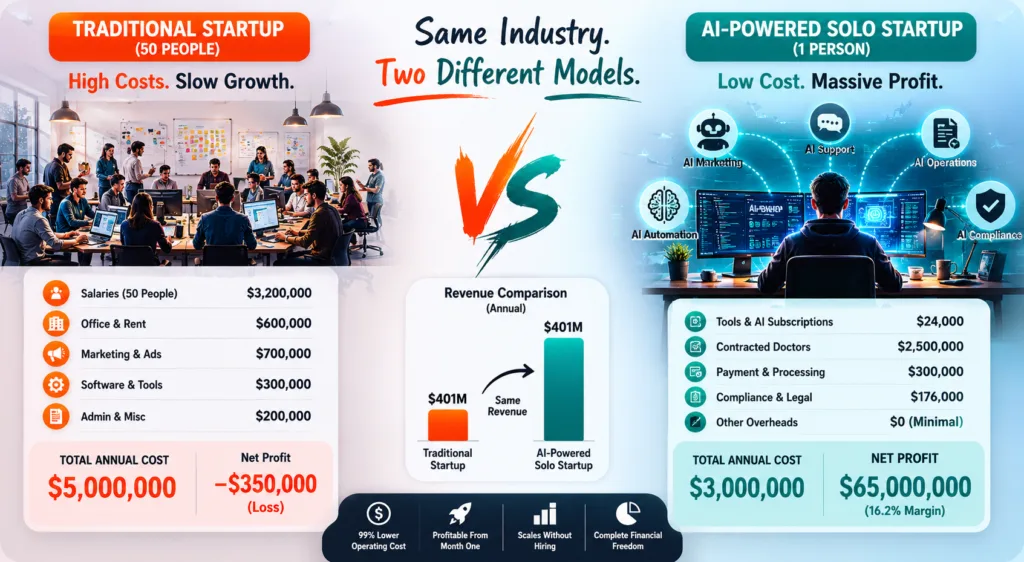
Most start up advice tells founders to expect years of losses before profitability. Medvi’s start up rejected that entirely. Because the start up had no salary costs, no start up office expenses, and minimal start up overhead, the unit economics were positive from the very first customer.
The start up’s 16.2% net profit margin on $401 million means Medvi cleared approximately $65 million in net profit in year one. A traditionally-built telehealth start up with 50 employees would have been lucky to break even on those numbers.
Profitability from month one creates a start up dynamic that most VC-backed start ups never experience: complete freedom from investor pressure. When your start up does not need external capital to survive, every decision you make for your start up is made in the long-term interest of your customer — not in the short-term interest of your next funding round. This start up freedom is enormously valuable and chronically underappreciated by founders who equate start up success with the size of their latest round.
“The most fundable startup in 2026 is the one that does not need funding — because it is already profitable.”
Startup Secret 4 — The Startup Chose a Highly Regulated Market Deliberately

Counterintuitively, one of the start up’s greatest strengths was entering a highly regulated industry. Most start up founders avoid regulated markets — healthcare, finance, legal — because compliance seems complex and expensive. Gallagher’s start up saw regulation as a start up moat, not a start up obstacle.
Regulation means fewer startup competitors. It means higher start up barriers to entry that protect any start up willing to do the compliance work upfront. It also means that once your start up builds the right infrastructure, you are protected from start up copycats who are not willing to navigate the same regulatory environment.
Regulated Startup Markets Worth Exploring in 2026
- Healthcare startup: high regulation equals high margin potential plus limited start up competition
- Fintech startup: compliance work creates a start up moat most copycats will not cross
- Legaltech startup: complex licensing requirements protect start ups that build properly from day one
- EdTech startup in India: AICTE and UGC regulations create barriers that protect well-built start up products
Every time a start up founder looks at a regulated market and thinks “too complicated”, that is an undiscovered start up opportunity. The start up that goes where others fear to go does not just find less competition — it finds a sustainable, defensible start up business that is genuinely hard to disrupt.
“The startup that goes where others fear to go does not just find opportunity — it finds a moat.”
Startup Secret 5 — The Startup Scaled by Removing Human Bottlenecks, Not Adding Them

Traditional start up scaling advice is built around people: hire more sales reps, add more support staff, grow your start up team. Medvi’s start up inverted this entirely. Every time the start up grew, Gallagher removed human touchpoints rather than adding them, replacing them with more sophisticated AI systems and automated start up workflows.
This start up approach means that revenue can grow without costs growing proportionally. A start up that doubles revenue while keeping costs flat is not just growing — it is compounding. By month twelve, Medvi’s start up was processing thousands of patient consultations per day with the same lean AI infrastructure it had on day one, just more refined and optimised.
The start up mental model shift this requires is significant. Most start up founders are trained to think of growth as requiring more people. Gallagher’s start up required retraining that instinct entirely: every start up growth milestone was an opportunity to ask not “who do we hire?” but “what do we automate?” This one start up question, asked consistently, is what produced the extraordinary unit economics that made Medvi’s start up the most discussed case study of 2025.
“The best startup growth strategy in 2026 is not to hire faster. It is to automate smarter.”
Startup Secret 6 — The Startup Used Personal Branding as Its Primary Growth Channel

The sixth start up secret is one of the most actionable for start up founders reading this right now. Matthew Gallagher did not spend millions on start up advertising. He built his start up audience through personal startup content on social media — sharing his start up journey, his start up results, and his start up process transparently and consistently.
This start up content strategy created compound organic growth that no paid start up marketing budget could replicate. Each piece of start up content he posted built trust, brought in new start up customers, and attracted the media attention that eventually made Medvi a globally covered start up story.
The start up psychology behind this approach is straightforward: people trust founders. Not brands, not companies, not start up marketing copy — people. When a real human being shares their genuine start up journey, including the difficulties, the doubts, and the start up failures alongside the wins, audiences connect with that narrative in a way they never connect with polished corporate start up marketing. For a solo start up founder with no marketing budget, personal brand content is the single highest-ROI startup growth channel available in 2026.
“The most powerful startup marketing channel in 2026 costs nothing but honesty and consistency.”
The Startup Lesson That Ties All Six Secrets Together
When you look at the six start up secrets behind Medvi’s extraordinary success, a single unified start up philosophy emerges: build your start up to be lean, automated, and customer-obsessed from day one. Not eventually. Not after the next funding round. From the very first day your start up exists.
This start up philosophy does not require millions in funding. It does not require a technical co-founder, a start up team, or a prestigious start up accelerator. It requires a start up founder who is willing to think differently about what a start up is — not a team of people working on a problem, but an AI-powered system serving a real customer need at extraordinary efficiency.
The start up founders who will create the next generation of Medvi-level stories are reading articles like this one right now, identifying the start up insight that is uniquely theirs, and building before they feel ready. That is the final and most important start up secret of all:
the startup that ships imperfect today beats the startup that is still planning to be perfect next year, every single time.
“Every startup secret in this article is available to any startup founder with a laptop and the courage to begin.”
you must know these topics which are so important before you start a start up:
- 7 Shocking AI Startup Trends Creating One-Person Billion-Dollar Companies in 2026
- Top 5 Shocking Misapprehensions Founders Make When Raising Capital
- Founder Reality Check:6 Brutal Start up Funding Myths Every Founder Must Stop Believing
- Why Start ups Fail to Get Funding from Investors: 28 Hard Truths No One Tells You
- Start up Fundability Explained: 7 Powerful Readiness Signals Founders Must Get Right
- Start up Non-Dilutive & Alternative Funding: 7 Powerful Ways to Raise Capital Without Equity
- Angel Funding and Early-Stage Capital: 5 Core Principles That Shape Start up Growth
- Start Up Funding in India: 10 Proven Strategies for Massive Growth
- Start Up Success: 7 Powerful Pitch Deck Storytelling Secrets That Win Investors
- From Classroom to Capital: The Ultimate Funding Guide for Student & First-Time Founders
- Founder Guide: 5 Powerful Funding Trends Every Start up Must Know
What Most Articles About Medvi Get Wrong
While the headlines focus on the astonishing $401 million revenue figure, the bigger lesson is not the number itself. The real lesson is understanding why stories like Medvi remain exceptionally rare.
Many founders will read this case study and conclude that AI alone was responsible for the company’s growth. That interpretation is dangerous.
AI was not the competitive advantage. AI was the amplifier.
The true advantage came from three factors that existed before a single AI workflow was deployed:
1. Market Timing
Medvi entered the market during an unprecedented surge in demand for GLP-1 medications. According to the Kaiser Family Foundation (KFF), interest in prescription weight-loss treatments has risen dramatically as obesity treatment becomes a mainstream healthcare priority.
Source:
https://www.kff.org
When a start up launches into a rapidly expanding market, customer acquisition becomes significantly easier than in stagnant industries. Even mediocre execution can generate traction when demand is exploding.
Many founders spend years trying to create demand from scratch. The smarter approach is often to identify demand that already exists and remove obstacles that prevent customers from accessing solutions.
2. Distribution Before Product Complexity
One of the most overlooked start up truths is that distribution usually matters more than innovation.
A start up with an average product and exceptional distribution frequently outperforms a start up with an exceptional product and poor distribution.
This principle has been demonstrated repeatedly by companies such as Amazon, Airbnb, and Uber. None of them invented entirely new human behaviours. They simply made existing behaviours easier, faster, and more convenient.
Source:
https://www.ycombinator.com/library
Gallagher’s approach followed the same pattern. Instead of building groundbreaking healthcare technology, he focused on creating the shortest path between a patient and a licensed provider.
3. Operational Leverage
Naval Ravikant famously described modern wealth creation as the ability to leverage code, media, and capital.
Source:
https://nav.al
Medvi represents one of the clearest examples of code-based leverage in recent start up history.
Traditional businesses scale by adding people.
Leverage-driven businesses scale by adding systems.
A founder who personally serves 100 customers is working hard.
A founder who builds a system serving 100,000 customers is creating leverage.
This distinction explains why some businesses grow linearly while others grow exponentially.
A Practical Framework for Founders
Before launching your next start up idea, ask yourself five questions:
- Is there already proven demand?
- Can AI automate at least 70% of operations?
- Can customers understand the value proposition in under 10 seconds?
- Does regulation create a barrier that protects the business?
- Can the business scale without hiring proportionally?
If the answer is “yes” to four or five of these questions, you may be looking at a high-potential opportunity.
The future belongs to founders who combine human insight with machine efficiency.
The lesson from Medvi is not that one person can build a billion-dollar company.
The lesson is that technology has dramatically increased the amount of value a single capable founder can create.
That shift may be one of the most important business trends of the decade.
FAQ
How did a one-person startup generate $401 million in revenue?
Medvi, the telehealth start up built by Matthew Gallagher, achieved $401M in year-one revenue by combining an AI-first start up infrastructure, massive existing GLP-1 drug demand, licensed physician contractors, and fully automated start up operations — eliminating the need for a traditional start up team.
Is the Medvi startup model replicable for other startup founders?
Yes. The core start up principles — AI automation, profitable-from-day-one economics, regulated market moats, and personal brand growth — are replicable in any start up vertical. The start up tools that made Medvi possible are available to any founder with a $300-500/month tool budget.
What startup sector did Medvi operate in?
Medvi is a GLP-1 telehealth start up that connects patients needing weight-loss medication prescriptions with licensed physicians. The start up identified the gap between explosive patient demand for GLP-1 drugs and the limited capacity of traditional healthcare to fulfil it.
Did the Medvi startup raise venture capital?
No. The Medvi start up was bootstrapped with $20,000 and reached $401M in revenue without external start up funding. This makes it one of the most capital-efficient start up success stories ever documented.
What is the single most important startup lesson from Medvi?
The most important start up lesson is to build your start up as an AI-first operation from day one — not as an afterthought. Every function in your start up that can be automated should be automated before you consider hiring a human to perform it. This start up principle is what produced Medvi’s extraordinary 16.2% net profit margin.