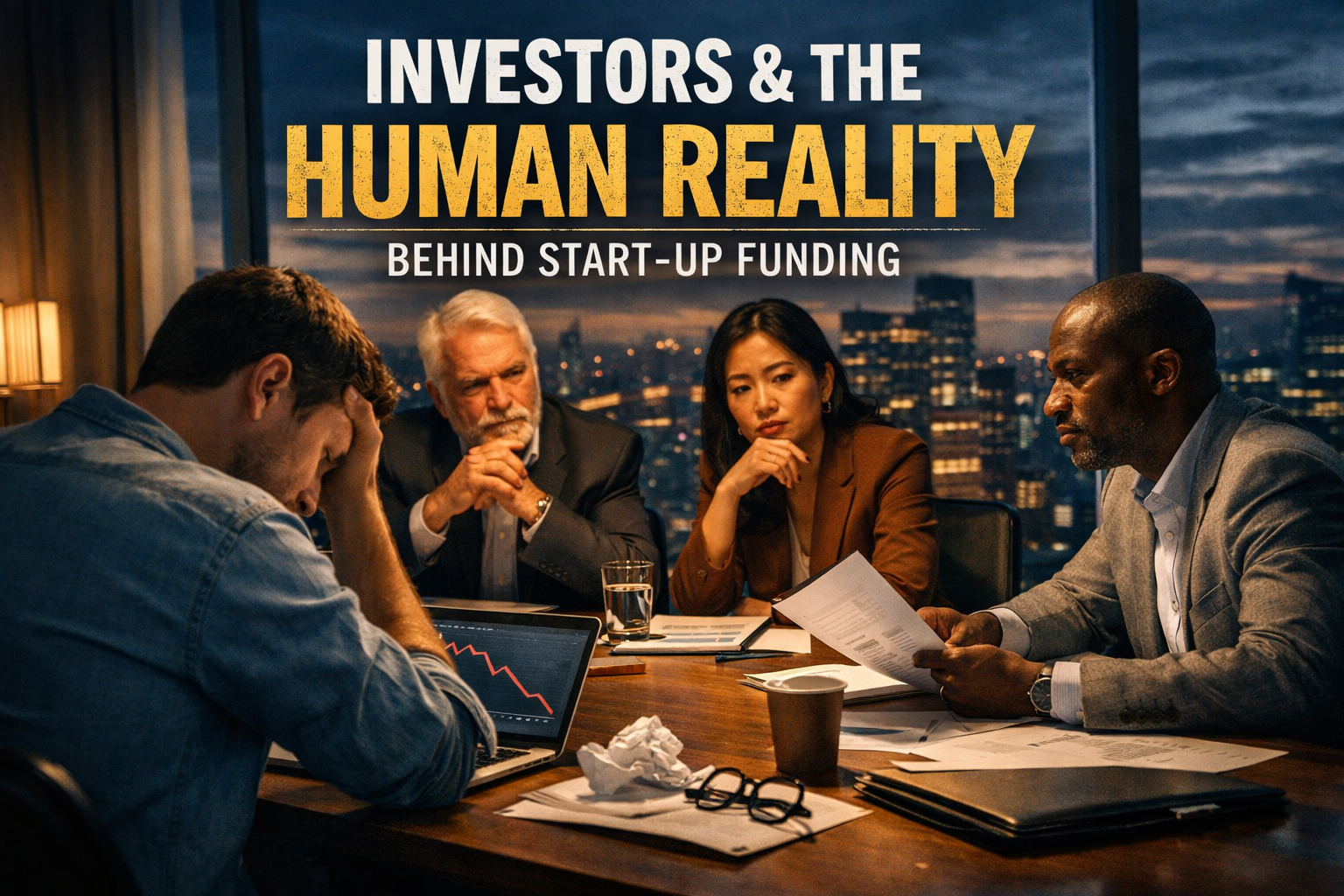
Investors and the Silent Human Courage Behind Starting
Before a founder ever thinks about investors, funding, or valuation, there is a quiet moment of courage. It is the moment when someone chooses to try instead of staying comfortable. Many start ups begin not from ambition, but from frustration—frustration with broken systems, inefficient services, or unfair realities. Founders often start with limited resources, limited guidance, and limited confidence, yet they move forward anyway. When these same founders later face rejection from investors, it can feel like that initial courage was misplaced. But in truth, the courage to start is never wasted. It is the foundation on which learning is built, even if funding does not arrive immediately.
“Courage is not knowing the outcome, but choosing to begin anyway.”
The Psychological Impact of Being Judged by Investors
Meeting an investor often feels like being judged in a compressed time frame. Founders are expected to explain months or years of thinking in minutes. This pressure can distort communication. Nervousness may be mistaken for lack of clarity. Passion may be misread as emotional instability. Investors do not intend to judge the person, but the format of pitching creates that experience for founders. Over time, repeated exposure to this environment without preparation can harm self-esteem. Understanding this dynamic helps founders separate personal identity from professional evaluation.
“Being evaluated is not the same as being defined.”
The Structural Reasons Start ups Fail to Get Funding
Many start ups fail to get funding from an investor due to structural reasons beyond individual control. Market saturation, economic slowdowns, sector-specific risks, and shifting investment trends all influence decisions. A strong founder with a solid idea can still face rejection simply because an investor is prioritizing different industries or conserving capital. Founders who do not understand these structural forces often internalize rejection unfairly. Recognizing the broader system reduces self-blame and encourages strategic patience.
“Not every closed door is locked because of you.”
The Gap Between Vision and Verifiability
Vision is essential to start ups, but investors operate in the world of verifiability. A founder may clearly see the future they are building, but an investor needs evidence that the path exists. This gap creates misunderstanding. Founders speak about potential, while an investor search for proof. Bridging this gap requires translating vision into small, testable actions. When founders learn to demonstrate progress instead of explaining ambition, conversations with an investor change meaningfully.
“A vision becomes believable when it leaves the mind and enters reality.”
The Role of Communication Over Intelligence
Highly intelligent founders sometimes struggle more with investors than average ones. This happens because intelligence does not automatically translate into clear communication. Investors value simplicity because simplicity reduces risk. A founder who explains a complex idea in simple terms signals deep understanding. On the other hand, complicated explanations raise concern. Learning to communicate clearly is not about reducing intelligence; it is about respecting the listener’s time and perspective.
“Simplicity is the highest form of understanding.”
Investors and Emotional Maturity as an Unspoken Requirement
One of the least discussed investor expectations is emotional maturity. An investor observe how founders react to pushback, disagreement, and uncertainty. A founder who becomes defensive or dismissive raises concerns about future leadership. Emotional maturity shows in listening, reflecting, and responding calmly. This quality reassures an investor that the founder can lead teams, handle conflict, and make decisions under stress.
“Emotional strength builds more trust than technical skill.”
The Loneliness of the Founder Journey

Founders often walk a lonely path. Friends may not understand their obsession. Family may worry about stability. Rejection from investors can deepen this loneliness. Without a support system, founders may begin to doubt their choices. A humanitarian view acknowledges that loneliness is not weakness; it is a natural response to walking an uncommon path. Founders who seek community, mentors, or peer support sustain themselves better over time.
“Loneliness is not failure; it is the cost of choosing a rare path.”
Why Speed Is Often Overvalued by Investors
Startup culture often glorifies speed—raising funds quickly, scaling fast, achieving rapid growth. Investors, however, understand that speed without direction leads to collapse. Many rejections happen because startups appear rushed and underprepared. Founders who slow down to understand users, refine their model, and build resilience often create stronger foundations. Patience may feel uncomfortable, but it protects long-term outcomes.
“Fast progress without direction is just movement, not growth.”
Investors and the Fear of Losing Control
Some founders unknowingly signal fear of losing control during investor conversations. This fear appears when founders resist feedback, avoid transparency, or insist on absolute authority. Investors interpret this as a governance risk. Healthy founders understand that funding introduces partnership, not loss of identity. Showing openness to collaboration reassures investors that future decisions will be balanced and thoughtful.
“Control weakens when it fears collaboration.”
The Reality of Financial Literacy
Many promising founders lack basic financial understanding. This gap does not make them incapable, but it increases perceived risk. Investors expect founders to understand costs, margins, and sustainability at a basic level. Financial literacy is not about expertise; it is about responsibility. Founders who invest time in learning fundamentals gain confidence and communicate more effectively with investors.
“Understanding money is understanding responsibility.”
Investors and the Misinterpretation of Confidence
Confidence is often misunderstood in start up culture. Loud certainty can appear impressive, but an investor look for grounded confidence—the kind that acknowledges uncertainty while moving forward anyway. Overconfidence signals ignorance, while quiet confidence signals preparation. Founders who balance belief with realism appear more trustworthy.
“True confidence does not need to shout.”
The Long Process of Becoming Fundable

Becoming fundable is not an event; it is a process. It involves learning, failing, improving, and adapting. Many founders approach investors too early, not realizing that readiness develops over time. An investor often reject start ups not because they will never succeed, but because they are not ready yet. Understanding this reframes rejection as timing, not destiny.
“Readiness cannot be rushed.”
Investors and the Value of Small, Unseen Progress
Small progress rarely excites an investor immediately, but it compounds over time. Talking to users, improving products, fixing small issues—these actions build credibility quietly. Founders who focus on consistent improvement eventually stand out. Investors often return later when they see sustained effort.
“Small steps taken daily build unshakable foundations.”
The Importance of Integrity
Integrity is one of the strongest yet least visible assets a founder can have. Honest communication, ethical decisions, and transparency create long-term trust. Investors may not immediately reward integrity, but they notice its absence quickly. Founders who maintain integrity protect their reputation even through rejection.
“Integrity is what remains when no one is watching.”
Mental Resilience as a Survival Skill
Mental resilience allows founders to face rejection without collapsing. It helps them separate feedback from identity. Resilience is built through reflection, rest, and perspective. Founders who ignore mental health often burn out before success arrives. Investors indirectly benefit when founders are mentally stable, even if they do not explicitly discuss it.
“Strength is the ability to continue without losing yourself.”
The Role of Learning Over Proving
Founders often approach investors trying to prove worth. A healthier approach is demonstrating learning. Investors trust founders who evolve faster than circumstances change. Showing curiosity, adaptability, and humility signals long-term potential.
“Growth impresses more than perfection.”
The Human Truth About Long-Term Success

Long-term success in start ups is rarely linear. It involves pauses, detours, and setbacks. Investors understand this better than founders sometimes do. Founders who accept uncertainty as part of the journey maintain emotional balance and strategic clarity.
“Progress is rarely straight, but it is always forward.”
The Final Humanitarian Reflection on Funding
Funding is not a measure of human value. It is a financial decision influenced by timing, readiness, and risk. Founders who understand this protect their dignity and motivation. Investors and founders are not opposing forces; they are participants in a shared ecosystem that requires patience, trust, and understanding.
“Worth is not determined by who funds you.”
The Unspoken Bias Toward Familiarity
One reality that founders rarely talk about openly is that investors, like all humans, are influenced by familiarity. Familiar educational backgrounds, familiar industries, familiar communication styles, and familiar success patterns often feel safer. This does not mean investors are intentionally unfair, but it does mean that founders from non-traditional backgrounds may face additional resistance. When an investor cannot easily relate to a founder’s story or worldview, uncertainty increases. For founders, understanding this dynamic is empowering. It helps them prepare better narratives, build credibility gradually, and seek investors who align with their context instead of forcing validation from spaces that are not ready to understand them.
“People trust what they recognize before they trust what is new.”
The Hidden Cost of Over-Preparation
Many founders believe that perfect preparation will eliminate rejection. They over-polish decks, rehearse answers endlessly, and try to anticipate every question investors might ask. While preparation is valuable, over-preparation can make founders sound rehearsed, rigid, or disconnected from reality. Investors often sense when responses are memorized instead of understood. They prefer thoughtful pauses and honest reflection over scripted confidence. True preparation is not about having all answers; it is about understanding the problem deeply enough to think clearly in real time.
“Prepared minds respond, rehearsed minds repeat.”
The Founder’s Relationship With Uncertainty
Startups exist in uncertainty by nature. Markets shift, user behavior changes, and assumptions break. Investors know this and pay close attention to how founders relate to uncertainty. Founders who panic, avoid uncertainty, or pretend it does not exist raise concern. On the other hand, founders who acknowledge uncertainty calmly and explain how they plan to navigate it appear more capable. Accepting uncertainty does not weaken a pitch; it strengthens trust. Investors want to see founders who can walk forward even when the path is unclear.
“Uncertainty handled well becomes confidence.”
The Silent Expectation of Self-Awareness
Self-awareness is one of the most underrated qualities investors look for. Investors observe whether founders understand their own strengths and limitations. A founder who knows what they are good at—and where they need help—appears far safer than one who claims total competence. Self-awareness signals maturity and reduces ego-driven risk. Investors trust founders who can build teams to complement their gaps rather than pretending gaps do not exist.
“Self-awareness is leadership before authority.”
The Difference Between Storytelling and Truth
Storytelling is powerful, but investors listen carefully for truth beneath the story. A compelling narrative without grounding can feel manipulative, even if unintentional. Investors appreciate honest stories that include struggle, doubt, and learning. When founders present only success and certainty, investors become skeptical. Authentic storytelling balances hope with reality. It invites trust rather than admiration.
“Truth builds trust; stories only carry it.”
Investors and the Founder’s Relationship With Time
Many founders approach investors with urgency, fearing they are running out of time. This urgency often leaks into conversations as desperation. Investors interpret this as pressure risk. In contrast, founders who respect time—both theirs and the investor’s—appear more stable. They understand that building something meaningful takes time and that rushing decisions creates long-term damage. Patience signals confidence in the process, not lack of ambition.
“Those who respect time are trusted with it.”
The Invisible Role of Ethics
Ethics rarely appear directly in pitch decks, but investors constantly look for ethical signals. How founders talk about competitors, users, employees, and regulations reveals their moral compass. Investors know that ethical shortcuts may create short-term gains but long-term disasters. Founders who demonstrate respect, responsibility, and fairness reduce reputational risk. Ethics, when practiced quietly, become a silent advantage.
“Ethics are noticed most when they are absent.”
The Founder’s Ability to Listen
Listening is a powerful yet overlooked skill in fundraising. Investors watch how founders listen to questions, feedback, and concerns. Founders who interrupt, defend, or dismiss feedback appear rigid. Founders who listen fully, ask clarifying questions, and respond thoughtfully appear adaptable. Listening shows respect for experience and openness to growth. Investors trust founders who treat conversations as learning opportunities, not performances.
“Listening turns conversations into relationships.”
The Emotional Cost of Comparison
Founders often compare themselves to startups that raised funding faster or received more attention. This comparison can distort self-perception and create unnecessary pressure. Investors sense when founders are chasing validation rather than building substance. Each startup has a unique context, pace, and journey. Founders who detach from comparison focus better, communicate more clearly, and grow more steadily. Investors value grounded founders who are not driven by external noise.
“Comparison steals clarity before it steals joy.”
The Quiet Strength of Long-Term Commitment
Long-term commitment is difficult to demonstrate in a short pitch, but investors look for signals of endurance. Founders who have stayed committed through obstacles, uncertainty, and slow progress demonstrate reliability. Commitment is shown not through words, but through consistency over time. Investors often return to founders who continue building quietly after rejection. Persistence, when combined with learning, becomes credibility.
“Consistency outlasts enthusiasm.”
Extended Key Suggestions for Founders Engaging With Investors
Human-Centred Reminders
- Investors evaluate risk, not character
- Rejection is information, not identity
- Growth often happens quietly
- Your journey is valid even without funding
- Click here to know about Misapprehensions Founders Make When Raising Capital
Practical Long-Term Suggestions
- Build clarity before seeking capital
- Learn financial basics gradually
- Communicate simply and honestly
- Seek feedback beyond investors
- Protect mental and emotional health
Final Grounding Thought
- You are not late
- You are not broken
- You are learning
“Becoming takes time, and time is not your enemy.”
For more information regarding this topic click here and stay tuned with us to prosper more in your entrepreneurial journey.
FAQ
Why do strong start ups still fail to get funding from investors?
Even strong startups can fail to get funding due to structural factors such as market timing, sector priorities, economic cycles, or investor risk appetite. Rejection does not always reflect the founder’s ability or the idea’s value—it often reflects circumstances beyond individual control.
Does investor rejection mean a founder or idea is not good enough?
No. Investor rejection is a financial and timing decision, not a judgment of human worth or long-term potential. Many startups are rejected because they are early, not wrong. Reframing rejection as feedback rather than failure protects confidence and clarity.
What do investors look for beyond ideas and intelligence?
Investors quietly evaluate emotional maturity, clarity of communication, self-awareness, integrity, and the ability to handle uncertainty. How a founder listens, responds to pushback, and reflects on feedback often matters as much as the idea itself.
How can founders bridge the gap between vision and investor expectations?
Founders bridge this gap by translating vision into verifiable progress—small experiments, user validation, financial understanding, and consistent execution. Investors trust evidence of learning and movement more than ambitious storytelling alone.
How should founders protect their mental health during the funding journey?
Founders should separate identity from evaluation, avoid unhealthy comparison, seek supportive communities, and treat learning as progress. Mental resilience is essential for long-term success and helps founders continue building even without immediate funding.