
The Day a Single Founder Changed the Definition of a Startup

In September 2024, Matthew Gallagher sat in a Los Angeles bedroom with $20,000 and an idea. No startup team. No startup co-founder. No startup investors. Twelve months later, his solo startup — Medvi, a GLP-1 telehealth platform — had generated $401 million in revenue with zero full-time employees. By 2026, that same startup is tracking toward $1.8 billion in annual sales.
This is not a startup fairy tale. This is a documented, verifiable turning point in what a startup can be. And it did not happen by accident — it happened because seven specific AI startup trends converged at exactly the right moment to make the one-person billion-dollar startup not just possible, but increasingly repeatable.
Whether you are a student exploring your first startup idea, a Gen Z founder reading this from Mumbai or Bengaluru, or someone who has been watching the startup world from the outside, this article is your map. Every startup trend below is backed by real data, real founder stories, and real implications for your startup journey in 2026.
The world of the startup has been fundamentally restructured. The barriers that once made launching a startup a privilege of the well-connected and well-funded have been systematically dismantled by artificial intelligence. What used to require a startup team, a startup office, and a startup investor now requires a laptop, the right tools, and a clear insight about what a customer desperately needs.
“The one-person startup is no longer a dream. In 2026, it is a business model.”
Why 2026 Is the Most Important Year in Startup History
Before we dive into the seven trends, it is worth pausing to understand why 2026 specifically represents such a unique startup moment. In Q1 2026 alone, global venture capital hit $297 billion — a new quarterly record — with AI startups capturing 81% of all funding. The average age of an AI startup founder who reached unicorn status has dropped from 40 in 2020 to just 29 in 2024. And solo-founded startups now represent 36.3% of all new ventures, up from 23.7% just five years ago.
Three forces converged at exactly the right moment. First, AI agents matured from assistants into autonomous operators that execute entire startup business functions independently. Second, the cost of running a startup collapsed — from $80,000–$120,000/month in team salaries to under $500/month in AI tool subscriptions. Third, no-code and vibe-coding tools eliminated the technical barrier that once blocked the majority of aspiring startup founders from ever shipping a product.
The result is a new category of startup founder who does not manage a team — they orchestrate AI systems. And in 2026, the window to be among the first to take this model seriously and build a genuinely transformative startup around it is still open. But it will not stay open forever.
“The startup window of 2026 is not permanent. The founders who move now will set the benchmarks that make entry harder for everyone who waits.”
Startup Trend 1 — AI Agents Are Every Startup’s First Employee

The most powerful force reshaping every start up right now is the rise of AI agents — autonomous software workers that execute entire business functions without human input. Unlike a chatbot, an AI agent does not just answer questions. It takes actions, makes decisions, and runs entire start up workflows on autopilot.
Enterprise AI agent adoption surged 1,445% in inquiry volume in 2025-2026. By end of 2026, over 80% of enterprise applications are expected to embed agents. For a solo start up founder, this means your first “hire” costs $29 a month — not $29,000.
Real Startup Story: Maor Shlomo and Base44
Maor Shlomo spent six months building his start up Base44 — an AI app builder — entirely alone. Using AI agents to handle coding, customer support, and operations, his start up grew to 250,000 users and was acquired by Wix for $80 million. Six months. One founder. Zero start up employees.
The Crunchbase Q1 2026 funding report confirms that AI-native start ups are now capturing 81% of all venture capital — the structural shift is real and it favours every lean start up that embraces agents.
“In 2026, a startup powered by AI agents has leverage that no traditional startup team can match.”
Startup Trend 2 — The SaaSpocalypse Is Killing Old Software and Creating New Startup Opportunities

In February 2026, approximately $2 trillion was wiped from SaaS market caps in thirty days. AI agents were replacing the exact subscription tools businesses had been paying for. Analysts called it the “SaaSpocalypse” — the structural collapse of per-seat start up software pricing.
For traditional software companies, this was a crisis. For every start up founder reading this article in 2026, it is the most exciting start up opportunity in a decade. Every SaaS product that dies leaves behind a market of users who still need that problem solved — just more efficiently. That is your start up’s opening.
What Smart Startup Founders Are Doing Right Now
- Rebuilding CRM tools as agent-native start up products at a fraction of legacy costs
- Replacing per-seat HR software with outcome-based start up automation platforms
- Launching start up customer support tools powered entirely by AI — no human agents needed
The key insight for any start up founder in 2026 is that the SaaSpocalypse is not destroying markets — it is resetting them. Every category that SaaS served still has real customers with real problems. What AI has done is lower the cost of the solution so dramatically that any lean start up can now compete with, and beat, a product that a hundred-million-dollar software company spent years building. This is arguably the most powerful start up market dynamic of the last twenty years.
“The SaaS graveyard is the AI startup founder’s goldmine. Every dead product is a start up brief waiting to be answered.”
Startup Trend 3 — Vibe Coding Is Making Every Startup Idea Buildable Without Code
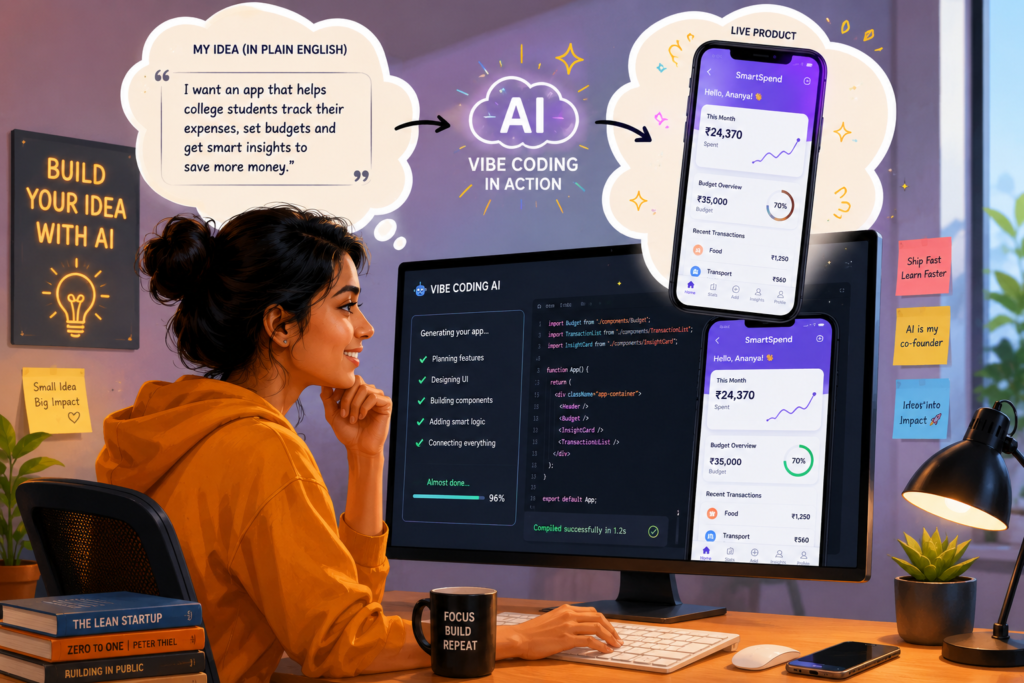
The biggest barrier to launching a start up for most young people was always the same: “I cannot code.” In 2026, that excuse is permanently retired. Vibe coding — building start up products using AI tools like Cursor, Claude Code, Lovable, and Bolt.new — has eliminated the technical moat that once separated technical start up founders from everyone else.
A 23-year-old with no programming background used Claude Code to build a start up from a competitor’s screenshots. That start up now generates $2 million in annual revenue. His start up journey began with a description in plain English and an AI tool — nothing more.
Lovable — an AI start up app builder — reached unicorn status in just eight months. That start up’s success proves that the execution bottleneck blocking most founders from launching their start up is now completely gone.
“Your startup idea is not held back by code anymore. In 2026, it is held back only by your willingness to start.”
Startup Trend 4 — The $300/Month Startup Stack Replacing 10-Person Teams

Running a full start up team used to cost $80,000 to $120,000 per month in salaries alone. In 2026, a solo start up founder can replicate that same capability with an AI tool stack costing $300 to $500 per month. This is not theory — thousands of profitable single-person start ups are operating on exactly this model right now.
- Cursor AI: handles your entire start up codebase for $20/month
- Canva AI: manages all start up design work for $15/month
- n8n: automates all start up workflows for $0–30/month
- Intercom Fin: runs your start up customer support for $39/month
Total start up operating cost: ~$350/month. Operating margin for your start up: 60–80%. Traditional start up teams cannot compete with that math. The broader economic implication of this start up trend is profound. When a start up can operate at 95% lower cost than its traditional competitors while delivering equal or superior customer outcomes, the incumbent start up model becomes structurally uncompetitive. Legacy start ups that built their operations around large teams face existential pressure from lean AI-powered start ups that can undercut their pricing, ship faster, and serve customers more responsively — all simultaneously.
“The $300/month startup is not a budget startup. It is the highest-margin startup model that has ever existed.”
Startup Trend 5 — The Gen Z Startup Founder Is Now Younger, Faster, and Bolder

According to Antler’s 2026 research, the average age of an AI start up founder who reached unicorn status has dropped from 40 in 2020 to just 29 in 2024. The time it takes for a start up to hit a $1 billion valuation has compressed from 7 years to just 4.7 years. This is not a coincidence — it is the direct result of AI lowering every start up barrier that once favoured experienced, well-connected founders.
The Fortune/Antler Gen Z Founder Report confirms that youth is now a start up advantage, not a liability. Gen Z start up founders adopt AI tools faster, carry fewer assumptions about how a start up “should” work, and are more willing to bet on new platforms.
“If you are 22 and building your startup in 2026, you are not late. You are exactly on time.”
Startup Trend 6 — India’s AI Startup Boom Is Creating the World’s Youngest Startup Millionaires

India is now the world’s second-largest Generative AI start up ecosystem with approximately 890 GenAI start ups. The Indian start up ecosystem raised $9.1 billion in 2025 — a 23% year-on-year increase — with AI accounting for 91% of all deeptech start up funding. This start up boom is not concentrated in Bengaluru or Mumbai anymore. Hyderabad, Pune, Chennai, and Ahmedabad are producing start up founders at rates not seen since 2021.
The Indian government’s IndiaAI Mission now offers 100% GPU compute subsidies for start up founders building foundational AI models, with compute available at just ₹67 per hour. The IDTA has committed a dedicated $1 billion for Indian AI start ups over three years. For any start up founder reading this from India, the infrastructure to launch your start up has never been better supported.
“India’s startup ecosystem in 2026 is not catching up to the world. It is leading it.”
Startup Trend 7 — Sovereign Wealth Is Pouring Into AI Startups and Changing Who Gets Funded

The global start up funding architecture has been fundamentally restructured. OpenAI raised $122 billion. Anthropic raised $30 billion for its start up ambitions. xAI raised $20 billion. The investors writing these checks — Singapore’s Temasek, Qatar’s Investment Authority, Saudi Arabia’s PIF, UAE’s Mubadala — are sovereign wealth funds, not traditional VCs.
The result is a bifurcated start up market: a handful of mega-start ups absorbing enormous rounds, and a highly competitive early-stage start up scene where angels and micro-VCs are writing checks more aggressively than ever. Pre-seed and seed start up deals represent 67% of all Q1 2026 deal activity — the market for first-time start up founders has never been more active.
“Sovereign wealth is chasing AI startups. That capital pressure trickles all the way down to the seed-stage startup founder with a great idea.”
The Honest Truth Every Startup Founder Needs to Hear
This article would fail you as a start up resource if it only showed you the upside. The start up reality of 2026 includes risks every honest start up founder must understand:
- Most solo start up founders earn $3,000–$5,000/month — not billions
- Only 2–3% of solo start up founders cross $1M ARR without eventually hiring
- 81% of VC money targets AI start ups — non-AI start ups face a harder capital market than any time since 2020
- AI tool pricing changes are a start up risk — never build your start up on a single vendor dependency
- The psychological cost of building a start up alone is real — burnout is the most underreported start up killer
These start up trends are real. But they do not replace the need for a sharp start up insight about a real customer problem. The tools have changed. The fundamentals of a great start up have not.
“Every start up tool in 2026 is a multiplier. But a multiplier times zero is still zero — the idea has to be yours.”
Your Start up Journey Starts With This Question
One founder. One bedroom. $20,000. $401 million in year-one revenue. Matthew Gallagher’s start up did not succeed because he was lucky. It succeeded because he understood the AI start up trends of 2026 earlier than almost anyone else and built his start up ruthlessly around them.
Every start up trend in this article is available to a 21-year-old start up founder in Ahmedabad just as much as it was to someone in Los Angeles. The start up tools are democratised. The start up funding is flowing. The start up window is open.
What would you build if execution was no longer the bottleneck for your startup?
“The startup revolution is not coming. It arrived. The only question is whether you will be in it.”
you must know these topics which are so important:
- Top 5 Shocking Misapprehensions Founders Make When Raising Capital
- Founder Reality Check:6 Brutal Start up Funding Myths Every Founder Must Stop Believing
- Why Start ups Fail to Get Funding from Investors: 28 Hard Truths No One Tells You
- Start up Fundability Explained: 7 Powerful Readiness Signals Founders Must Get Right
- Start up Non-Dilutive & Alternative Funding: 7 Powerful Ways to Raise Capital Without Equity
- Angel Funding and Early-Stage Capital: 5 Core Principles That Shape Start up Growth
- Start Up Funding in India: 10 Proven Strategies for Massive Growth
- Start Up Success: 7 Powerful Pitch Deck Storytelling Secrets That Win Investors
- From Classroom to Capital: The Ultimate Funding Guide for Student & First-Time Founders
- Founder Guide: 5 Powerful Funding Trends Every Start up Must Know
FAQ
What are the top AI start up trends to watch in 2026?
The seven most important AI start up trends in 2026 are: AI agent adoption, the SaaSpocalypse opportunity, vibe coding enabling non-technical start up founders, ultra-low-cost start up stacks, Gen Z start up founder dominance, India’s start up ecosystem explosion, and sovereign wealth restructuring start up funding.
Can a solo start up founder really build a billion-dollar company in 2026?
Matthew Gallagher’s Medvi start up generated $401M in year one with no employees. Anthropic CEO Dario Amodei has publicly stated a 70–80% probability of a one-person billion-dollar start up emerging in 2026. The data strongly supports the possibility.
What AI tools does a solo start up need in 2026?
The core AI start up stack for 2026 includes Cursor or Claude Code for development, Canva AI for design, n8n for start up automation, and Intercom Fin for customer support — totalling approximately $300–500/month.
How can a student launch a start up using AI without coding experience?
Tools like Lovable, Bolt.new, and Claude Code allow any start up founder to build full-stack products using plain English descriptions. Multiple non-technical start up founders have crossed $1M ARR using only these tools in 2025–2026.
Is India a good place to launch an AI start up in 2026?
India is the world’s second-largest GenAI start up ecosystem. With IndiaAI Mission compute subsidies, the IDTA’s $1 billion AI start up fund, and a 23% YoY increase in start up funding, India offers exceptional conditions for launching an AI start up in 2026.
1 thought on “The AI Startup Revolution: How Solo Founders Are Building Billion-Dollar Companies”
Comments are closed.