
Introduction: Start Up Funding in India
India has emerged as one of the fastest-growing start up ecosystems in the world, driven by innovation, technology, and a new generation of ambitious entrepreneurs. From small towns to metropolitan cities, start ups in India are solving real-world problems in areas such as technology, healthcare, education, fintech, agriculture, and sustainability. However, behind every successful start up lies one crucial factor — the right funding strategy.
Start up funding in India is not just about raising money; it is about choosing the right capital at the right stage. The Indian funding landscape is unique because it offers a diverse mix of traditional and modern funding options. Founders can begin with bootstrapping or family support, move on to angel investors and venture capitalists, and even explore government-backed schemes and corporate partnerships. Each funding source comes with its own advantages, risks, and expectations, making strategic decision-making extremely important.
In recent years, India has witnessed a massive surge in investor confidence, thanks to policy support, digital transformation, and a rapidly growing consumer market. Yet, many promising start ups fail not because their ideas are weak, but because they lack proper funding knowledge or planning. Understanding how funding works in India helps founders avoid early mistakes, unnecessary equity loss, and financial stress.
Funding also plays a critical role in achieving massive growth. Capital enables start ups to hire skilled talent, scale operations, invest in technology, improve products, and expand into new markets. At the same time, funding brings accountability, discipline, and long-term vision. Indian investors today look beyond ideas — they focus on execution ability, market understanding, revenue models, and founder commitment.
“In the Indian start up journey, funding does not create success — it accelerates the right foundation.”
1. Bootstrapping in India

Bootstrapping in India means building a start up using personal savings or internally generated revenue, without relying on external investors. In the Indian start up ecosystem, bootstrapping is not just a funding method—it is a mindset of discipline, resilience, and self-reliance.
India is uniquely suited for bootstrapping because of its low-cost talent, affordable infrastructure, and massive domestic market. Many successful Indian start ups began with minimal capital and focused first on solving real problems, rather than chasing funding. Bootstrapped founders learn to manage money carefully, prioritize essentials, and achieve early profitability.
When start ups bootstrap, founders retain 100% ownership and decision-making power. This freedom allows them to experiment, pivot, and grow at their own pace. It also builds strong credibility—investors often trust bootstrapped start ups more because they show proof of execution rather than just ideas.
However, bootstrapping also comes with challenges. Growth can be slower, resources are limited, and founders often juggle multiple roles. Despite this, bootstrapping creates financially strong and sustainable businesses, which are well-prepared for future funding if needed.
Key Points
- No equity dilution, full founder control
- Encourages financial discipline and efficiency
- Ideal for early-stage and service-based start ups in India
- Builds strong fundamentals and investor trust
Quote:
“Bootstrapping doesn’t limit growth—it strengthens the foundation.”
In India, bootstrapping is often the first proven strategy that turns an idea into a real business. It teaches founders how to survive, adapt, and grow—skills that are essential for massive long-term success.
2. Friends and Family Funding in India

Friends and family funding is often the first external funding step for a start up in India. It involves raising capital from people who already trust the founder personally, such as parents, relatives, close friends, or mentors. In the Indian context, this method is extremely common because of strong family ties and relationship-based support systems.
This type of funding usually happens at the idea stage or early execution stage, when banks and professional investors are not yet willing to take risks. In India, friends and family funding is commonly used to build prototypes, register the business, hire initial talent, or launch a minimum viable product (MVP).
One major advantage is speed and flexibility. There are fewer formalities, no complex valuation discussions, and quick access to funds. However, this also makes it emotionally sensitive. Mixing money with personal relationships can lead to misunderstandings if expectations are not clearly defined.
Indian founders must treat this funding professionally, even though it comes from close circles. Clear communication about risk, timelines, and uncertainty is essential. Written agreements, even simple ones, help avoid future conflicts. Transparency builds long-term trust and protects relationships.
Friends and family funding should be viewed as high-responsibility capital. Losing this money does not just affect finances—it can damage relationships. That’s why founders should raise only what is truly required and use the funds carefully.
Key Points
- Fast and accessible early-stage funding
- Based on trust, not just business metrics
- Requires clear communication and honesty
- Best suited for idea validation and early launch in India
Quote:
“When money comes from trust, responsibility must come first.”
In India’s ecosystem, friends and family funding acts as a bridge between an idea and a real business, helping founders take their first confident step toward growth.
3. Angel Investors in India

Angel investors are high-net-worth individuals who invest in early-stage start ups in exchange for equity. In India, angel investing has grown rapidly with experienced entrepreneurs reinvesting their success into new ventures.
Indian angels provide more than money—they offer mentorship, industry connections, and strategic guidance. They usually invest during the seed or pre-Series A stage, when start ups show early traction.
To attract angels in India, founders must present a strong value proposition, scalable business model, and clear revenue path. Networking events, pitch forums, and start up communities play a major role.
Key Points:
- Equity-based funding
- Strong mentorship support
- Ideal for early growth
- Requires convincing pitch
Quote:
“Angel investors invest in people before they invest in ideas.”
4. Venture Capital Funding in India

Venture Capital (VC) funding in India is one of the most powerful growth engines for start ups that aim for rapid scale, large markets, and national or global impact. Unlike early funding methods, venture capital is designed for start ups that have already proven their idea and are ready for massive expansion.
In the Indian ecosystem, VC funding usually comes after a start up shows product–market fit, user traction, and a scalable business model. Venture capitalists invest large sums of money in exchange for equity and strategic influence. Their goal is to help start ups grow fast and deliver high returns over time.
VC funding in India happens in stages such as Seed, Series A, Series B, and Series C. Each stage represents a higher level of maturity, revenue, and valuation. Along with capital, VCs bring mentorship, industry expertise, strong networks, and credibility, which can open doors to partnerships and future investments.
However, venture capital also comes with high expectations and pressure. Founders must meet aggressive growth targets, share control through board seats, and accept dilution of ownership. Decisions become data-driven, performance-focused, and growth-oriented. For this reason, VC funding is best suited for start ups that are ready to scale fast, not those still experimenting.
In India, VC funding has played a crucial role in building technology, fintech, SaaS, edtech, and consumer start ups. When used wisely, it transforms start ups into market leaders.
Key Points
- Large capital for rapid scaling
- Equity dilution and shared control
- Strong mentorship and investor networks
- Best for high-growth Indian start ups
Quote:
“Venture capital doesn’t fund survival—it funds speed.”
Venture capital funding in India is not just about money; it is about ambition, execution, and the courage to grow big.
5. Government Schemes for Start Up Funding in India
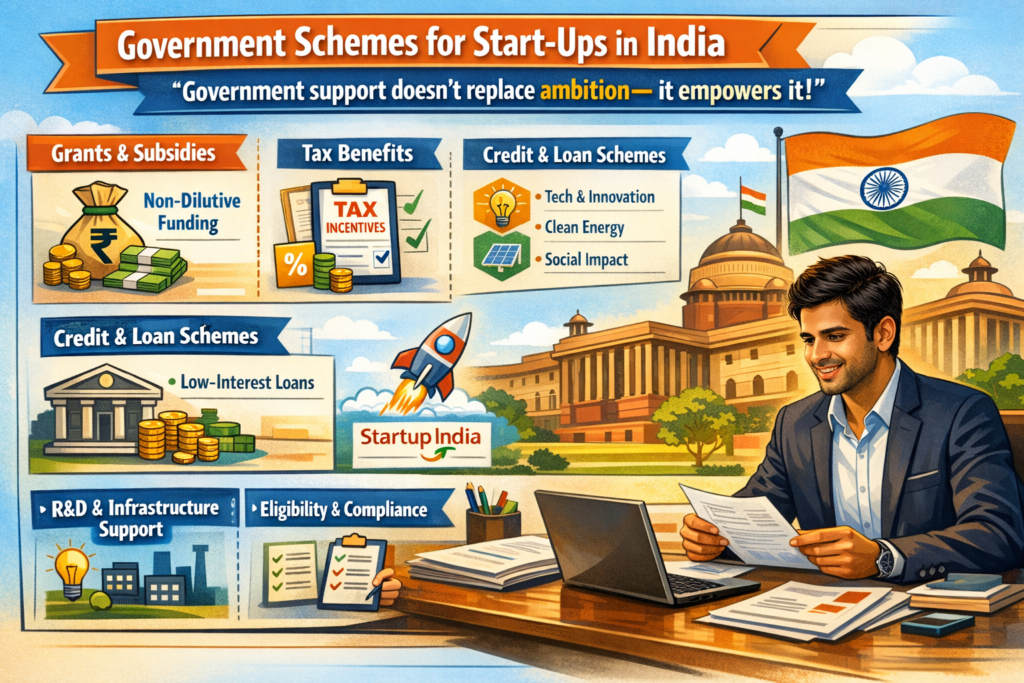
Government schemes for start up funding in India play a vital role in encouraging innovation, entrepreneurship, and inclusive economic growth. Unlike private funding, government support focuses not only on profits but also on nation-building, employment generation, and technological advancement.
The Indian government has introduced several initiatives to support start ups through grants, subsidies, tax benefits, and credit guarantees. These schemes are especially valuable for early-stage start ups, as they provide non-dilutive funding, meaning founders do not have to give up equity.
Government funding is particularly strong in sectors such as technology, manufacturing, healthcare, clean energy, and social impact. Many schemes are designed to help start ups overcome early financial barriers like research costs, infrastructure setup, and product development.
One major advantage of government schemes is financial stability with reduced risk. Start ups receive structured support, policy backing, and sometimes access to incubators and mentors. However, the process often involves documentation, eligibility checks, and longer approval timelines. Patience and compliance are essential.
For Indian founders, government funding works best when combined with strong execution and transparency. Start ups that use these schemes efficiently gain credibility, making it easier to attract private investors later.
Key Points
- Non-dilutive funding (no equity loss)
- Strong focus on innovation and impact
- Ideal for early-stage Indian start ups
- Requires compliance and documentation
Quote:
“Government support doesn’t replace ambition—it empowers it.”
In India’s ecosystem, government schemes act as a foundation layer, enabling start ups to grow responsibly while contributing to the country’s long-term development.
6. Incubators and Accelerators in India

Incubators and accelerators in India play a crucial role in shaping early-stage start ups by providing structured guidance, mentorship, and initial funding support. While funding is important, these platforms focus more on building strong foundations, refining ideas, and preparing start ups for long-term growth.
An incubator supports start ups at a very early stage—often when the idea is still evolving. It offers workspace, mentoring, technical support, and extended time to develop products. In contrast, an accelerator works with start ups that already have a product or early traction and helps them scale quickly within a fixed time frame, usually 3–6 months.
In India, incubators and accelerators are supported by universities, corporates, private organizations, and the government. They help founders understand market fit, customer needs, business models, and investor expectations. Many also provide seed funding in exchange for small equity, along with access to demo days and investor networks.
One of the biggest advantages is mentorship from experienced entrepreneurs and industry experts. This guidance helps founders avoid common mistakes, save time, and grow smarter. Start ups graduating from strong accelerator programs often gain higher credibility, making it easier to raise angel or venture capital funding later.
However, founders must choose programs carefully. Not all incubators or accelerators add equal value. The right fit depends on industry focus, mentor quality, network strength, and growth goals.
Key Points
- Early-stage mentorship-driven support
- Access to networks, investors, and experts
- Small funding with learning-focused growth
- Ideal for first-time founders in India
Quote:
“The right guidance can accelerate growth faster than money alone.”
In the Indian ecosystem, incubators and accelerators act as launchpads, turning raw ideas into investor-ready businesses.
7. Bank Loans and NBFC Funding in India
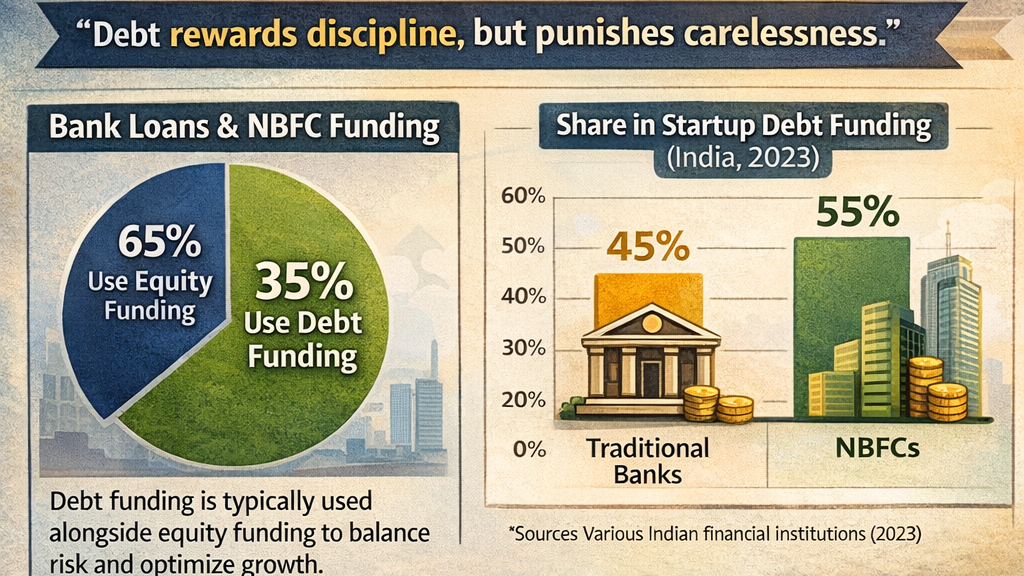
Bank loans and NBFC (Non-Banking Financial Company) funding in India offer start ups a way to raise capital without giving up equity. This form of funding is known as debt financing, where start ups borrow money and repay it with interest over a fixed period.
In India, traditional banks usually prefer start ups that have stable revenue, clear cash flow, and a proven business model. Because of strict eligibility criteria, many early-stage start ups find it difficult to access bank loans. This is where NBFCs step in, offering more flexible lending options, faster approvals, and customized repayment structures.
Debt funding is best suited for start ups that already generate income and need capital for working capital, equipment purchase, expansion, or inventory management. Since ownership remains fully with the founders, this funding method helps maintain control and long-term decision-making power.
However, bank loans and NBFC funding also come with financial pressure. Repayments must be made regardless of business performance. Missing payments can affect credit scores and future funding opportunities. Therefore, start ups must plan repayment carefully and avoid over-borrowing.
In the Indian ecosystem, debt funding is often used alongside equity funding to balance risk and growth. When used responsibly, it strengthens financial discipline and improves business credibility.
Key Points
- No equity dilution, full ownership retained
- Suitable for revenue-generating start ups
- Fixed repayment and interest obligations
- Requires strong financial planning
Quote:
“Debt rewards discipline, but punishes carelessness.”
Bank loans and NBFC funding in India act as a growth-support tool, not a survival mechanism. For start ups with steady cash flow, this strategy can accelerate expansion while preserving ownership.
8. Crowdfunding Opportunities in India
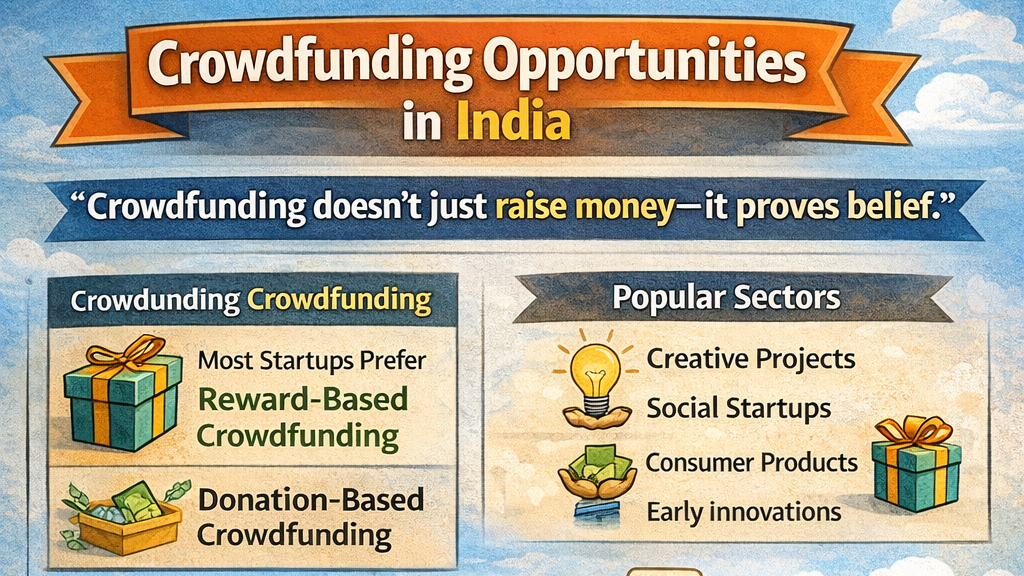
Crowdfunding in India is a modern funding method where start ups raise small amounts of money from a large number of people, usually through online platforms. Instead of relying on a single investor, founders present their idea to the public and invite support based on belief, interest, or shared purpose.
In India, crowdfunding is commonly used for creative projects, consumer products, and early-stage innovations. It not only helps raise funds but also acts as market validation. When people are willing to contribute, it shows real demand for the product or idea.
There are different forms of crowdfunding, such as reward-based, donation-based, and limited equity-based models (with regulations). Most Indian start ups prefer reward or donation-based crowdfunding due to simpler compliance.
One major benefit is brand building. Crowdfunding turns supporters into early customers and promoters. However, it requires strong storytelling, transparency, and trust. Campaigns that fail publicly can affect reputation, so preparation is crucial.
Key Points
- Funding from the public instead of investors
- Strong market validation tool
- Builds early customer community
- Requires clear communication and planning
Quote:
“Crowdfunding doesn’t just raise money—it proves belief.”
9. Corporate and Strategic Investors in India

Corporate and strategic investors in India are large companies that invest in start ups to achieve long-term business goals, not just financial returns. Unlike venture capitalists, these investors look for strategic alignment, such as technology integration, market expansion, or innovation support.
In the Indian ecosystem, corporate investors often come from sectors like technology, telecom, manufacturing, finance, healthcare, and retail. They invest in start ups that can complement their existing products, improve efficiency, or open new markets. Along with capital, they provide start ups access to industry expertise, infrastructure, distribution channels, and brand credibility.
One major advantage of strategic investment is market access. Start ups can scale faster by leveraging the corporate partner’s customer base and operational strength. This type of funding also increases trust among other investors and customers.
However, corporate funding may reduce flexibility. Strategic investors may influence product direction or business decisions to suit their interests. Therefore, founders must ensure clear alignment of vision and expectations before accepting such investments.
Key Points
- Focus on long-term strategic value, not just profit
- Provides market access and industry expertise
- Enhances credibility and scaling speed
- Requires strong alignment of goals
Quote:
“Strategic capital builds partnerships, not just profits.”
In India, corporate and strategic investors act as growth partners, helping start ups move from innovation to large-scale impact.
10. Preparing a Strong Pitch for Indian Investors

Preparing a strong pitch for Indian investors is one of the most critical steps in securing funding in India. A pitch is not just a presentation—it is a story backed by data, clarity, and confidence. Indian investors look for founders who deeply understand their problem, market, and execution plan.
A strong pitch clearly explains the problem, the solution, and why the start up is uniquely positioned to win. Investors expect clarity on market size, revenue model, traction, and scalability. Simplicity matters—complex ideas should be explained in easy, logical terms.
In India, investors pay close attention to the founding team. They assess leadership ability, commitment, and adaptability. Honest numbers, realistic projections, and transparency about risks build trust and credibility. Overpromising or exaggeration often leads to rejection.
Visual storytelling also plays a key role. A clean pitch deck with clear charts, minimal text, and strong insights helps investors quickly understand the opportunity. Practicing delivery is equally important—confidence and clarity can make a decisive difference.
Key Points
- Clear problem–solution narrative
- Strong focus on market and traction
- Honest data and realistic projections
- Confident, well-practiced delivery
Quote:
“A great pitch doesn’t sell dreams—it proves readiness.”
In India’s competitive start up ecosystem, a strong pitch transforms ideas into investor confidence and funding success.
- To know about Top 5 Shocking Misapprehensions Founders Make When Raising Capital click here.
- To know about Why Start ups Fail to Get Funding from Investors click here.
- To learn about start up fundability click here.
- To understand Why investors Readiness Matters in Start up click here.
- To know about Start up Non-Dilutive & Alternative Funding: 7 Powerful Ways to Raise Capital Without Equity click here.
- To know about Start up Angel Funding and Early-Stage Capital click here.
FAQ
What is the best funding option for a start up in India?
The best option depends on the stage of the start up. Early-stage start ups often use bootstrapping or friends and family funding, while growing start ups prefer angel investors or venture capital.
Can a start up in India get funding without giving equity?
Yes. Start ups can use bootstrapping, government schemes, bank loans, NBFC funding, and crowdfunding to raise funds without equity dilution.
Is government funding available for all start ups in India?
Government funding is mainly available for start ups that meet eligibility criteria, especially in innovation, technology, manufacturing, and social impact sectors.
How important is a pitch deck for Indian investors?
A pitch deck is crucial. Indian investors evaluate start ups based on problem clarity, market size, traction, revenue model, and team strength.
What is the biggest mistake start ups make while raising funds in India?
The biggest mistake is raising funds too early or without clear execution, along with overpromising and poor financial planning.
1 thought on “Start Up Funding in India: 10 Proven Strategies for Massive Growth”