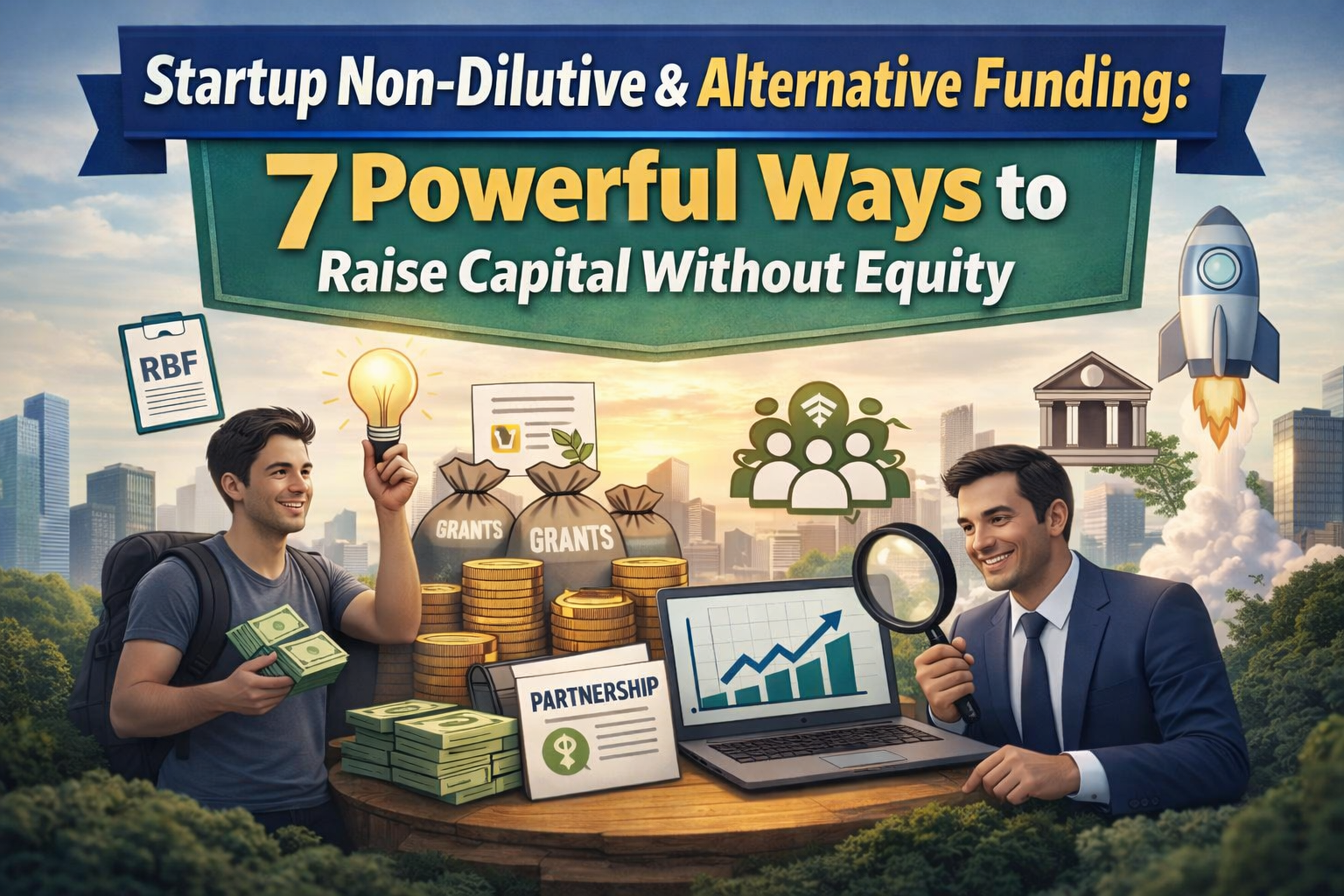
Why Investors Care About Non-Dilutive & Alternative Start up Funding
A few years ago, a first-time founder walked into an investor meeting with a confident pitch, solid product traction, and a growing user base. The conversation was going well—until the funding slide appeared. The founder was asking for capital, but at the cost of heavy equity dilution, despite already having early revenues. The investor paused, leaned back, and asked a simple question: “If your start up is already earning, why are you giving away ownership so early?” That moment captures exactly why investors today care deeply about non-dilutive and alternative funding.
Modern investors are no longer impressed by start ups that burn cash recklessly or dilute equity at the first sign of growth. Instead, investors increasingly value capital efficiency, financial discipline, and long-term sustainability. When a start up leverages non-dilutive funding—such as grants, revenue-based financing, or strategic partnerships—it signals to investors that the founder understands how to grow responsibly without unnecessary risk.
From an investor’s perspective, non-dilutive and alternative funding reduces dependency on equity rounds and lowers downside exposure. It shows that the start up can survive market volatility, manage cash flows wisely, and prioritize value creation over inflated valuations. Investors also see such funding choices as a sign of founder confidence—confidence that the business model can generate real returns without constant external capital.
In today’s cautious funding environment, investors are shifting their focus from “growth at all costs” to “growth with control.” Start ups that adopt non-dilutive and alternative funding methods often stand out in investor pipelines because they demonstrate resilience, strategic thinking, and maturity—qualities every serious investor looks for before committing capital.
How Investors Evaluate Start ups That Avoid Equity Dilution
Behind every investment decision, there is a human being—not just numbers, charts, or spreadsheets. Investors understand that building a start up is hard. That’s why, when they see a founder trying to grow without immediately giving away equity, they pay closer attention. From an investor’s point of view, this choice often reflects responsibility, patience and respect for the business.
Investors first look at how carefully a start up uses its money. A founder who avoids early dilution usually tracks expenses closely, plans runway realistically, and understands where each rupee or dollar goes. This discipline builds trust. Investors feel safer backing founders who treat capital as something valuable, not disposable.
Another key factor investors evaluate is traction. Even small but consistent revenue matters more than big promises. When a start up chooses alternative funding, investors often assume the founder believes in the product enough to let it prove itself before selling ownership. This mindset aligns strongly with what long-term investors want—real growth backed by real demand.
Investors also observe decision-making behaviour. Choosing non-dilutive funding shows that founders are thinking beyond short-term valuation. It tells investors that the start up is focused on building something sustainable, not just raising rounds. This creates confidence that future funding—if needed—will be used wisely.
Most importantly, investors value honesty and clarity. Founders who openly explain why they avoided equity dilution and how alternative funding supports their mission often connect better with investors on a human level. In the end, investors don’t just invest in start ups—they invest in people who show responsibility, resilience, and respect for growth.
1. Investor-Approved Government Grants & Start up Schemes

Many investors quietly appreciate start ups that secure government grants. Why? Because grants act like a third-party vote of confidence. When a start up receives grant funding, it signals that the idea has already passed evaluation by experts, institutions, or policymakers. For investors, this reduces early-stage risk.
Government grants are non-dilutive, meaning founders don’t give away equity. Investors see this as smart capital management. It shows that founders are willing to explore every responsible option before asking investors to dilute ownership.
Grants also help startups build early traction—whether through R&D, pilot programs, or hiring—without increasing burn pressure. This makes the startup more stable when it finally approaches investors for equity funding.
Important Investor Signals
- ✔ Reduced capital risk
- ✔ External validation of the startup idea
- ✔ Longer runway without dilution
“Smart founders earn investor trust by proving value before selling ownership.”
2. Revenue-Based Financing That Investors Prefer

Revenue-based financing feels fair to many investors because repayment is tied to performance. Instead of fixed EMIs or equity dilution, the start up repays capital as it earns revenue. This creates alignment between growth and responsibility.
Investors like this model because it shows confidence. Founders choosing revenue-based funding believe their product will generate steady income. That belief matters to investors more than aggressive projections.
This funding model also protects founders from over-dilution while keeping financial pressure manageable. Investors see it as a sign of maturity and long-term thinking.
Important Investor Signals
- ✔ Predictable cash flow
- ✔ Founder confidence in revenue model
- ✔ Balanced risk-return structure
“Investors trust businesses that grow first and raise later.”
3. Strategic Partnerships Backed by Industry Investors

Strategic partnerships tell investors one important thing: the market believes in you. When a start up partners with an established company, it validates demand, usability and relevance.
Investors view partnerships as proof that the start up solves a real problem. It reduces customer acquisition risk and often opens new distribution channels. This kind of support excites investors far more than paid marketing alone.
Partnerships also show that founders can negotiate, collaborate, and think beyond funding—skills investors deeply respect.
Important Investor Signals
- ✔ Market validation
- ✔ Reduced go-to-market risk
- ✔ Long-term scalability
“When the market trusts you, investors follow.”
4. Bootstrapping Signals That Attract Serious Investors

Bootstrapped start ups often earn quiet admiration from investors. Bootstrapping shows resilience, patience and belief in the product. It tells investors that founders didn’t wait for money to start building.
Investors notice when founders grow revenue slowly but steadily. This approach signals discipline and problem-solving ability—qualities investors value more than flashy growth.
Bootstrapping also proves that founders understand their customers deeply. Investors trust founders who learn from the ground up.
Important Investor Signals
- ✔ Strong founder commitment
- ✔ Deep customer understanding
- ✔ Sustainable growth mindset
“Bootstrapping doesn’t delay success—it strengthens it.”
5. Crowdfunding Through an Investor Trust Lens

Crowdfunding does more than raise money—it builds community trust. Investors look at crowdfunded start ups as socially validated businesses. A crowd willing to support a product financially sends a strong signal.
However, investors also examine how responsibly crowdfunding is handled. Transparency, communication and delivery matter a lot. A well-managed campaign builds investor confidence.
Important Investor Signals
- ✔ Social proof
- ✔ Early adopter validation
- ✔ Brand trust
“When people believe in your product, investors believe in your future.”
6. Debt Financing That Investors Consider Healthy

Debt is not always bad—investors know this. What matters is how and why it’s used. Healthy debt supports growth, not survival.
Investors prefer start ups that use debt for predictable expenses like inventory or expansion—not to cover losses. Responsible debt shows planning and financial awareness.
Important Investor Signals
- ✔ Controlled leverage
- ✔ Clear repayment plan
- ✔ Financial maturity
“Debt is a tool, not a lifeline.”
7. Accelerator & Incubator Programs Investors Respect

Investors closely track accelerator-backed start ups. These programs filter, mentor, and validate founders before they reach investors.
Being part of a respected accelerator tells investors that the start up has received guidance, feedback, and exposure. It reduces uncertainty and increases trust.
Important Investor Signals
- ✔ Expert validation
- ✔ Strong founder mentoring
- ✔ Investor-ready mindset
“Acceleration builds credibility before capital.”
Common Funding Mistakes That Push Investors Away
Many founders believe investors only care about big ideas and fast growth. In reality, what often pushes investors away are small but repeated funding mistakes. These mistakes don’t just affect numbers—they affect trust. Investors are human, and trust plays a huge role in where they put their money.
One common mistake is overusing alternative funding without a clear plan. While non-dilutive funding is attractive, stacking too many grants, loans, or short-term funds without strategy can confuse investors. They may worry that the founder is reacting instead of planning. Investors prefer founders who know why they are using a funding source and what comes next.
Another mistake is poor financial storytelling. Investors don’t expect perfection, but they do expect clarity. When founders cannot clearly explain how funds were used or how alternative funding helped growth, investors become cautious. Transparency matters more than impressive numbers.
A third mistake is ignoring investor alignment. Some founders focus so much on avoiding dilution that they forget long-term investor returns. Investors don’t dislike non-dilutive funding—they dislike founders who avoid equity without understanding when it actually makes sense.
Finally, misusing debt scares investors quickly. Debt taken to cover losses or poor planning signals deeper issues. Investors see this as a warning sign rather than support.
Important Points Investors Watch Closely
- ✔ Clear funding strategy, not random sources
- ✔ Honest communication and transparency
- ✔ Alignment between funding choices and growth goals
- ✔ Responsible use of debt
“Investors walk away not from risk—but from confusion.”
How Founders Can Use Non-Dilutive Funding to Win Investors Later
Non-dilutive and alternative funding is not just about surviving early stages—it’s about preparing for better investor conversations later. Smart founders use these funding methods as stepping stones, not destinations.
Investors appreciate founders who use non-dilutive funding to strengthen fundamentals. Grants, bootstrapping and revenue-based models allow start ups to improve products, understand customers, and refine business models before equity discussions. This preparation reduces uncertainty for investors.
One major advantage is valuation strength. When start ups show revenue, partnerships, or traction built without equity dilution, investors often see less risk and higher potential. This leads to healthier negotiations and better long-term relationships.
Founders can also use alternative funding to prove discipline. Investors respect founders who didn’t rush into fundraising but waited until the business was ready. This patience reflects confidence and maturity.
Equally important is timing. Investors don’t expect founders to avoid equity forever. What they want is thoughtful timing—raising equity when it accelerates growth, not when it merely keeps the start up alive.
How Founders Impress Investors Later
- ✔ Strong traction built with minimal dilution
- ✔ Clear explanation of funding decisions
- ✔ Investor-ready metrics and reporting
- ✔ Strategic timing of equity rounds
“The best equity rounds are earned, not rushed.”
Conclusion: What Investors Truly Want From Funded Start ups
At the heart of every funding decision lies a simple truth: investors want to believe in the future of the start up—and the people building it. Non-dilutive and alternative funding methods help shape that belief long before equity enters the picture.
Investors don’t expect founders to avoid equity forever. They expect responsible growth, thoughtful decisions, and respect for capital. When startups use non-dilutive funding wisely, it signals resilience, confidence, and long-term thinking.
What truly attracts investors is not the funding source itself, but how it is used. A start up that grows steadily, learns from customers, and manages money carefully stands out far more than one that raises large rounds too early.
Investors also value founders who understand balance. Avoiding dilution is smart—but knowing when dilution adds value is even smarter. This balance reassures investors that the founder thinks beyond ego or control and focuses on building something meaningful.
Ultimately, non-dilutive and alternative funding is a tool—not a shortcut. When used with intention, it helps founders build stronger businesses and creates healthier investor relationships based on trust, transparency, and shared vision.
What Investors Remember Most
- ✔ Sustainable growth over hype
- ✔ Financial discipline over fast money
- ✔ Honest founders over perfect decks
- ✔ Long-term value over short-term valuation
“Investors don’t fund ideas—they fund responsibility, vision, and trust.”
Bonus Section: How Smart Funding Choices Shape the Long-Term Start up–Investor Relationship
Funding is not just about money—it is about relationships. The way a start up chooses to raise capital often leaves a lasting impression on investors long after the first cheque is written. Smart funding decisions can build trust, confidence, and long-term alignment between founders and investors, while rushed or unclear choices can quietly damage credibility.
Investors closely observe how founders approach funding, not just how much they raise. Start ups that explore non-dilutive and alternative funding options show investors that they value independence, responsibility and thoughtful growth. This approach signals that the founder is not desperate for capital but strategic about it. For many investors, this is a powerful emotional and logical trigger—it suggests maturity and leadership.
Another reason this matters is storytelling. When founders later speak to investors, their funding journey becomes part of their narrative. A start up that successfully used grants, bootstrapping, partnerships, or revenue-based financing has a stronger, more authentic story to tell. Investors connect deeply with stories that show learning, resilience, and progress over time.
This is also where education and awareness play a major role. Many founders miss valuable funding opportunities simply because they are unaware of them. That’s why it’s important to explore curated resources, expert insights, and real-world examples. Readers are encouraged to check the internal links provided in this blog to understand specific funding methods in depth, case studies, and practical guides tailored for startups at different stages.
At the same time, external perspectives matter. Exploring external links to trusted start up platforms, investor blogs, and government or ecosystem resources can help founders gain a broader understanding of how investors think globally. These resources offer fresh viewpoints, updated policies, and real investor opinions that strengthen decision-making.
For investors, start ups that continuously learn and adapt stand out. For founders, staying informed creates confidence. When both sides speak the same language—clarity, trust, and long-term vision—funding becomes a partnership rather than a transaction.
Why This Section Matters to Readers
- ✔ Builds deeper founder–investor understanding
- ✔ Encourages learning beyond a single blog
- ✔ Increases confidence in funding decisions
- ✔ Creates a long-term growth mindset
- To know about Top 5 Shocking Misapprehensions Founders Make When Raising Capital click here.
- To know about Why Start ups Fail to Get Funding from Investors click here.
- To learn about start up fundability click here.
- To understand Why investors Readiness Matters in Start up click here.
In the end, the best-funded start ups are not always the ones that raised the most money—but the ones that made the smartest choices. By exploring the internal and external resources shared here, founders can take informed steps toward building stronger businesses and healthier investor relationships that last far beyond the first round of funding.
FAQ
What is non-dilutive funding for a start up?
Non-dilutive funding allows a startup to raise capital without giving up ownership or equity to investors.
Why do investors prefer start ups with non-dilutive funding?
Investors prefer such startups because they show financial discipline, lower risk, and sustainable growth potential.
Is alternative funding better than equity funding for start ups?
Alternative funding is better in early stages, while equity funding works best when scaling rapidly.
Can start ups raise investor funding after using non-dilutive funding?
Yes, non-dilutive funding often improves valuation and makes start ups more attractive to investors later.
What is the biggest risk investors see in alternative funding?
The biggest risk is poor planning or misuse of funds that creates financial instability.
1 thought on “Start up Non-Dilutive & Alternative Funding: 7 Powerful Ways to Raise Capital Without Equity”